Brushless Screwdriver vs Impact Driver: Which Tool Is Right for You?
Compare brushless screwdrivers and impact drivers to decide which tool fits your DIY needs. Learn about torque, control, versatility, and value for home projects.


For most DIY homeowners, a brushless screwdriver is the better all-around choice for lightweight to moderate screwdriving tasks, offering precision, efficiency, and longer battery life. An impact driver excels in heavy-duty driving, quickly sinking large screws and lag bolts with minimal effort. The best approach is to own one for precision work and keep the other for stubborn fasteners to maximize efficiency and accuracy.
Core distinctions
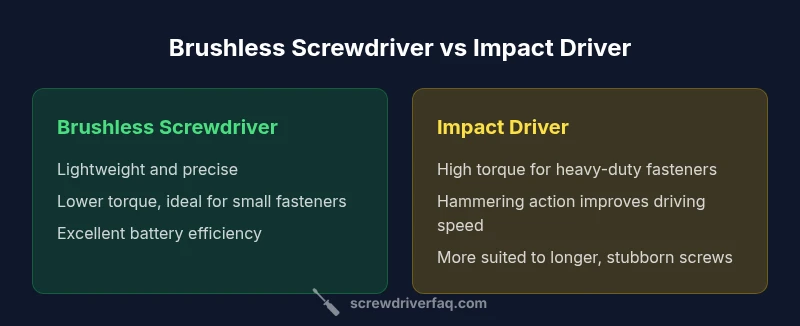
Two tools sit side by side in many workshops, yet they’re built for different jobs. A modern brushless screwdriver is optimized for precision screwdriving and light-to-moderate fasteners, prioritizing control and efficiency. The impact driver, by contrast, uses an internal hammer mechanism to deliver bursts of torque, making quick work of stubborn or long screws. The practical takeaway is simple: choose the tool that aligns with the task. For routine cabinet assembly, photo hanging, or furniture building with small fasteners, the brushless screwdriver shines. For deck screws, lag bolts, and tasks that resist turning, the impact driver is your workhorse. According to Screwdriver FAQ, selecting the tool that matches the job reduces wear and speeds completion. Thoughtful pairing—brushless for precision, impact for power—often yields the best results across a range of home projects.
Motor design and efficiency
Motor design shapes how tools feel and perform in real use. Brushless motors reduce wear, generate less heat under load, and optimize battery efficiency, translating to longer run times between charges. They also tend to have fewer maintenance needs than brushed equivalents, which matters for homeowners who don’t want to babysit a tool. Impact drivers, even when brushless, emphasize raw torque and durability in high-load situations. The result is a trade-off: you gain runtime and smooth operation with reduced maintenance using a brushless screwdriver, while an impact driver delivers superior driving force at the expense of higher torque spikes and potentially more vibration. The Screwdriver FAQ team notes that alignment between project demands and tool capabilities drives long-term satisfaction.
Torque, speed, and control
Torque and speed are the heart of performance. A brushless screwdriver typically operates with lower torque than an impact driver but provides fine control, enabling precise screw depths and reduced cam-out on delicate fasteners. An impact driver delivers high torque in short pulses, which makes it excellent for driving through tough materials and into hard substrates with less physical effort. Speed settings also differ: screwdrivers often excel at incremental tightening with consistent torque, while impact drivers favor rapid, aggressive driving for stubborn joints. When optimizing for a project, consider how often you’ll need speed control versus raw power. The balance between torque, control, and bit retention determines which tool truly fits your workflow.
Use-case scenarios
Think about typical tasks in your workflow. Light furniture assembly, cabinet installation, and general home repairs usually benefit from a brushless screwdriver due to precision and finish quality. If your projects regularly require driving through hardwood, deck screws, or long bolts, an impact driver becomes invaluable. For a mixed toolkit, many DIYers keep both: the screwdriver for delicate tasks and the impact driver for heavy-duty fasteners. As you plan, map tasks to tool strengths and budget accordingly. Screwdriver FAQ’s guidance emphasizes task-oriented buying to maximize tool life and reduce frustration.
Ergonomics and balance
Ergonomics matter as well as raw power. Brushless screwdrivers can be lighter and more compact, with comfortable grips that reduce fatigue during long screwdriving sessions. Impact drivers tend to be larger and sometimes heavier, but their compact hex bit fits into tight spaces and reduces the force needed to drive fasteners. If your work involves overhead projects, consider balance and vibration control, which influence accuracy and comfort. In practice, a well-balanced tool reduces fatigue, improves control, and helps you finish tasks with better results over extended periods.
Bit compatibility and accessory ecosystem
Both tool types use standard hex shanks, commonly 1/4 inch, which means many high-quality bits are interchangeable. However, you’ll want impact-rated bits for the impact driver to handle the hammering action without shattering, and you’ll want precision bits for the screwdriver to minimize cam-out and stripping. Compatibility with your existing bit set and quick-change accessories can save time and money. A robust accessory ecosystem also helps you keep working when bits wear out or when you encounter unusual fastener heads.
Battery life and charging
Battery chemistry, voltage, and cell quality drive runtime. Brushless tools typically deliver longer run times per charge due to improved efficiency, but actual performance depends on voltage and battery capacity. Both tool types benefit from smart battery systems that regulate power draw and prevent overheating. When evaluating packs, consider the number of amp-hours and the ability to swap packs between tools to minimize downtime. If you work in a location with limited charging options, a larger-capacity battery for your primary tool can reduce interruptions.
Noise, vibration, and comfort
Noise and vibration levels can influence your experience, particularly during extended sessions. Impact drivers generally produce more vibration and higher noise due to the hammering action, which can affect comfort and accuracy over time. Brushless screwdrivers tend to be quieter and smoother because they lack the impulsive drive. If you work in quiet environments or with sensitive occupants, these factors matter for safety and satisfaction. Protective equipment such as hearing protection is advised for longer tasks with any power tool.
Budget and value: Price considerations
Budgeting for these tools involves evaluating upfront cost against long-term value. A brushless screwdriver is often cheaper than a high-torque impact driver, but you’ll pay more for official brushless motor designs with premium batteries. Evaluate the long-term payoff: improved efficiency, reduced maintenance, and greater versatility can justify a higher initial investment. If you expect to perform many light-to-moderate tasks, a high-quality brushless screwdriver generally provides better value. For heavy-duty workloads, the impact driver’s power can shorten project times and reduce user fatigue, making it worth the cost.
Practical buying tips: How to choose
Begin with your most frequent tasks and project types. If you primarily drive small screws or assemble furniture, prioritize precision, grip comfort, and battery efficiency; a brushless screwdriver is likely best. For projects requiring fast sinking of large fasteners or working in dense materials, an impact driver saves time and effort. Consider weight, balance, and ergonomics; a tool you’ll reach for every week should feel good in your hands. Finally, check the ecosystem: compatible bits, spare batteries, and warranties matter for long-term satisfaction. The Screwdriver FAQ guidance emphasizes a task-aligned approach to avoid buying twice.
Comparison
| Feature | brushless screwdriver | impact driver |
|---|---|---|
| Torque | low-to-moderate torque for precise screwdriving | high torque with hammering action for tough fasteners |
| Speed/Drive | steady, controlled tightening | burst-driven driving for speed |
| Motor type | brushless motor standard | brushless with impact mechanism (usually) |
| Weight | lighter, balanced for two-handed control | slightly heavier but compact under load |
| Chuck/bits | 1/4" hex common bits, good bit retention | 1/4" hex common bits, need impact-rated bits for longevity |
| Best for | precision screwdriving, cabinetry, light furniture assembly | heavy-duty framing, deck screws, hard materials |
| Battery life | efficient run-time on light tasks | strong run-time under heavy driving when paired with good batteries |
| Noise & vibration | quieter, smoother operation | higher vibration and noise due to hammer action |
Pros
- Longer motor life and efficiency with brushless design
- Greater precision and control for delicate screwdriving
- Usually more compact and easier to handle for small projects
- Impact drivers excel at heavy-duty driving with less effort
Negatives
- Higher upfront cost for high-quality models
- Can be less forgiving for delicate work if wrong tool is used
- Impact drivers require impact-rated bits and accessories
- Noise and vibration can be higher during heavy-duty use
Choose based on task: brushless screwdriver for precision and efficiency; impact driver for heavy-duty driving.
For most homeowners, start with a brushless screwdriver for everyday tasks. Add an impact driver if you regularly tackle stubborn fasteners or large-diameter screws.
Quick Answers
What is the primary difference between a brushless screwdriver and an impact driver?
The brushless screwdriver focuses on precise screwdriving with controlled torque, ideal for light to moderate fasteners. The impact driver delivers high torque through a hammering action, making it better for stubborn or large fasteners. Your choice should align with the typical tasks you perform.
The brushless screwdriver is for precise screwdriving, while the impact driver is for high-torque driving of tough fasteners.
Can I replace an impact driver with a brushless screwdriver for most tasks?
A brushless screwdriver can handle light to moderate screws, but it struggles with heavy-duty fasteners. For frequent large screws or dense materials, an impact driver saves time and effort. Assess your common projects before deciding.
A brushless screwdriver works for light tasks, but for heavy-duty driving you’ll want an impact driver.
Are brushless screwdrivers suitable for driving large bolts?
Brushless screwdrivers are generally not ideal for very large bolts or through-hardened materials. An impact driver or a drill with a suitable bit is more appropriate for those jobs. Use the right tool for the fastener size and material.
Not ideal for very large bolts; use an impact driver for heavy jobs.
Is a hammer drill needed when using an impact driver?
A hammer drill is not required when using an impact driver. They operate with a separate hammering mechanism in the impact driver itself. For most home projects, the impact driver handles the task without a hammer drill.
No hammer drill needed with an impact driver; the tool provides its own impact mechanism.
What features should I look for when buying a brushless screwdriver vs an impact driver?
Prioritize torque range, battery life, weight, and grip comfort. Check bit access and compatibility with common 1/4" hex bits, as well as the availability of spare batteries. Consider the warranty and the ecosystem of accessories for long-term value.
Look for torque, battery life, weight, and comfort, plus bit compatibility and warranty.
The Essentials
- Identify your primary tasks before buying to pick the right tool
- Brushless screwdrivers prioritize precision and efficiency for light work
- Impact drivers deliver high torque for heavy-duty fasteners
- Balance weight, ergonomics, and budget to maximize value