Screwdriver and Drill: A Comprehensive Comparison for DIYers
Compare cordless screwdrivers and drills to decide which power tool fits your DIY projects. Explore capabilities, use cases, maintenance tips, battery life, and smart buying strategies for light fastening, drilling, and kit planning.


TL;DR: A cordless drill offers broader versatility for drilling holes and driving larger fasteners, while a cordless screwdriver excels at precise, lightweight fastening. For most DIYers, a drill is the smarter single-tool option; add a dedicated screwdriver later for efficient screwdriving. Consider your typical projects, battery life, and ergonomics to make the best choice.
Tooling Landscape: Screwdriver and Drill in DIY
In the world of DIY, a screwdriver and drill are two of the most frequently used power tools. They serve overlapping yet distinct roles in fastener-driven projects, furniture assembly, cabinetry, and basic home repairs. The phrase "screwdriver and drill" often comes up when homeowners plan upgrades to their toolkit, so understanding how these tools differ—and where they complement each other—is essential. According to Screwdriver FAQ, the modern DIYer should balance precision with versatility, ensuring the chosen tools cover a wide array of tasks without overwhelming the workspace. The goal is to create a practical toolkit that minimizes swap time and maximizes accuracy while keeping safety front and center in every project.
Core Capabilities: What Each Tool Delivers
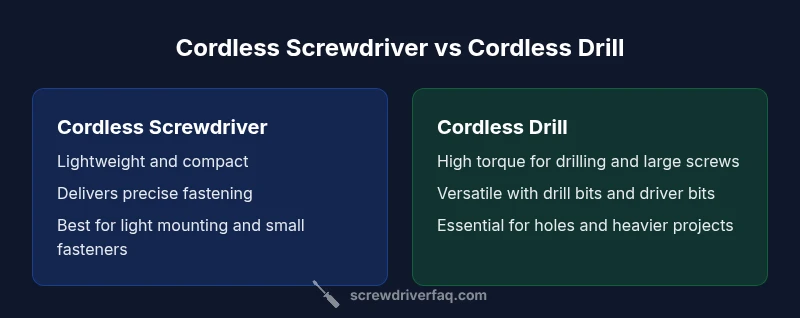
A cordless screwdriver is optimized for driving screws with controlled torque, often featuring a compact design, lighter weight, and a comfortable grip for long fastening sessions. It shines on assemblies, cabinetry, and lite construction where precision matters and hole drilling is not required. A cordless drill, by contrast, is built to handle holes and the same or larger screws with higher torque, offering more versatility for wood, drywall, metal, and multi-material projects. For most DIYers, the drill becomes the anchor tool because it can expand from simple screwdriving to drilling, countersinking, and even light demolition with the right bits.
Torque, Speed, and Control: Why It Matters
Torque and speed settings directly affect how cleanly and securely fasteners seat, and how deep a hole you can drill without wandering. A screwdriver typically operates at lower RPM and higher control to prevent cam-out and stripped heads. A drill provides higher RPM ranges and adjustable torque, enabling faster drilling and more aggressive screw driving when needed. Mastery comes from matching the task to the tool’s sweet spot: gentle driving for particle board and pre-drilled holes, powerful drilling for hardwoods and larger fasteners.
Comparison
| Feature | Cordless screwdriver | Cordless drill |
|---|---|---|
| Power/torque | Low to moderate torque optimized for fastening | High torque for drilling and heavy fasteners |
| Speed (RPM) | Lower RPM for precision fastening | Higher RPM for drilling and faster screw driving |
| Chuck size / bit compatibility | Typically 1/4 inch hex quick-change for bits | Commonly 1/2 inch chuck or larger for drill bits |
| Weight and ergonomics | Lightweight, compact design for reach and comfort | Heavier due to gearing; balance matters for long sessions |
| Battery life | Often smaller batteries with decent runtime for fasteners | Larger batteries and longer runtime for holes and larger screws |
| Price range | $25-100 (starter models) | $40-200 (mid-range to pros) |
| Best use case | Light fastening, precision work, tight spaces | Hole drilling, large fasteners, versatile tasks |
| Accessory ecosystem | Hex driver bits, countersink bits, small driver bits | Drill bits, screwdriver bits, chucks, driver sets |
Pros
- Lower fatigue and better control for long tightening sessions
- Precision is easier with a screwdriver for small fasteners
- Drills provide greater versatility for holes and large fasteners
- Cordless options reduce cord clutter and increase mobility
- Combo kits can expand value and readiness for diverse tasks
Negatives
- Drills can be heavier and less nimble for simple screwdriving
- Screwdrivers have limited capacity for large holes or heavy materials
- Drill maintenance can be more involved with bit changes and bit life
- Battery management becomes important with frequent switching
Cordless drills win for versatility; cordless screwdrivers excel at precision fastening and compact tasks
For most DIYers, start with a cordless drill to cover drilling and driving needs. Add a cordless screwdriver later to optimize fastening accuracy and ease of use in tight spaces.
Quick Answers
What is the fundamental difference between a screwdriver and a drill?
A screwdriver is designed primarily to drive screws with controlled torque and precision. A drill is built to create holes and can drive screws with the right bit, offering higher torque and versatility for various materials.
A screwdriver drives screws with precision; a drill holes and can drive screws with the right bit for more versatility.
Can I use a drill to drive screws in all situations?
You can drive screws with a drill, but you risk cam-out, overdriving, or stripping heads on delicate materials. Use appropriate torque settings and bits, and consider a dedicated screwdriver for frequent fastening.
A drill can drive screws, but use caution to avoid damage; a screwdriver is better for frequent fastening.
Should I buy a combi kit or separate tools?
Combo kits offer value and ready versatility by combining a drill and screwdriver with common bits. Separate tools let you tailor performance, but may cost more upfront. Choose based on your project mix and budget.
Combo kits are convenient and often cost-effective; separate tools suit specific performance goals.
What bits do I actually need?
Begin with a basic set: bit drivers for screws, a couple of drill bits (wood and metal), a countersink bit, and a universal chuck. Expand as you encounter new materials and joinery techniques.
Start with basic bits for screws and common drilling tasks; add specialty bits as needed.
How can I maximize battery life?
Use appropriate speed/torque settings, recharge between demanding tasks, and store batteries at moderate temperatures. Regular maintenance and proper storage extend overall tool life.
Optimize settings and storage to stretch battery life and tool longevity.
Are corded tools better than cordless for beginners?
Corded tools offer constant power but sacrifice portability. For beginners, cordless tools promote mobility and safer handling, though you’ll manage battery charges and capacity.
Cordless tools are more convenient for beginners; corded tools deliver steady power when mobility isn’t needed.
The Essentials
- Choose a cordless drill for overall versatility
- Add a cordless screwdriver for precision fastenings
- Prioritize ergonomic design and battery life
- Check bit compatibility and upgrade options
- Consider a combo kit for comprehensive coverage