Impact Driver vs Electric Screwdriver: Which Tool Is Right for Your DIY Projects?
A data-driven comparison of impact drivers and electric screwdrivers for DIYers. Learn torque, control, use cases, and buying tips to choose the right tool for your projects.


Impact driver vs electric screwdriver: both are essential for DIY projects, but they serve different jobs. An impact driver delivers hammer-like torque ideal for driving long screws and lag bolts, while an electric screwdriver focuses on precise, low-torque screw driving and fastened assemblies. For most homeowners, the right choice depends on material, fastener size, and how often you work with wood.
What Are Impact Drivers and Electric Screwdrivers?
Impact driver vs electric screwdriver represent two common power tools that are often confused, yet they have distinct roles in any toolkit. According to Screwdriver FAQ, the first step in choosing between them is to map your typical tasks to the tool’s capabilities: heavy-duty driving versus precise, controlled fasteners. In practice, you’ll reach for an impact driver when you need to drive long screws or lag screws quickly through dense material; you’ll reach for an electric screwdriver when the goal is precise positioning and clean finish with minimal cam-out.
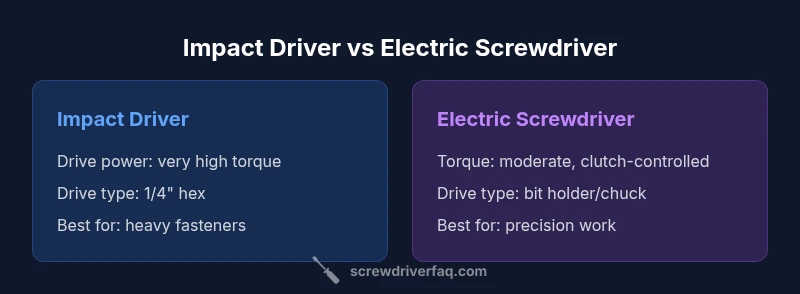
Impact drivers deliver hammer-like impacts as the bit engages with a screw, which translates into very high torque at low to mid speeds. This hammer-action helps prevent cam-out and makes it easier to drive stubborn fasteners without pre-drilling. The downside is reduced precision, more vibration, and limited ability to control the exact driving depth without additional clutch settings. Electric screwdrivers, on the other hand, emphasize smooth control. They use a clutch or torque-limiting mechanism to prevent overdriving and to allow consistent seating depth. Their speed is generally higher, which speeds up many assembly tasks, but their torque is smaller and sometimes insufficient for larger or hardwood screws. Most cordless electric screwdrivers accommodate a broad range of bits with a magnetic bit holder or a small chuck, which makes them versatile for household repairs, furniture assembly, and electronics projects.
From a practical standpoint, almost every DIYer will eventually own both tools, or a single tool with dual capabilities. The ideal choice depends on how often you drive fasteners, the material you work with, and the level of control you need. The Screwdriver FAQ team emphasizes that understanding the difference in application will save time and prevent frustration on your next project.
Comparison
| Feature | impact driver | electric screwdriver |
|---|---|---|
| Drive type | 1/4-inch hex drive with quick-change bit holder | Interchangeable bits via magnetic bit holder or chuck |
| Torque potential | very high torque with hammer-action | moderate torque optimized for precision and control |
| Speed (RPM) | low-to-mid RPM focused on torque delivery | mid-to-high RPM for faster driving with lighter fasteners |
| Weight and size | often compact but heavier due to hammer mechanism | lighter and typically more compact for overhead work |
| Best use | heavy driving in wood and dense materials | assembly tasks, furniture, electronics, and soft-fastener work |
| Control and precision | less precise due to limited clutch options on many models | built-in clutch and torque settings for finer control |
Pros
- Clear advantage for driving long screws quickly
- Less pre-drilling required in tough materials
- Compact and versatile for overhead tasks
- Broad bit ecosystem supports many jobs
- Good value for heavy-duty tasks
Negatives
- Can be challenging to control for small fasteners
- Higher vibration and louder operation
- Requires awareness to avoid over-driving in soft materials
- Bit selection and accessibility can add cost
Impact driver for heavy-duty driving; electric screwdriver for precision tasks
Choose the impact driver when you need brute force and speed driving large fasteners. Choose the electric screwdriver for delicate assemblies, controlled seating, and versatility with light-to-medium screws.
Quick Answers
What is the main difference between an impact driver and an electric screwdriver?
An impact driver delivers hammer-like torque to drive fasteners quickly, while an electric screwdriver offers greater precision and control with torque settings. The choice depends on the screw size, material, and how much control you need.
An impact driver is built for power and speed in tough jobs, whereas an electric screwdriver is all about precision and control for lighter, everyday screws.
Can I use impact driver bits in an electric screwdriver?
Many impact drivers use a 1/4-inch hex drive, which is compatible with common hex bits. Electric screwdrivers use a variety of bit holders or chucks; some accept hex bits via adapters. Always check the tool’s bit system before mixing tasks.
Yes, but you’ll need the right bit holder or adapter for the screwdriver to use hex bits.
Which tool is safer for beginners?
Electric screwdrivers offer more predictable control with clutch settings, making them friendlier for beginners. Impact drivers can cause more kick and require careful handling to avoid over-driving or bit slipping.
For beginners, start with an electric screwdriver to build precision, then add an impact driver if you need more power.
Do I need pre-drilling when using an impact driver?
Pre-drilling is often unnecessary with an impact driver for many fasteners in softwood or hardwood. However, pre-drilling can reduce wood splitting and is recommended for very large screws or dense materials.
Usually no pre-drilling with an impact driver, but it can help in tough materials.
How do I decide between cordless and corded models?
Cordless models are more versatile and portable, ideal for most DIY tasks. Corded tools provide constant power and may be preferred for extended jobs. Consider battery life and the task duration when choosing.
Go cordless for flexibility; choose corded if you’ll run long sessions without recharging.
What should I look for in a buying guide?
Prioritize torque options, clutch settings, battery capacity, weight, and bit compatibility. Look for a balanced kit that suits your common projects and includes essential bits.
Focus on torque control, battery life, and a solid bit selection.
The Essentials
- Prioritize torque and control needs when choosing tools
- Use an impact driver for dense materials and long screws
- Pick an electric screwdriver for precision and ease of use
- Consider battery life, weight, and ergonomics in the decision
- Many DIYers benefit from owning both or a multi-tool with interchangeable heads