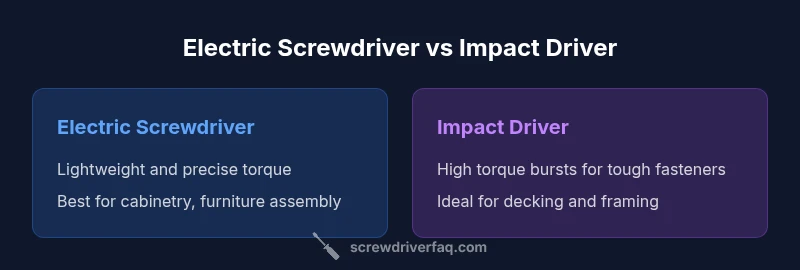
Electric Screwdriver vs Impact Driver: A Practical Comparison
A practical, analytical comparison of electric screwdrivers and impact drivers, detailing torque, speed, drive systems, and use cases to help DIYers choose the right tool.


Is an electric screwdriver the same as an impact driver? In short, no. They are distinct tools built for different tasks: electric screwdrivers emphasize steady torque for precise driving, while impact drivers deliver bursts of high torque for stubborn fasteners. This comparison explains key differences, use cases, and how to choose between them based on project needs, drive size, and the materials you work with.
What these tools are and how they differ
There are two common cordless tools used for fasteners around the home and workshop: electric screwdrivers and impact drivers. An electric screwdriver is a low-torque device designed for driving screws with precision and minimal twisting, often featuring electronic clutch settings and soft-start to protect delicate materials. In contrast, an impact driver is engineered to deliver short, rapid bursts of high torque that minimize cam-out and allow driving longer or harder fasteners with less effort. The question many DIYers ask, is an electric screwdriver the same as an impact driver? The simple answer is no; the two devices serve different purposes, and recognizing those differences will prevent underperforming projects and unnecessary tool purchases.
This article from Screwdriver FAQ is designed to give you a clear, practical framework for comparing these tools. We focus on core differences in torque and speed, driving mechanisms, drive interfaces, ergonomics, and suitable use cases. By the end, you’ll know which tool you should reach for in common scenarios, and when it makes sense to own both. The goal is to empower you to select tools based on task requirements, not marketing claims.
Key technical differences: Torque, speed, and impact
The core distinction between these tools lies in how they apply force to a fastener. An electric screwdriver provides steady rotation with controlled torque, featuring adjustable clutch settings and sometimes soft-start to protect delicate materials. An impact driver, by contrast, combines rotation with a hammering action that delivers short bursts of high torque. Those bursts help overcome friction, cam-out, and dense materials, making it easier to drive long or stubborn screws. Because of this, the phrase is an ongoing topic of discussion: is an electric screwdriver the same as an impact driver? The consensus among professionals is that they are designed for different end goals. If you need precise, controlled driving for cabinetry or furniture, the electric screwdriver is often the better choice; if you’re tackling decking, framing, or dense lumber, the impact driver can save time and effort. Ergonomics also come into play—impact drivers tend to be slightly heavier and louder, while electric screwdrivers are typically lighter and quieter, which matters on long projects.
Torque and speed configurations illustrate the contrast: electric screwdrivers commonly offer lower torque and smoother clutch engagement, while impact drivers provide torque bursts and higher potential peak torque. The practical impact is straightforward: you’ll see faster insertions with the impact driver on tough fasteners, but you’ll have less control at very small sizes. In everyday projects, you’ll prioritize one tool or use both depending on the material and fastener length. This understanding helps you plan your toolkit with purpose rather than dependency on a single multi-tool.
For clarity, think in terms of project intensity: light, precise screwing versus heavy-duty fastening. If you’re asking is an electric screwdriver the same as an impact driver, the answer is that they are not interchangeable in most scenarios, though they can complement each other well when used together in a well-rounded toolkit.
Drive size, chuck compatibility, and bit ecosystems
Drive interfaces also differentiate the two tools. An electric screwdriver typically uses a quick-change or chuck system designed for standard screwdriver bits, often in a 1/4-inch hex shank range. The focus here is on bit precision, alignment, and constant, controlled driving for small fasteners. An impact driver, on the other hand, is built around a hex drive that accepts heavy-duty bits designed to withstand hammering and high torque. The hex drive in impact drivers is optimized for robust, slip-resistant engagement, which helps prevent bit wobble during rapid bursts. It’s common to see 1/4-inch hex bits in both tools, but impact drivers frequently pair with bits made to handle impact loads, sometimes including floor-rated or reinforced shanks. When a project involves drywall screws, cabinetry screws, or deck fasteners, you’ll notice that the choice of drive system and bit matters as much as the torque itself. If you’re unsure whether a particular bit set is compatible with your tool, check the manufacturer’s guidance; wrong fitment can cause cam-out, stripped fasteners, or damaged bits. A practical approach is to maintain separate bit sets for precision screwing and for high-torque, impact-driven tasks.
Use-case scenarios: when to use each
In real-world projects, your decision often comes down to the job at hand. Woodworking tasks that require meticulous screw placement, fine control, and smaller fasteners—such as installing cabinet hardware, assembling furniture, or attaching plywood—typically favor an electric screwdriver. The clutch settings can prevent overtightening, and the smoother rotations help protect delicate finishes from cam-out. For tasks that demand speed and raw power—installing deck boards, framing, or driving long screws into dense materials—an impact driver shines. The tool’s hammering action helps push fasteners with less torque fatigue on the user and reduces the effort needed by a noticeable margin. These scenarios illustrate the practical distinction: an electric screwdriver is the precision instrument; an impact driver is the powerhouse that handles tough fasteners. It’s worth noting that some projects benefit from having both tools at the ready, especially when working on a series of varied fasteners or when you need to alternate between delicate woodwork and heavy-duty framing without swapping tools mid-task.
Ergonomics, weight, and comfort
Weight and balance affect how long you can work before fatigue sets in. Electric screwdrivers tend to be lighter, with compact grips and softer handling, which makes them ideal for overhead tasks or long sessions at lower torque. Impact drivers are typically heavier and more compact in the grip due to the hammer mechanism, though modern designs aim to minimize vibration and improve control. Vibration dampening, grip texture, and trigger feel all influence how comfortable each tool is to use over time. The takeaway is simple: if you frequently work above shoulder height or with small fasteners, the lighter electric screwdriver reduces fatigue; for heavy-duty fastening across a large area, the power and torque of an impact driver can preserve your wrists and forearms. To maximize comfort, incorporate proper stance and hand positioning, select models with low-vibration features, and choose a tool whose weight distribution aligns with your most common tasks.
Maintenance, care, and longevity
Proper maintenance extends the life of both tools. Keep the chuck area clean of debris, inspect and replace worn bits, and follow battery care guidelines for cordless models. For electric screwdrivers, periodic clutch calibration (as recommended by the manufacturer) helps maintain precision. For impact drivers, check the anvil, if applicable, and ensure that the bit retention mechanism remains secure. Battery health is a fundamental factor in cordless tools; store batteries at moderate temperatures, avoid full discharges, and recharge according to the manufacturer’s guidelines to preserve capacity. A well-maintained electric screwdriver will provide consistent, controlled driving performance and preserve delicate fasteners, while a well-maintained impact driver will deliver its peak hammer-blow performance across plenty of tough tasks. Regular inspection and bit management—keeping bits labeled, clean, and sharp—prevents misfits and reduces the risk of damaging fasteners or tools.
Safety considerations and common mistakes
When using either tool, follow basic safety practices: wear eye protection, keep hands clear of the rotating bit, and secure the workpiece properly. A common mistake is using the wrong bit size or a damaged bit, which increases the risk of cam-out or stripped fasteners. Another error is using too-large fasteners for predrilled holes, which forces the tool to work excessively and can overheat the motor. Always match the screw type to the material and select the appropriate torque or impact setting. Finally, never rely on a tool alone to drive very long or dense fasteners; if resistance is high, pause and reassess hole preparation or consider predrilling. Understanding these safety and usage guidelines helps reduce the risk of injury and tool damage, preserving both your project quality and your equipment.
How to decide: a practical framework
To determine which tool is right for a given job, follow these steps: 1) define the task: light or heavy fastening; 2) assess material density and screw length; 3) evaluate your tolerance for damage or cam-out; 4) consider ergonomic constraints and weight; 5) compare models based on torque range, boost options, and bit compatibility. Start with an evaluation of the project’s primary needs; if you primarily drive small woodscrews with precision, lean toward the electric screwdriver. If you routinely drive long screws in harder materials, the impact driver is the prudent choice. Finally, build a small tool kit that includes both tools for versatility, especially if you frequently encounter varied fasteners or different materials. This framework aligns with Screwdriver FAQ’s guidance on choosing tools that match the job rather than relying on one multi-purpose device.
Common myths and misconceptions
A frequent misconception is that an impact driver can replace a traditional drill or that an electric screwdriver can handle all fasteners with minimal effort. In reality, each tool has a defined scope. Another myth is that more torque always means better results; in precision work, too much torque can strip wood, snap fasteners, or damage surfaces. Finally, some DIYers assume cordless is always better than corded; while cordless offers convenience, cordless runtime and battery health can limit performance on big projects. By debunking these myths, you’ll approach tool selection with a clearer, task-focused mindset.
Comparison
| Feature | Electric Screwdriver | Impact Driver |
|---|---|---|
| Torque | Low-to-mid torque focused on precision | High torque bursts for heavy fasteners |
| Impact mechanism | No impact; rotation only | Hammering action provides additional torque |
| Speed (RPM) | Moderate, smooth rotation with clutch | Very high torque potential with bursts |
| Drive/Bit compatibility | 1/4-inch hex bits common; quick-change options | 1/4-inch hex bits designed for high impact loads |
| Weight and ergonomics | Typically lighter; balanced for precise work | Usually heavier but compact for tough jobs |
| Best for | Cabinetry, furniture assembly, light fasteners | Decking, framing, dense materials, long screws |
Pros
- Helps DIYers pick the right tool for the job
- Highlights strengths and limits of each option
- Guides safer, more efficient projects
- Supports budgeting by clarifying price/value tradeoffs
- Encourages appropriate usage for different materials
Negatives
- Requires time to read and digest
- May still miss edge-case scenarios
- Could overwhelm beginners with jargon
Electric screwdriver and impact driver each excel in distinct roles; neither is universally superior.
For light-duty screwing, an electric screwdriver provides control and finish protection. For heavy-duty fastening, an impact driver delivers power and speed. Use the framework to guide your toolkit decisions and avoid overbuying.
Quick Answers
Is an electric screwdriver the same as an impact driver?
No. An electric screwdriver focuses on precise, controlled driving with steady torque, while an impact driver adds hammer-like torque bursts for tough fasteners. They are designed for different tasks.
No—electric screwdrivers are for precision driving, and impact drivers handle tougher fasteners with hammer-like torque.
Can I rely on an electric screwdriver for heavy-duty work?
Only for light-duty projects. For long screws into dense materials, use an impact driver to avoid overworking the tool and risking damage.
Only for light work; heavy-duty jobs are better with an impact driver.
What bits do I need for these tools?
Both typically use 1/4-inch hex bits, but impact drivers require bits rated for impact loads. Have separate bit sets for precise driving and hammering tasks.
Both use 1/4-inch hex bits, but use impact-rated bits with the impact driver.
Is cordless always better than corded for these tools?
Cordless models offer mobility and convenience but require battery management. For continuous heavy work, a corded option may provide consistent performance.
Cordless is convenient, but battery life matters; corded tools stay strong for long sessions.
Should beginners own both tools?
Ideally yes for versatility. Start with one based on your typical projects, and add the other as you encounter varied fasteners or materials.
Yes, having both covers most home projects well.
The Essentials
- Identify your primary tasks and match torque needs
- Favor an electric screwdriver for precision driving
- Choose an impact driver for heavy-duty fasteners
- Consider weight, ergonomics, and bit compatibility
- Use a decision framework to guide purchases