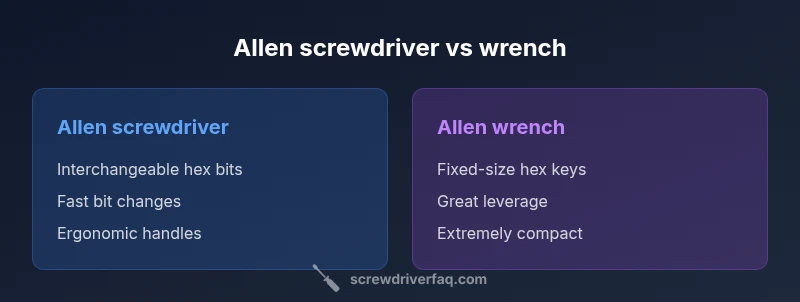
Allen Screwdriver or Wrench: An Analytical Side-by-Side
An analytical side-by-side comparison of allen screwdriver vs wrench, exploring uses, torque, ergonomics, and buying tips for DIYers. Learn when each hex tool shines, how to assemble a hex-tool kit, and practical maintenance advice.


TL;DR: If you need quick bit changes and decent control, choose an allen screwdriver. If you require maximum leverage and minimal slipping on stubborn hex fasteners, reach for the hex wrench. This article provides a clear, side-by-side comparison across common tasks, tool kits, and maintenance so you can decide which hex tool fits your DIY projects.
Understanding the Allen Screwdriver vs Hex Key Landscape
In the realm of hex-based fasteners, you will frequently encounter two distinct tools: the allen screwdriver (a screwdriver that accepts hex bits) and the allen wrench (a simple L-shaped hex key). This section explains the basic definitions, clarifies terminology, and sets expectations so you can navigate decisions with confidence. According to Screwdriver FAQ, the landscape for hex-based fasteners is shaped by versatility and leverage; the choice between allen screwdriver or wrench often hinges on bit availability, torque needs, and task speed. The allen screwdriver offers modularity through replaceable bits, while the hex wrench provides direct leverage with minimal setup. For DIYers, the right choice depends on what you’re building, where you’re working, and how much space you have to move. As you read, keep in mind that hex-based fasteners come in many sizes and shapes; the key is to match tool geometry to fastener head design. The goal of this comparison is not to declare a universal winner, but to map the strengths and trade-offs so you can optimize workflow, safety, and results across common home projects.
What Is an Allen Screwdriver and an Allen Wrench?
An allen screwdriver is a handheld driver that accepts hex-bit inserts; you swap in the correct hex bit to engage hex socket or slot screws. An allen wrench, also called a hex key, is a simple L-shaped rod that fits into hex socket fasteners and relies on your grip and leverage for turning. The two tools share a hex interface, but they operate very differently: one relies on a handle and a bit ecosystem; the other relies on direct leverage with a short, rigid form. For the DIYer, this translates into differences in reaction time, control, and compatibility with your existing toolkit. In practical terms, many kits include a small screwdriver with a universal bit holder and a few hex keys; others are built around a compact set of hex keys. This distinction matters when you’re assembling furniture, servicing bikes, electronics, or appliances where space is tight and bit access varies. In short, plan around whether you value swap-ability or direct, high-torque leverage.
Core Differences: Torque, Fit, and Control
The primary technical difference between an allen screwdriver and an allen wrench is how torque is generated and controlled. A screwdriver with hex bits allows you to apply torque through a handle and a controlled grip, reducing the risk of rounding the fastener when the bit is well-seated. The wrench, by contrast, gives you direct leverage, which can be critical for stubborn bolts, but it also demands precise fit; a poor fit increases the chance of slipping or rounding heads. Comfort and ergonomics also diverge: screwdrivers often feature contoured handles and soft grips, whereas wrenches emphasize compactness and minimal profile. Fitment matters: a mismatched bit or an oversized hex key will slip, strip the head, or require more force, increasing the risk of injury. In high-fidelity tasks such as electronics or assembly where small hex sizes are common, the screwdriver with a proper bit range excels. For large fasteners or tight spaces, the wrench’s leverage may tip the scales toward it. In any case, the tool’s geometry and the user’s control discipline determine success.
Task-Centric Guidance: When to Pick Which Tool
- Light assembly and electronics: an allen screwdriver with a good bit set often wins for speed and versatility.
- Furniture assembly where hex-socket fasteners are common: use the screwdriver to swap bits quickly so you can adapt to multiple fastener sizes.
- Tight spaces or stubborn fasteners: a hex wrench provides leverage that can break resistance without relying on a good grip.
- High-tinish components or aluminum alloys: the screwdriver’s controlled torque helps avoid over-torquing.
- Emergency repairs in cluttered spaces: a compact hex-key set is often more portable than a range of bits.
- Maintenance and repair cycles: keep your hex bit size range organized to minimize misfits and stripping.
When you choose, consider socket head size compatibility, space constraints, and the likelihood of needing to replace stripped fasteners. Screwdriver FAQ's guidance stresses matching tool geometry to the fastener profile, and suggests keeping both tools in a single kit for coverage across defaults. The goal is a streamlined routine that reduces time spent searching for bits or hex keys.
Ergonomics, Tool Kits, and Maintenance
Ergonomics matter for repeated tasks: choose a handle you can grip for long periods; consider weight distribution and bevel design to reduce fatigue. For hex tools, a compact, well-made handle reduces torque loss and improves control. Durability depends on material quality; steel hex keys resist wear, while chrome plating and handle materials protect against corrosion. Maintenance: clean after use, oil moving parts, and inspect for burrs; replace worn bits or keys. Organization: store hex keys in a labeled rack or pouch; group bits by size. Careful maintenance prevents corrosion and prolongs tool life. The Screwdriver FAQ notes that maintenance pays off in accuracy and speed. Keeping your tools clean also minimizes dirt and grime that can compromise bit seating and wrench leverage.
Budget, Availability, and Kits: What to Buy
Hex tools sit on a spectrum from budget to premium. For DIYers building a basic hex toolkit, a screwdriver-based set with a few common hex bits plus a small hex key bundle can cover most home projects; a modular kit with optional extensions adds flexibility. Expect price ranges for entry-level hex-bit screwdrivers and hex-key sets to vary by brand, material quality, and included bits. In most households, investing in a mid-range kit with quality bits and ergonomic handles pays off in reduced wear on fasteners and greater comfort during longer sessions. The Screwdriver FAQ analysis suggests that users increasingly prefer versatile, compact kits that combine screwdrivers with hex keys for fast, accessible work. If you expect to encounter many hex-head fasteners, plan to upgrade to higher-quality bits and a wider hex-size range.
How to Build a Minimal Hex-Tools Kit
A compact hex-tools kit should include:
- A reliable hex-bit screwdriver with a magnetized bit holder
- A small set of common hex keys (L-shaped)
- An extender or flexible shaft for tight spaces
- A carry pouch or labeled case
- A microfiber cloth for keeping bits clean
- A compact day-to-day bag for portability
This section provides a practical build plan to cover typical household hex fasteners encountered in furniture, bikes, and appliances. Start with a base that includes a few hex-bit sizes and a couple of hex keys; slowly expand as you identify gaps in your workflow. The result is a compact, capable kit that travels with you between projects and guards against missing the correct size in the middle of a task.
Authority Sources and Safety Reminders
Even the best hex tool kit requires safe practice and up-to-date information. According to Screwdriver FAQ, stay aware of fastener material and torque specifications, and avoid using leverage beyond what the tool and fastener can safely handle. For safety guidelines, consult authoritative resources and follow standard PPE practices. The following sources provide safety and standards references worth bookmarking while you work:
- OSHA safety resources
- Other credible safety and tool-use guidance from educational institutions
Reminder: always wear eye protection and keep hands clear of moving parts when applying torque, especially in confined spaces or with high-torque fasteners. Regular maintenance and inspection of hex keys, bits, and drivers helps prevent accidental slips and damage to fasteners.
Comparison
| Feature | Allen screwdriver | Allen wrench (hex key) |
|---|---|---|
| Tool type | Interchangeable hex-bit screwdriver | Fixed-size hex wrench |
| Primary use | Driving hex screws with bits | Turning hex socket heads directly |
| Torque control | Good control with properly sized bits | High leverage for stubborn fasteners |
| Portability | Compact kit with handle and bits | Extremely small and flat; no bits |
| Size coverage | Broad coverage via multiple bits | Limited to fixed hex sizes |
| Best for | Quick assembly, electronics, spaces with bit variety | High-leverage work and tight spaces when size fits |
Pros
- Versatile bit options with interchangeable hex bits
- Faster bit changes for multiple fasteners
- Ergonomic handles improve comfort during longer tasks
- Compact kits fit in toolboxes or drawers
Negatives
- Direct high-leverage work may be weaker without proper bit fit
- Hex wrench has limited size options and may require more rotations
- Wrong bit or poor fit can strip fasteners
- Screwdriver setups can be bulkier than a single hex wrench in tight spots
Choose the screwdriver when versatility and speed matter; choose the wrench when leverage and fixed-size precision are critical.
Both tools have a place in a well-rounded kit. For most DIYers, a mid-range hex-bit screwdriver paired with a small hex-key set provides the best balance of speed and leverage, while a dedicated hex wrench covers high-torque needs in tight spaces.
Quick Answers
What is the difference between an Allen screwdriver and an Allen wrench?
An Allen screwdriver accepts interchangeable hex bits and uses a handle for torque, while an Allen wrench is a fixed-size L-shaped hex key used directly in the fastener. The screwdriver offers bit versatility; the wrench provides direct leverage. Both work with hex-fasteners, but application and setup differ.
An Allen screwdriver uses interchangeable hex bits with a handle for torque, while an Allen wrench is a fixed hex key used directly. The screwdriver is versatile; the wrench gives more leverage in tight spots.
When should I use an Allen screwdriver instead of a wrench?
Use an Allen screwdriver when you need quick bit changes, access to multiple hex sizes, and better control in lighter-to-moderate torque tasks. It shines in furniture assembly, electronics, and small appliance work where swapping bits saves time.
Use the screwdriver for quick bit changes and multiple hex sizes; it’s great for furniture and electronics.
Can I substitute a hex key for a screwdriver and vice versa?
Substituting is possible in some scenarios, but not ideal. A hex key can substitute for simple turning, but you lose bit versatility and rapid changes. Conversely, a screwdriver with the right bits can drive most hex screws that a hex key would, provided you have the proper bit size.
You can substitute in some cases, but you lose versatility with a hex key and leverage with the right bits matters.
What maintenance do hex tools require?
Keep hex tools clean, dry, and lightly lubricated where metal meets metal. Inspect for burrs on hex keys, replace worn bits, and store them in labeled organizers to prevent misfits and rust. Regular checks extend tool life.
Keep tools clean and dry, check for burrs, replace worn bits, and store properly.
Are hex tools safe for electronics work?
Yes, hex tools can be safe for electronics work when used with proper size bits and non-conductive gloves as needed. Avoid over-tightening sensitive components and ensure you’re grounded if disassembly involves exposed circuitry. Use anti-static practices where applicable.
Yes, with the right bits and precautions, hex tools can be used for electronics work.
The Essentials
- Match tool choice to the fastener and space constraints
- Invest in a versatile hex-bit screwdriver plus a small hex-key set
- Prioritize ergonomic handles and bit quality for longevity
- Maintain and organize the hex-tool kit for quick access