Hex Screwdriver vs Allen Key: Is There a Difference?
Is a hex screwdriver the same as an Allen key? This analytical guide clearly distinguishes hex screwdrivers from Allen keys, explains when to use each, and helps DIYers choose the right tool for hex fasteners with practical tips and examples.


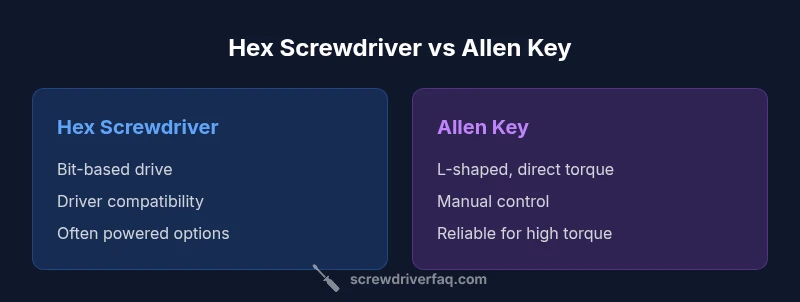
Hex screwdriver and Allen key are not the same. An Allen key is an L-shaped hex wrench used by hand to turn hex screws. A hex screwdriver uses a hex bit in a handle or powered driver to turn fasteners. See our chart for detailed differences and choose the right tool for your project.
Is a hex screwdriver the same as an Allen key? Defining the terms
Two tools sit at the core of hex fasteners: hex screwdrivers and Allen keys. In common DIY language, people often use the phrase 'hex screwdriver' to describe any screwdriver that uses a hex-shaped bit, while an Allen key (also called an Allen wrench) is a simple L-shaped hex driver designed to turn sockets directly by hand. According to Screwdriver FAQ, the terminology can be confusing because "hex" describes the drive shape rather than a single tool type. The same hex profile can appear in interchangeable bits for drivers or as a built-in feature on a handle, which leads to a broad category of tools rather than a single device. In practice, the hex screwdriver is a family member of a broader bit-based system, optimized for use with a driver or flexible handle. For most homeowners, understanding this distinction helps prevent mis-purchases or poorly suited fasteners. The Screwdriver FAQ team emphasizes focusing on task needs rather than brand names to avoid buying the wrong tool for a specific hex fastener.
What the terms mean: hex screwdriver, Allen key, and hex bit
A hex screwdriver typically refers to a screwdriver that uses a hex-shaped bit. The bit is inserted into a driver handle and can be turned by hand or with a powered drill/driver. An Allen key, by contrast, is a simple metal L-shaped tool used to turn hex socket screws directly. The two tools are designed around the same hex profile, but their user experience, torque capacity, and intended applications differ significantly. For DIY enthusiasts and homeowners, this distinction matters when you want fast changes, tight spaces, or high torque. Remember: while both celebrate hex geometry, they occupy different tool categories and are not universally interchangeable in all tasks.
Why the distinction matters in real projects
Choosing the right tool can affect speed, control, and the probability of damaging fasteners. When a hex socket needs quick changes or integration with an impact driver, a hex screwdriver (with the right bit) is often the better choice. For high-torque situations or precise alignment with a hex recess, an Allen key offers direct, lever-based control. The difference can be subtle in theory but meaningful in practice, especially for furniture assembly, bicycle maintenance, or electronics work where hex sizes and tolerances vary.
How practitioners describe the difference in practice
Most DIYers who work with hex fasteners encounter two common scenarios: when you need quick bit changes or power-assisted turning, and when you require tactile feedback and leverage without a driver. In the first case, a hex screwdriver shines; in the second, an Allen key—or a set of hex keys with the appropriate sizes—delivers better control. The goal is to avoid forcing a tool beyond its design envelope, which can strip screws or bend tools.
Comparison
| Feature | Hex screwdriver | Allen key (Allen wrench) |
|---|---|---|
| Is the drive a bit or a key? | Hex bit in a handle or driver | Fixed L-shaped hex key |
| Typical use method | Inserted into a driver for quick changes and powered turning | Turned by hand for direct engagement and leverage |
| Common sizes | Bit sizes vary; metric and imperial options exist | Discrete sizes corresponding to hex socket dimensions |
| Torque handling | Depends on bit quality and driver, generally moderate | Higher control for manual torque, especially in small fasteners |
| Best scenarios | When using impact or drill drivers; quick swaps | When high torque or precise alignment is needed |
| Portability and fit in toolkit | Very compact; often included in bit sets | Low-profile, needs space to maneuver in tight corners |
| Cost range | Budget-friendly to mid-range (depends on bit set and handle) | Typically inexpensive; sold individually or in sets |
| Maintenance considerations | Keep bits clean; replace worn bits | Keep the key ends clean and avoid bending |
Pros
- Offers rapid bit changes and compatibility with powered drivers
- Very portable and affordable with broad availability
- Works with multiple hex sizes via interchangeable bits
- Can be used in tight spaces where a wrench cannot reach
Negatives
- Limited torque compared to a solid hex key for stubborn fasteners
- Bit wear or poor bit fit can strip hex sockets
- Not ideal for high-torque applications without proper tooling
- Size compatibility can be confusing across metric/imperial systems
Hex screwdriver is generally not the same as an Allen key; choose based on torque needs, space, and whether you’ll use a powered driver.
For quick, driver-assisted work, a hex screwdriver is the better choice. For high-torque, precise manual work, rely on an Allen key. The right decision depends on the task and the fastener size.
Quick Answers
Is a hex screwdriver the same as an Allen key?
No. An Allen key is a hand-driven L-shaped hex wrench. A hex screwdriver uses a hex bit in a handle or driver to turn fasteners, often with powered assistance. The two serve different purposes and are not always interchangeable.
No. An Allen key is a fixed L-shaped hex wrench, whereas a hex screwdriver uses a hex bit in a handle or driver for turning screws.
Can I use an Allen key in a hex screwdriver?
Generally not recommended. Allen keys are designed for hand-turning, and forcing one into a screwdriver could damage the bit, handle, or fastener. Use the tool designed for the task.
Usually not recommended; use the right tool for the job to avoid damage.
When should I choose a hex screwdriver over an Allen key?
Choose a hex screwdriver when you need quick bit changes, driver compatibility, or working with a powered tool. Choose an Allen key for high-torque, precise manual turning and tight spaces.
Pick the hex screwdriver for speed and power; the Allen key for torque and control.
Are hex keys and Allen keys the same size?
Sizes for hex keys and the corresponding screws come in both metric and imperial standards. A size marked on the fastener should match the key or bit closely; mismatches can damage the fastener.
Sizes need to match the fastener; metric and imperial sizes vary.
What are common hex sizes?
Common hex sizes span small to medium ranges and appear in both metric and imperial systems. Always verify the hex socket or fastener size before selecting a tool.
Hex sizes vary; check the fastener first to choose the correct size.
The Essentials
- Identify hex size range before tool selection
- Use hex screwdriver for speed with a driver
- Prefer Allen keys for high-torque control
- Check metric vs imperial sizing and bit compatibility
- Maintain bits and keys to prevent wear