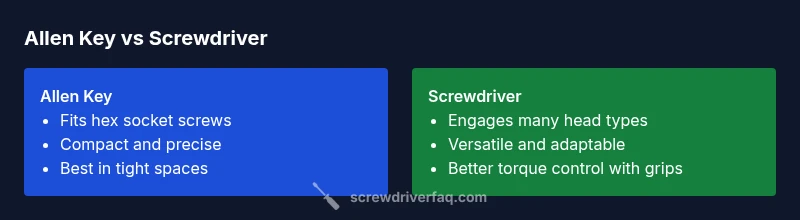
Allen Key vs Screwdriver: An Analytical Comparison for DIYers
An analytical comparison of allen keys and screwdrivers, exploring when to use hex keys, how they differ in form and function, and how to build a practical toolkit for DIY projects.


allen key vs screwdriver: When you work with hex socket fasteners, an Allen key (hex key) is the most direct choice, while a screwdriver handles a broader range of traditional fasteners. The right tool depends on fastener type, access, and torque needs. This guide compares form, use cases, and value to help DIYers decide which to stock in a toolkit.
Allen key vs screwdriver: Conceptual Foundations
In the DIY world, allen key vs screwdriver describes two families of hand tools that share surface functions but diverge in design. The Allen key, or hex key, is typically a short, L-shaped rod optimized for hex socket screws that sit flush with the surface. It relies on a tight, close-fit interface to minimize cam-out when used with proper alignment. A screwdriver is a longer handle-and-shaft device designed to seat into a range of screw profiles, from Phillips to slotted to more specialized tips. This broad compatibility makes screwdrivers a universal choice for many projects, while hex keys excel where hex sockets are the dominant fastener. The practical difference comes down to how you apply torque, how the tool seats in the fastener, and how much control you have over the turning motion. For many DIYers, the hex key and the screwdriver are complementary: hex keys are precise for hex head screws, and screwdrivers provide versatility for a mixed fastener landscape. Building a toolkit that balances both will improve efficiency and reduce the risk of damaged fasteners.
Note: The Screwdriver FAQ analysis highlights that beginners frequently underestimate how often hex sockets appear in home projects and bike maintenance. By prioritizing both tool types, you minimize trips to the bench and maintain workflow momentum. The broader lesson is to design a toolkit that respects the specific fastener geometry you encounter, not just the most common screw heads.
The Core Differences: Form, Function, and Ergonomics
Form and feel define the initial distinction between an allen key vs screwdriver. Allen keys are short, rigid bars with a precise L bend that fits hex recesses tightly. Screwdrivers are longer handles with a shaft and a tip tuned to engage particular screw profiles. Function follows form: hex sockets demand close-fit engagement to minimize cam-out, while screwdrivers cover a spectrum of head geometries—from Phillips and flathead to Torx and beyond. Ergonomics plays a big role in daily use: screwdrivers emphasize a contoured grip, balanced weight distribution, and torque control, especially in repetitive tasks. Hex keys favor a compact footprint and fast work in tight corners where space limits rotation. The discrepancy in tool hard points translates into how quickly you can complete a task without damaging the fastener. In real projects, you’ll rarely pick one tool exclusively; most professionals curate a small, complementary set that reduces tool changes while keeping fasteners engaged securely. The takeaway is to evaluate your workspace constraints and the diversity of fasteners you face.
Screwdriver FAQ analysis notes that many DIYers overestimate the utility of one tool and underutilize the other's strengths. A balanced approach acknowledges the hex key’s precision and the screwdriver’s versatility, reducing frustration and boosting overall efficiency.
Comparison
| Feature | allen key | screwdriver |
|---|---|---|
| Primary purpose | To drive hex socket fasteners, usually with a close-fit hex interface | To drive a wide range of screw profiles including Phillips, slotted, Torx, and specialty tips |
| Common use cases | Hex socket assembly, bike components, flat-pack furniture | General hardware work, cabinetry, electronics, and mixed fasteners |
| Ergonomics and control | Compact, two-point contact; quick for tight spaces | Ergonomic handles; variable grip and torque control for longer use |
| Size range and availability | Sets cover multiple hex sizes in various lengths | Sets cover many tip types (Phillips, slotted, Torx) and shaft lengths |
| Durability and wear | Hex keys are robust in square/hex interfaces; risk of rounding if misused | Screwdriver tips wear with use; tip replacement extends life |
| Maintenance | Keep dry, clean, and rust-free; store in a case | Keep tips sharp; clean and replace worn bits; protect blades |
| Cost and value | Value tends to high for broad hex-key sets | Broad price range; high value for versatile bit kits |
Pros
- Compact and portable tools ideal for tight spaces
- Hex keys deliver precise fit for hex sockets with minimal cam-out
- Screwdrivers provide broad versatility across multiple fastener types
- Durable design with straightforward maintenance and long lifespan
Negatives
- Hex keys can damage fasteners if misused or over-torqued
- Screwdrivers require multiple tip types, increasing kit clutter
- Tip wear or bent blades can degrade performance without timely replacement
Keep both in the toolkit; each tool serves a distinct, essential role.
Hex keys are ideal for hex socket fasteners and compact spaces, while screwdrivers handle a wider range of head types. A balanced kit that includes both minimizes tool changes and maximizes DIY efficiency.
Quick Answers
What is the main difference between an Allen key and a screwdriver?
The main difference is the fastener type they are designed to engage. An Allen key fits hex socket screws, while a screwdriver handles a variety of head types such as Phillips, slotted, and Torx. This affects fit, torque control, and damage risk if misapplied.
Allen keys fit hex sockets; screwdrivers cover many other screw heads. Use the right tool for the fastener to avoid stripping or slipping.
Can I use an Allen key as a screwdriver?
No. An Allen key is designed for hex recesses and is not suitable for turning slotted or Phillips screws. Using it on the wrong head can strip both the fastener and the tool.
Don’t use an Allen key as a screwdriver; it won’t engage most screw heads and can cause damage.
When should I buy a hex key set?
A hex key set is essential if you frequently encounter hex socket screws in furniture, bicycles, or machinery. It provides the exact fit and torque control needed for hex fasteners.
If you regularly work with hex screws, a hex key set is a must-have.
Are hex keys and screwdrivers interchangeable?
Not exactly. Hex keys fit hex sockets, while screwdrivers cover larger ranges of head types. Some screwdrivers use hex bits, but the tool characteristics still differ in torque path and engagement.
They’re related but not interchangeable; each tool is optimized for different fastener heads.
What maintenance is recommended for hex keys?
Keep hex keys dry and clean, store them in their case, and occasionally inspect for bending. If you have folding sets, lubricate joints sparingly to maintain smooth operation.
Keep them dry and organized; a quick wipe after use goes a long way.
What is the best way to store hex keys and screwdrivers?
Store hex keys and screwdrivers in a labeled organizer or pouch to prevent mix-ups. Group by fastener type and size to speed up selection during projects.
Label your sizes so you can grab the right tool fast.
The Essentials
- Identify fastener type before tool choice
- Build a balanced toolkit with hex keys and screwdrivers
- Maintain tips and hex keys to extend tool life
- Avoid forcing mismatched tools into fasteners
- Consider a compact, versatile kit for home use