Hex screwdriver vs Allen key: A Practical Comparison
A thorough, analytical comparison of hex screwdrivers and Allen keys to help DIY enthusiasts decide which tool fits their projects best. Learn usage, ergonomics, compatibility, and buying tips for hex screwdriver vs allen key.


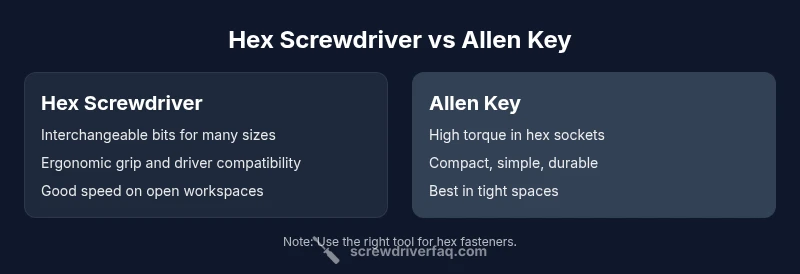
According to Screwdriver FAQ, the hex screwdriver vs allen key debate centers on versatility versus torque in tight spaces. A hex screwdriver excels in versatility, offering interchangeable bits and driver compatibility for many fasteners. An Allen key, or L-shaped hex key, delivers high torque in recessed sockets and compact workspaces. For most DIY tasks, the hex screwdriver wins on versatility, while the Allen key wins where space and torque are critical.
Hex screwdriver vs allen key: Core differences
In everyday DIY projects, you’ll encounter hex fasteners that require either a hex screwdriver or an Allen key. The core distinction lies in how each tool engages the fastener and how you apply torque. A hex screwdriver is typically a handle with a hex-shaped bit or a modular bit set that you turn with a manual grip or an attached driver. It blends the familiarity of a traditional screwdriver with the hex-bit geometry used by many furniture and equipment fasteners. An Allen key, by contrast, is a simple L-shaped tool designed specifically for hex socket screws. Its geometry minimizes contact area with the screw head and emphasizes leverage, especially in tight spaces. In practice, the choice comes down to task context: how much torque you need, how much space you have, and how many different hex sizes you’ll encounter. According to Screwdriver FAQ, the decision should factor in versatility versus torque in constrained environments.
When hex screwdriver shines in DIY tasks
Hex screwdrivers are particularly valuable when you’re assembling furniture, mounting hardware, or working with equipment that uses hex head fasteners with readily available bit sets. The ability to swap bits quickly and switch between a driver and a manual handle increases speed and reduces the risk of stripping a fastener. For projects with multiple hex sizes, a good hex screwdriver kit provides a broad range of bits and a comfortable grip for extended use. In this context, the hex screwdriver vs allen key comparison favors the hex screwdriver for its adaptability, enabling you to tackle a wide spectrum of fasteners without hunting for a separate tool mid-project.
When Allen keys are the better choice
Allen keys excel in situations where space is severely restricted or where you need precise, high-torque engagement in a hex socket. The L-shaped design provides solid leverage in corners and recesses where a standard screwdriver handle wouldn’t fit. Allen keys are often compact and require minimal setup, which makes them ideal for quick repairs in tight panels, bicycles, or automotive interiors. They also tend to be inexpensive and extremely durable when used within their design limits. In the hex screwdriver vs allen key comparison, the Allen key’s strength lies in simplicity and torque delivery in constrained areas. For many professionals, its reliability in difficult-to-reach fasteners makes it indispensable.
Ergonomics, grip, and control
Ergonomics play a major role in user fatigue and precision. A hex screwdriver often combines a comfortable grip with a longer lever when used with a bit extension, improving control during extended tasks. The ability to apply outward and downward pressure helps prevent cam-out and reduces fatigue. Allen keys benefit from a straightforward, robust design; they’re less prone to slipping if you’re applying steady force. The downside is that the lack of a traditional handle can cause discomfort during long sessions. For those who work on assemblies or repairs frequently, a hybrid approach—using a hex screwdriver with a comfortable handle and an occasional Allen key—can optimize control across a range of tasks.
Durability, wear, and material considerations
Material quality strongly influences longevity. Hex screwdriver bits are typically made from hardened steel with coatings to resist wear, and many sets offer stamped sizes for quick identification. Routine maintenance involves keeping bits clean, flipping through used bits to prevent rounding, and replacing worn bits. Allen keys are simple steel rods that resist wear well when used with appropriate fasteners; the keys themselves often require little maintenance beyond cleanliness and rust prevention in humid environments. In environments with contaminants or high torque demands, both tools benefit from proper storage and organization to avoid misplacement and damage.
Compatibility and standards: size ranges and interfaces
Hex socket fasteners come in a variety of sizes, typically specified in metric or imperial units. A hex screwdriver kit often includes multiple bits to match common screw sizes, plus adapters for powered drivers. Allen keys cover a subset of hex sizes and can be proprietary to certain manufacturers. The main consideration is ensuring you have the correct size for your fasteners. Mismatched sizes can strip sockets or damage screws. When planning your toolkit, map the most common hex sizes you encounter and choose a hex screwdriver set that covers those sizes, while keeping a compact Allen key set for tight spaces.
Budget, portability, and kit considerations
A bare hex screwdriver and a lone Allen key differ in portability and cost. Hex screwdriver sets may be more expensive if you require a broad range of bits and ergonomic handles, but they pay off in speed and versatility. Allen keys are typically inexpensive and extremely compact, ideal for emergency kits or limited tool spaces. For homeowners building a small toolkit, a mid-range hex screwdriver set paired with a compact Allen key set offers the best balance of versatility, torque, and portability. For more experienced DIYers, investing in a high-quality hex screwdriver with a broad bit library can streamline many common tasks.
Real-world scenarios: deciding which to reach for
In cabinet installations or flat-pack furniture assembly, hex screwdrivers often prove more efficient because you can quickly switch bits and drive screws with a driver. In tight car interiors or bicycle maintenance, Allen keys are invaluable due to their reach and torque in restricted spaces. A practical approach is to assemble a scenario-based decision guide: for open workspaces and multi-size hex fasteners, lean hex screwdriver; for cramped spaces and higher torque, lean Allen key. This pragmatic framework aligns with the hex screwdriver vs allen key decision principle: pick the tool that matches the spatial and torque demands of the job.
How to evaluate quality and buy decision
When evaluating hex screwdrivers, prioritize ergonomic handles, durability of the bits, and the breadth of the bit library. Look for hardened steel bits and corrosion-resistant finishes, along with a secure bit retention mechanism. For Allen keys, inspect the alloy quality, finish, and whether the set includes standard-sized keys that cover the common hex sockets you encounter. Consider the tool’s portability and whether a compact pouch or organizer is included. A smart buying approach combines a versatile hex screwdriver kit for broad tasks with a compact Allen key set for tight spots, ensuring you’re prepared for most hex-based fasteners. The Screwdriver FAQ approach is to focus on utility and longevity when evaluating tool sets.
mainTopicQueryNode
Comparison
| Feature | hex screwdriver | allen key |
|---|---|---|
| Primary engagement method | Bit-based engagement with interchangeable bits or driver compatibility | L-shaped key engagement for direct hex socket contact |
| Ergonomics of use | Typically ergonomic handles and optional extensions for speed | Compact, simple grip with robust leverage in tight spaces |
| Torque delivery in tight spaces | Good torque with larger bits or driver torque | Excellent torque with direct leverage in recessed areas |
| Size range coverage | Broad bit variety to cover many hex sizes | Limited size range focused on common hex sizes |
| Maintenance | Bit replacement and maintenance of driver bits | Minimal maintenance; rust prevention on steel keys |
| Best use scenario | Open workspaces, multi-size hex fasteners, frequent bit changes | Tight spaces, high-torque hex socket screws |
| Cost considerations | Moderate to high depending on bit library | Low to moderate; simple, durable design |
Pros
- Versatile for a wide range of hex fasteners and driver-supported tasks
- Interchangeable bits enable quick adaptation to different sizes
- Allen keys are compact, rugged, and require minimal setup
- Low maintenance with straightforward usage
Negatives
- Hex screwdriver setups can be bulkier and more expensive
- Bit management adds potential for losing bits in busy workspaces
- Allen keys provide less comfort for extended use and can be awkward in long sessions
Hex screwdriver generally offers greater versatility, while Allen keys excel in high-torque, tight-space tasks
Choose a hex screwdriver kit for broad coverage and faster bit changes. Opt for Allen keys when you need solid leverage in cramped spaces or high-torque hex socket work.
Quick Answers
What is the main difference between a hex screwdriver and an Allen key?
A hex screwdriver uses interchangeable hex bits and a handle or driver, offering versatility across sizes and tasks. An Allen key is a fixed L-shaped tool designed for high-torque engagement in hex sockets, especially in tight spaces.
The main difference is versatility versus torque in confined spaces.
Are hex screwdrivers compatible with all Allen sockets?
Not all Allen sockets may fit every hex screwdriver bit. You’ll generally find compatible hex bit sets, but some sockets require specific bit profiles or sizes. Always verify size and drive compatibility before use.
Check the size and profile to ensure a proper fit.
Should a beginner buy both tools or pick one to start?
For beginners, starting with a mid-range hex screwdriver set plus a compact Allen key set is practical. This covers most furniture and small repairs and lets you evaluate which tool you use more often before expanding.
Start with both, then expand as needed.
Can I use an Allen key with a power drill or driver?
Allen keys are primarily manual tools. Using them with powered drivers can strip sockets or damage fasteners. Some hex bits for drivers may resemble Allen bits, but use the correct bit and socket for powered tools.
Best to stick to appropriate hex bits with a driver.
Do hex screwdrivers wear out or need replacement?
Bits wear with use, especially on high-torque or damaged fasteners. Regular inspection and replacement of worn bits prolongs tool life and protects fasteners from damage.
Inspect and replace worn bits to keep performance high.
What maintenance do each tool require?
Hex screwdrivers require bit organization, occasional lubrication of moving parts if applicable, and corrosion prevention. Allen keys mainly require rust prevention and cleaning after use, especially in humid environments.
Keep them clean and dry to maximize life.
The Essentials
- Choose hex screwdriver for versatility and speed
- Keep a compact Allen key set for crammed spaces
- Match tool choice to space, torque needs, and hex size variety
- Invest in quality bits for durability and performance
- Plan a balanced toolkit to cover common hex fasteners