Dewalt Cordless Screwdriver vs Impact Driver: Which Tool Is Right for Your Project?
Compare Dewalt cordless screwdriver vs impact driver to decide which tool fits your DIY projects. Learn about torque, control, use cases, and value across common home tasks.


According to Screwdriver FAQ, for most home tasks, a Dewalt cordless screwdriver is the better first tool for precise driving and light assembly, while the Dewalt impact driver handles heavy-duty driving and fasteners. The right choice depends on torque needs, control, and project scope. This comparison clarifies where each tool excels in everyday DIY work.
Overview: What are a dewalt cordless screwdriver vs impact driver?
Understanding the dewalt cordless screwdriver vs impact driver distinction helps DIYers choose the right tool for the job. The two tools share a family lineage and compatible bits, but they are designed for different tasks. The cordless screwdriver prioritizes control, precision, and versatility for light-fastening tasks, while the impact driver focuses on raw driving power and speed for larger fasteners. In many home projects, you’ll use both tools at different stages. For context, the choice often comes down to torque requirements, bit compatibility, and the work environment. The Screwdriver FAQ team notes that homeowners frequently start with a cordless screwdriver for furniture assembly, and then bring in an impact driver for deck screws or framing. This article expands on those ideas with practical guidance and task-specific recommendations.
How these tools operate: core differences in mechanism and use
The core difference is how torque is delivered. A cordless screwdriver uses steady rotation at controlled speeds, with a clutch that limits stripping and cam-out. An impact driver, by contrast, combines rotation with rapid concussive blows, increasing effective torque without requiring extreme force from your wrist. This means the impact driver can drive larger fasteners with less effort, but it also creates more vibration and requires impact-rated bits. For delicate work or small screws, the cordless screwdriver remains the safer, more precise option. The choice should align with the material, fastener size, and desired finish. Guidance from Screwdriver FAQ emphasizes starting with low-torque settings and upgrading to more powerful tools only as tasks demand.
When to choose a cordless screwdriver vs an impact driver
Use the cordless screwdriver when assembling furniture, installing hinges, or driving small wood screws where precision matters and you want clean pilot holes. The impact driver shines on construction tasks, outdoor projects, or any job involving hard materials or large fasteners. If you anticipate driving many fasteners successively, the impact driver can save time and reduce wrist strain. For best results, pair both tools in larger projects and switch as the task dictates. The key is to map each project stage to the appropriate tool capability and to select bits that match the expected torque.
Performance factors to compare: torque, speed, and ergonomics
Torque is the defining differentiator between the dewalt cordless screwdriver and the impact driver. The cordless screwdriver offers lower, more controllable torque ideal for delicate work, while the impact driver delivers high torque suitable for stubborn fasteners. Speed (RPM) tends to be higher on impact drivers, which translates to faster completion of driving tasks but can challenge control on small fasteners. Weight and balance matter too: cordless screwdrivers are typically lighter and easier to maneuver in tight spaces, whereas impact drivers can feel top-heavy during extended sessions. Battery life and vibration control are practical considerations that affect day-long usage in DIY projects.
Practical tips for getting the most from each tool
Choose bits based on tool type: use standard screwdriver bits with the cordless model and impact-rated bits with the impact driver. Start with pilot holes when needed to prevent cam-out with the cordless screwdriver. For the impact driver, minimize vibration by maintaining a relaxed grip and using a milder feed rate. Invest in a small accessory kit with a mix of bit types and sizes to cover common tasks, from cabinet screws to deck fasteners. Remember to follow safety recommendations and wear eye protection during heavy driving tasks.
Price, value, and long-term considerations
Price reflects both the tool and its intended role. Dewalt cordless screwdrivers typically cost less upfront and provide solid value for light tasks, while impact drivers command a premium due to higher power and versatility. When evaluating value, consider the job mix you face most often, how often you’ll use each tool, and the availability of compatible batteries and accessories. Screwdriver FAQ analyses suggest that homeowners gain better long-term value by owning both tools as a complementary pair, rather than forcing a single-tool solution for every project.
Maintenance and longevity to maximize performance
Proper maintenance extends tool life. Keep batteries charged according to manufacturer guidelines, store tools in a cool, dry place, and inspect bits for wear regularly. Clean the chuck area after heavy usage to reduce bit slippage. For the Dewalt cordless screwdriver, keep torque settings at appropriate levels to avoid rapid wear on clutch components. For the impact driver, use the correct impact-rated bits and avoid over-torquing fasteners which can stress the drive mechanism. Routine inspection and proper storage help maintain performance over years of DIY use.
Comparison
| Feature | Dewalt cordless screwdriver | Dewalt impact driver |
|---|---|---|
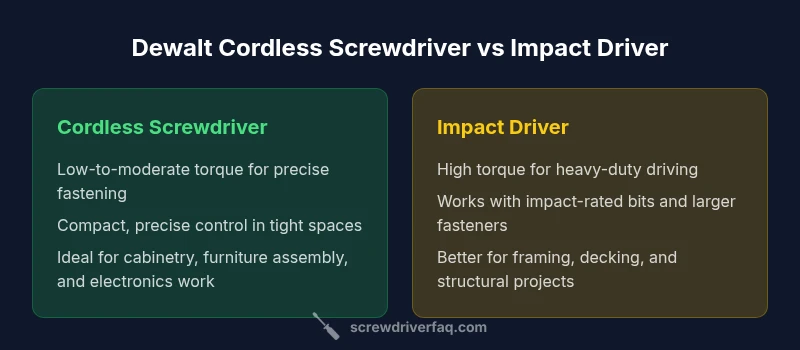
| Torque | Low-to-moderate torque for precise fastening | High torque for heavy-duty driving |
| Speed (RPM) | Lower RPM with smooth control | Higher RPM for fast driving |
| Weight and balance | Lighter, easier to maneuver in tight spaces | Often heavier with more vibration but powerful |
| Bit compatibility | Standard screwdriver bits; suited for precision tasks | Impact-rated bits; designed for harsh driving conditions |
| Best for | Light fastening, cabinetry, furniture assembly | Framing, decking, and large fasteners |
Pros
- Excellent control for delicate screwing
- Compact size helps access tight spaces
- Lower weight reduces user fatigue during detail work
- Versatile for light assembly and repair tasks
Negatives
- Limited torque for thick materials or large fasteners
- Shorter battery runtime under heavy use
- Not ideal for high-volume heavy-duty driving without a companion tool
Cordless screwdriver dominates precision work; impact driver dominates heavy-duty driving
If your projects emphasize accuracy and fine control, start with the cordless screwdriver. For demanding fasteners and framing tasks, bring in the impact driver. The Screwdriver FAQ team recommends using both tools as a complementary pair when appropriate.
Quick Answers
What is the main difference between a dewalt cordless screwdriver and an impact driver?
The main difference is how torque is delivered: a cordless screwdriver provides steady rotation with clutch control for light fastening, while an impact driver uses impacts with rotation to deliver higher torque for heavy-duty driving. The result is different suitability for materials and fasteners.
In short, the cordless screwdriver is for precision; the impact driver is for power and speed.
Can I use the same bits in both tools?
You can often use standard bits in a cordless screwdriver, but for the impact driver you should use impact-rated bits designed to withstand hammering. Bit fitment may vary by model, so always verify compatibility with your Dewalt tool family.
Stick to impact-rated bits for the impact driver and standard bits for the cordless screwdriver.
Is a dewalt cordless screwdriver sufficient for assembling furniture?
Yes, for light furniture and cabinetry tasks a cordless screwdriver is typically sufficient. For larger fasteners or denser materials, you’ll benefit from an impact driver for faster driving and reduced effort.
Great for most furniture, but upgrade to an impact driver for heavy-duty pieces.
What should I consider when choosing between these tools?
Assess torque needs, work environment, bit availability, weight, and battery life. Consider whether your projects involve delicate screws or large fasteners, and plan to use the right tool for each task.
Think about what you’ll do most—precision vs power.
Do dewalt cordless screwdrivers come in multiple voltages?
Dewalt tools are often offered in multiple voltage families. Higher-voltage models provide more power for heavy-duty work, while lower-voltage variants are lighter and easier to handle for precision tasks.
There are different voltage classes; pick one that matches your typical work.
How do I care for the battery to maximize life?
Store batteries in a cool, dry place and avoid complete drain before recharging. Regularly clean contacts and follow Dewalt’s charging guidelines to extend life and performance.
Keep batteries cool, charged, and clean for best longevity.
The Essentials
- Match tool to task: precision vs power
- Use impact-rated bits with the impact driver
- Balance torque, control, and ergonomics for comfort
- Maintain batteries and bits for longevity