Screwdriver Like Drill: A Comprehensive Comparison
This in-depth comparison helps DIYers decide between a screwdriver-like drill and a traditional drill, covering design, performance, ergonomics, power, and buying guidance for better tool choices.


For DIY tasks that mix drilling and screwing, a screwdriver-like drill can be a versatile middle ground. It delivers adequate torque for fasteners and lighter drilling, while staying compact and easy to control. In this article, we compare it to traditional drills to help you choose.
What qualifies as a screwdriver-like drill?
A screwdriver-like drill is a compact cordless tool that centers screwdriving as a core function while offering light drilling performance. In practice, these tools excel when you need to drive fasteners in tight spaces without swapping bits. Their design emphasizes an ergonomic grip, moderate torque, and solid battery life. According to Screwdriver FAQ, homeowners and hobbyists increasingly value tools that blend precision with simplicity, rather than purchasing separate screwdriver and drill solutions. The Screwdriver FAQ team found that many DIY users appreciate having a single, reliable tool for assembling furniture, installing fixtures, and making quick repairs. This article compares how such a tool stacks up against a traditional drill across torque, size, battery life, and cost. It also provides practical buying guidance and care tips to help you decide whether to buy one or stick with a standard drill.
The goal is to help you choose a tool that fits your typical projects and budget, while recognizing that real-world tasks often demand different capabilities.
Design priorities and ergonomics
Ergonomics for a screwdriver-like drill center on comfortable, repeatable control. A compact body, balanced weight distribution, and a grippy handle help reduce fatigue during long driving sessions. A smaller chuck improves precision when handling small fasteners but may limit bit size. Many models feature a smooth trigger with variable speed and a clutch to prevent overdriving screws. The Screwdriver FAQ analysis shows that users prize intuitive controls and a forgiving learning curve for beginners. When evaluating ergonomics, consider your usual working stance, whether you work from a bench or on walls, and whether a textured grip helps you maintain control in dusty or greasy environments.
Good ergonomics also mean compatibility with accessories like magnetic bit holders and compact bit sets, which streamline work in tight spaces.
Performance basics: torque, speed, and duty cycle
A screwdriver-like drill generally provides moderate torque and slower speeds than heavy-duty drills, prioritizing control for fasteners over raw drilling power. The result is reliable screwdriving performance with enough punch for light drilling in soft woods or plastics. Because torque and speed profiles vary by model, it’s essential to match the tool to your typical jobs—installation of shelves, cabinetry assembly, and light fixtures often benefit from steady torque and a predictable clutch. The Screwdriver FAQ team notes that a well-tuned clutch reduces screw head cam-out and protects fasteners, a crucial factor for DIY success rather than professional-level material removal. When shopping, look for a model with a wide clutch range and smooth, repeatable torque steps to cover diverse tasks.
In daily use, you’ll notice that the screwdriver-like drill excels at consistency and comfort, especially in cramped spaces, while a traditional drill handles denser materials more aggressively.
Versatility: use cases and task fit
The screwdriver-like drill shines in tasks that blend driving and drilling in small spaces. It’s ideal for assembling flat-pack furniture, hanging picture frames, or installing cabinetry where you want minimal tool-switching. For homeowners who frequently switch between screwdriving and drilling, these tools offer a pragmatic compromise. The trade-off is that very dense materials or large-diameter holes may require a more powerful drill with higher torque and faster bit speeds. To maximize value, consider your typical mix of projects and whether a mid-range tool with decent speed control can cover most needs without sacrificing performance.
New users often benefit from tutorials on proper bit selection and technique, as these factors determine how effectively the tool delivers on its intended use.
Battery life, charging, and runtime optimization
Cordless models rely on lithium-ion or similar chemistry for a balance of power and weight. Runtime depends on torque demand, bit size, and battery capacity. A screwdriver-like drill often consumes less energy at light screwdriving tasks than a high-torque drill, which can translate to longer battery life for common projects. Smart charging features and battery preservation practices—such as avoiding full discharges and using compatible chargers—help extend runtime and equipment life. Screwdriver FAQ’s practical guidance emphasizes having a spare battery for busy days and using the lowest adequate speed setting to reduce drain during screwdriving.
Safety first: handling, maintenance, and longevity
Always wear eye protection and follow manufacturer guidelines when operating any drill, even a compact screwdriver-like model. Secure workpieces properly, use the correct bit type, and avoid forcing the tool beyond its design. Regular maintenance—keeping the chuck clean, lubricating moving parts as recommended, and inspecting the battery contacts for corrosion—extends tool life. The Screwdriver FAQ team highlights that safe handling and routine checks are often overlooked but critically extend performance longevity. If you notice unusual vibrations or irregular speed changes, stop and inspect the tool and bits for wear or damage.
A well-maintained tool reduces repair costs and improves overall reliability for DIY projects.
Buying guidance: how to choose between models
When evaluating candidates, prioritize ergonomics, clutch range, and the size of the chuck for your common tasks. If you expect to do frequent light drilling alongside screwdriving, a model with balanced torque and comfortable handling is ideal. For predominantly drilling tasks, a traditional drill with greater torque and quicker bit speeds may be a better fit. Compare battery packs, charging options, and included accessories like bit sets and carrying cases. The Screwdriver FAQ analysis suggests looking for a model with a backup battery and a versatile clutch system to adapt to varied workloads. Finally, consider warranty coverage and service options, which can save time and money on repairs or replacements.
Maintenance and longevity: keeping it in top form
Keep your screwdriver-like drill clean and dry, store batteries at an appropriate temperature, and avoid exposing the tool to moisture or extreme heat. Clean the chuck and bit holder regularly to prevent wear and ensure smooth operation. Charge and store spare batteries per the manufacturer’s recommendations, and never leave a battery fully discharged for extended periods. Routine inspections of fasteners and screws, plus timely replacement of worn bits, help maintain performance and extend the tool’s life. By following these practices, you’ll preserve the tool’s efficiency and reduce the likelihood of unexpected failures.
Real-world tips and optimization for projects
In real-world use, a screwdriver-like drill can streamline your workflow by reducing tool changes and keeping your workspace tidy. For best results, pre-select the right bit types and sizes, adjust torque settings to avoid cam-out, and maintain a consistent grip to improve control. If you’re working overhead or in cramped corners, practice slow, deliberate movements rather than rapid, forceful actions. The combination of compact size, stable control, and reliable clutching makes the screwdriver-like drill a practical choice for many common DIY tasks. Remember, a well-chosen model paired with good technique yields dependable results and a more efficient project timeline.
Comparison
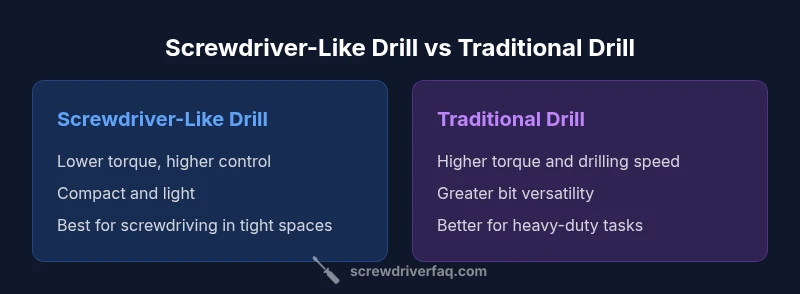
| Feature | Screwdriver-like drill | Traditional cordless drill |
|---|---|---|
| Primary use | Screwdriving with light drilling | General-purpose drilling and driving |
| Torque handling | Moderate torque suitable for fasteners | Higher torque for dense materials |
| Size and weight | Compact and lighter | Bulky and heavier in most cases |
| Chuck size | Smaller chuck for precision | Typically larger chuck for bigger bits |
| Battery and runtime | Smaller battery with efficient use | Larger battery for extended runtime |
| Best for | Screwdriving in tight spaces | General projects requiring versatility |
Pros
- Compact design enables controlled use in tight spaces
- Balanced option for light drilling and screwdriving
- Typically more affordable than specialized drills
- Easier for beginners to learn
- Reduces tool-switching during simple projects
Negatives
- Limited high-torque performance for heavy-duty drilling
- Not ideal for large holes or dense materials
- Smaller chuck may limit bit sizes
- Battery life may be shorter on demanding tasks
Screwdriver-like drills offer a balanced, beginner-friendly option for mixed screwdriving and light drilling tasks.
Choose this tool if you frequently drive screws in tight spaces and perform light drilling. A traditional drill may be better when you routinely tackle high-torce tasks or larger holes.
Quick Answers
What is a screwdriver-like drill?
A screwdriver-like drill is a compact cordless tool that centers screwdriving while offering light drilling capability. It emphasizes control, ergonomics, and ease of use for DIY tasks.
A small, handy drill that’s great for screws and light holes in wood or plastic.
When should I buy a screwdriver-like drill instead of a traditional drill?
Buy this if your projects involve frequent screwing in tight spaces and you want a single tool for light drilling as well. If you regularly drill large holes or need high torque, a traditional drill may be more suitable.
If you mostly drive screws and do light drilling, it’s a smart all-in-one choice.
Can a screwdriver-like drill handle heavy-duty drilling?
It can handle light to moderate drilling, especially in soft materials, but it is not designed for frequent, heavy-duty drilling. For dense materials or large-diameter holes, a more powerful drill is preferable.
It’s not built for heavy-duty drilling; use it for screws and light holes.
Are cordless and corded variants available?
Most screwdriver-like drills are cordless and battery-powered for portability. Corded variants exist but are less common and heavier due to the cord.
Most are cordless, which is convenient for moving around the workspace.
What should I look for when buying a screwdriver-like drill?
Look for a model with a broad torque range, comfortable grip, a reliable clutch, acceptable chuck size for your bits, and decent battery life. Accessories and warranty are also worth considering.
Pick one with flexible torque, comfy grip, and solid battery life.
Is it safe to use for masonry?
Masonry drilling is generally not ideal for screwdriver-like drills. If you must, use light chiseling or drilling with appropriate masonry bits and reduced torque to avoid tool strain and bit wear.
Not ideal for masonry; use proper bits and gentle settings if necessary.
The Essentials
- Choose compact design for tight spaces
- Match torque range to typical tasks
- Consider battery life and backup options
- Avoid overestimating light-duty models for heavy work