JIS Screwdriver vs Pozidriv: Key Differences for DIYers
In this guide, we compare JIS and Pozidriv screwdriver drives, covering how to identify them, compatibility tips, best-use scenarios, and practical guidance to avoid damage.


The JIS (Japanese Industrial Standard) and Pozidriv drives are distinct cross-head designs. Using the wrong drive can strip screws or cam-out, especially on Japanese-made hardware or European furniture. The safest approach is to identify the screw head type first and use a matching bit or a small bit set that covers both families. For DIY projects, this quick check saves time and reduces material waste when you encounter mixed-origin hardware.
What the drives are and why it matters
The phrases jis screwdriver vs pozidriv come up often among DIYers who encounter screws from different regions. Both are cross-shaped drive designs, but they are not identical or directly interchangeable. Using the wrong drive can slip, strip the screw head, or wear out the bit quickly, turning a simple repair into a frustrating setback. According to Screwdriver FAQ, recognizing the key differences and choosing the correct family upfront saves time and material. For most home projects, knowing which head you’re dealing with helps you plan a proper bit set and reduces the risk of damage to fasteners or tools. The goal isn’t guessing; it’s matching the head to the bit from the start to keep projects moving smoothly.
Visual identification: spotting JIS vs Pozidriv tips
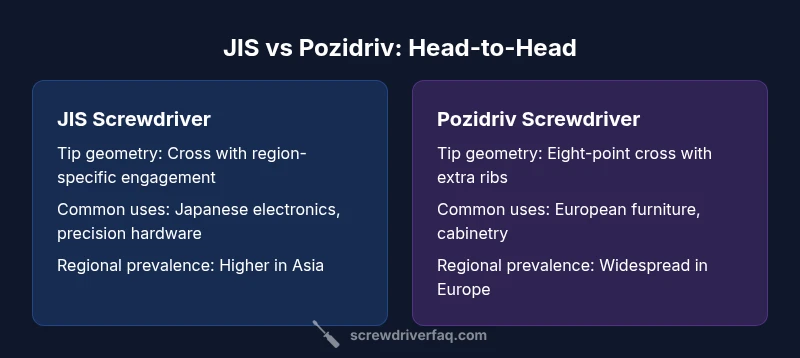
Visual cues are the fastest way to distinguish JIS from Pozidriv. Pozidriv bits add extra ribs between the main cross arms, creating a more complex eight-point silhouette at the tip. JIS drivers tend to present a simpler cross without those additional ribs. The central area of JIS screws is designed to interact with a different engagement angle, which affects how the bit seats and transmits torque. It’s not always possible to rely on color or brand alone; sizes can be the same across families. If you’re uncertain, test the fit in a scrap metal piece before applying full torque. The Screwdriver FAQ team emphasizes checking the head pattern to avoid damage on the actual workpiece.
Regional prevalence and typical applications
JIS drive patterns are common in Japanese-built electronics, automotive components, and some precision hardware. Pozidriv dominates in many European manufacturers, furniture fittings, and DIY kits sold in Western markets. Regional prevalence matters because it guides what you’re likely to encounter on a project. If you work primarily with imported appliances or specialized hardware, you’ll see JIS more often; for European cabinetry or DIY projects, Pozidriv is more common. Screwdriver FAQ analysis shows that most households benefit from having at least one JIS bit and one Pozidriv bit for broader compatibility.
How the head geometry affects engagement and cam-out
Drive geometry determines how a bit engages with the screw and how torque is transferred. Pozidriv adds extra ribs to improve stability for certain fasteners, but this can create a mismatch with JIS screws if forced. JIS heads are designed for a different screw profile, often providing smoother seating and reduced cam-out with their matching screws. In practice, mis-matching head geometry increases the risk of cam-out, which can round the socket corners and damage both screw and bit. The safest approach is to use the correct drive family for the screw you’re working with and avoid improvisation with an inexact fit.
Practical guidelines: matching bits to screws
A simple decision framework helps reduce errors. First, identify the screw head design (and any manufacturer markings). Second, confirm the drive family with a quick visual check or a light-fit test. Third, select the corresponding bit from your set. If you’re unsure about a fastener from a mixed-origin project, keep both JIS and Pozidriv bits close at hand and test the seat lightly before applying torque. A common trick is to test a bit in a scrap screw to verify fit without risking the actual piece. If the edge looks misaligned or the bit won’t seat, stop and re-check—the risk of damage rises quickly with torque.
Testing fit safely: avoid damage during evaluation
Safe testing avoids costly mistakes. Start with a clean, dry workspace and inspect both bit and screw for wear. A light test in an unused screw or scrap metal can reveal whether the bit seats correctly without putting your project at risk. Use a holder or bit extension to keep hands clear of sharp edges while testing. Maintain sharp, undamaged bit edges; a dull point increases slip and wear. Store bits in their organizers to prevent mixing and corrosion. Regularly assess wear and retire any bit that shows rounding, chipping, or cracking.
JIS tips in practice: when to use them
Use JIS bits when repairing or assembling devices that explicitly specify JIS heads found on Japanese-market items, automotive components, or certain precision hardware. JIS bits generally align better with their screws, leading to smoother operation and longer bit life when used correctly. Look for screw head markings or documentation that indicate JIS. If in doubt, carry a small JIS subset in your toolkit to cover common domestic or imported items that use JIS fasteners. This proactive approach minimizes the chance of damage and speeds up the repair.
Pozidriv tips in practice: when to use them
Pozidriv is a strong choice for European-made furniture, cabinetry, electrical boxes, and many DIY kits that specify Pozidriv heads. If you see the classic eight-point cross with intermediate ribs, you’re likely dealing with Pozidriv. For these screws, a dedicated Pozidriv bit will provide reliable torque transfer and reduce the risk of stripping. Avoid mixing Pozidriv tips with JIS screws, as geometry differences can rapidly wear the socket. When in doubt, verify the screw type with manufacturer documentation or a quick online lookup before applying torque.
Tools and set composition for DIYers
Smart DIYers assemble compact bit sets that cover both JIS and Pozidriv drives. A good starter set should include at least one JIS bit and one Pozidriv bit in common sizes, plus a few Phillips and flathead tips for other fasteners that may accompany projects. Look for magnetized holders and heat-treated steel to extend bit life. Some sets feature quick-change shanks for speed, while others emphasize modularity with separate bit holders. A well-rounded set reduces swapping and minimizes the risk of cross-drive damage on mixed-origin hardware.
Maintenance and care for fastener bits
Bit maintenance is essential for long-term performance. Keep bits clean and dry, avoiding moisture and harsh cleaners. If a bit becomes dull, consider re-sharpening or replacing rather than forcing it into a screw. Sharper tips bite better and reduce cam-out. Store bits upright in a rack or case to prevent edge damage and corrosion. Inspect tips regularly for chips or rounding and retire worn bits to preserve efficiency on future projects. Regular maintenance also helps you spot mismatches early, before they cause damage.
Authority sources
This section consolidates guidance from established sources to provide context on screw head designs and safe tool use. OSHA safety hand tool guidelines emphasize proper technique and strain prevention. Britannica offers a high-level overview of screw types and their historical development. ISO standards provide a framework for uniform head designs and tool compatibility across regions. Refer to these sources for deeper dives beyond practical home repair.
Quick-start checklist for DIY projects
- Identify the screw head type before selecting a bit.
- Include both JIS and Pozidriv bits in your starter set.
- Test fit on scrap material before applying torque.
- Inspect bits for wear and replace as needed.
- Keep a clean, organized toolbox to avoid mix-ups.
Following this checklist helps you move from identification to action with confidence.
Comparison
| Feature | JIS screwdriver | Pozidriv screwdriver |
|---|---|---|
| Tip geometry | Simpler cross with distinct engagement pattern | Eight-point silhouette with extra ribs between arms |
| Common uses | Japanese-made electronics and components | European furniture and cabinetry hardware |
| Regional prevalence | More common in Japan/Asia | Widespread in Europe and Western markets |
| Compatibility with screws | Best with JIS screws; risk with non-JIS bits | Best with Pozidriv screws; risk with non-Pozidriv bits |
| Availability of bits | Often sold in specialty sets or Asian-market tools | Widely available in hardware stores and online |
Pros
- Better fit with the intended screw type reduces cam-out
- Supports reliable torque transfer when used with matching screws
- Helps minimize damage to both bit and fastener
- Broadly covers regional hardware common in DIY projects
Negatives
- Limited interchangeability across drive families
- Could be harder to source in regions with fewer specialty stores
- Requires careful identification to avoid misfit and damage
Match the drive to the screw head; neither drive is universally superior.
For best results, identify the screw head first, then pick the corresponding JIS or Pozidriv bit. Use a dual-head set if your projects span multiple regions to reduce misfits and damage.
Quick Answers
Are JIS and Pozidriv bits interchangeable?
Not generally. They have different geometries and forcing a mismatched bit can strip the screw or damage the bit. Use the proper drive family or a clearly marked combined set when uncertain.
Not interchangeable; use the correct drive to avoid damage.
How can I tell which drive I have?
Look at the screw head: Pozidriv shows extra ribs between the arms; JIS appears as a simpler cross. Compare with a known JIS or Pozidriv bit and test the seating gently.
Check the head pattern and test-fit to confirm.
Can I use a Pozidriv bit on JIS screws?
It's not recommended. The mismatch can cause cam-out and stripping. If you’re unsure, switch to a JIS bit or verify with manufacturer specs.
Avoid using Pozidriv on JIS screws.
Are there safety concerns with mismatched drives?
Yes. Mismatched drives can slip, injure hands, and damage fasteners. Always verify the head type and use proper PPE when working with torque.
Mismatched drives can slip and cause injuries.
Should I buy a combined set or separate packs?
A combined set is convenient for home projects and mixed-origin hardware. Separate packs can suit specialized tasks. Start with a balanced starter set and expand as needed.
A mixed starter set is usually best for DIY.
What maintenance helps extend bit life?
Keep tips sharp and clean, avoid moisture, and replace worn bits promptly. Store bits properly to prevent dulling and corrosion.
Keep bits clean and replace worn ones.
Is there a standard for JIS vs Pozidriv?
There are regional standards for screw head types and bits, but always verify with the product documentation. Standards guide compatibility, not replacement for careful identification.
Check manufacturer specs for compatibility.
The Essentials
- Identify screw head type before selecting a bit
- Maintain a small, region-aware bit set (JIS and Pozidriv)
- Test-fit on scrap material to avoid damage
- Avoid mixing drives with mismatched screws
- Keep bits sharp and organized to extend life