JIS Screwdriver vs Regular: A Practical Comparison for DIYers
An analytical guide comparing the JIS screwdriver to a regular Phillips head, with use cases, maintenance tips, and buying guidance for DIYers and homeowners.


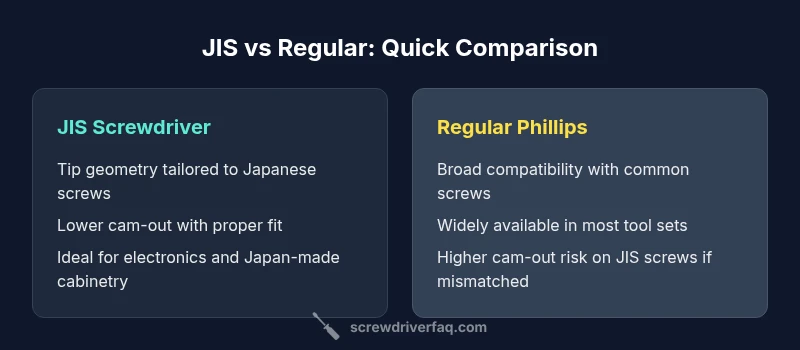
JIS screwdrivers are optimized for Japanese-style screws, featuring a cross-tip that fits their screws more precisely than a standard Phillips head. For many tasks you can use a regular Phillips, but the JIS design reduces cam-out and wear on screws used in electronics and cabinetry. In a jis screwdriver vs regular comparison, JIS offers better fit and durability, while Phillips provides broad compatibility and lower upfront cost.
What is a JIS screwdriver and why it matters
In the jis screwdriver vs regular comparison that guides many home projects, the JIS standard defines a cross-tip design used widely in Japan. Based on the JIS B1010 standard, the tip is shaped to fit Japanese screws precisely, reducing the risk of cam-out and head damage when driven with correct torque. For DIYers and homeowners, understanding this distinction matters: using the wrong tip can strip screws, damage drivers, or require rework. According to Screwdriver FAQ, the JIS design is particularly common in electronics enclosures, cabinetry in Japanese-made furniture, and consumer devices. The practical takeaway is simple: selecting the right tip matters for reliability, longevity, and overall results. In short, jis screwdriver vs regular is not just a label; it’s a performance choice that pays off in precision and durability.
##jis screwdriver vs regular: key differences
This section introduces the core distinctions between the two cross-head families, focusing on when each type shines. Tip geometry: JIS cross tips resemble Phillips but with subtly different geometry that yields a tighter, more secure fit on JIS screws; regular Phillips tips can slip or cam-out more easily on the same screws. Screw compatibility: JIS is designed for screws marked with JIS standards; Phillips heads dominate Western hardware and many consumer products. Cam-out behavior: properly matched JIS tips seat more securely, protecting screw heads; mismatched Phillips tips are prone to slipping on JIS screws. Availability: Phillips is ubiquitous in hardware stores; JIS bits are common in electronics and Japanese-oriented tool kits. The choice should reflect the screw types you encounter most; for Japanese devices, JIS is often the sensible bet.
##When to use jis screwdriver vs regular: practical scenarios
Choosing between a JIS screwdriver and a regular Phillips depends on the task at hand. If you routinely work with Japan-made electronics, cabinetry, or fasteners labeled with JIS markings, a JIS driver minimizes cam-out and head damage. For generic home repairs—shelves, furniture, or repair projects using standard Phillips screws—a regular Phillips driver offers broad compatibility, speed, and cost efficiency. In mixed environments where you encounter both Western and Asian hardware, keeping both tip types is the most efficient approach, ensuring clean, reliable fastenings and reducing the chance of damaging screws. Screwdriver FAQ notes that having a concise, dual-tip set often yields the best overall results.
Common pitfalls and how to avoid them
A frequent pitfall is using the wrong tip on a screw head, which leads to cam-out, rounded slots, and frustrated rework. Another error is assuming all cross-head screws are interchangeable; JIS and Phillips have distinct geometries that aren’t universally compatible. Avoid over-tightening, which can strip screws or warp soft materials, and always align the tip squarely with the screw slot before applying pressure. Keep tips clean and dry to prevent corrosion, and store them in labeled, organized cases so you don’t confuse JIS vs Phillips heads under time pressure. The right habits save time and protect expensive electronics casings and cabinetry.
Gear and maintenance tips for longevity
Maintaining your screwdriver set extends its life and performance. Protect tips from moisture and dust; avoid dropping bits into damp environments that accelerate corrosion. Use a magnetizer to hold fasteners briefly when needed, but don’t over-magnetize metal components that could attract ferrous debris. Keep handles clean and dry, test-fit tips on scrap screws before starting a project, and rotate through your bit collection to prevent uneven wear. A well-maintained JIS set will retain its precise geometry longer, leading to cleaner slots and fewer stripped screws over time.
How to identify authentic JIS vs fake or Western equivalents
Authentic JIS tips have distinctive geometry designed to mate with JIS screws, and many reputable sets display JIS-B1010 or equivalent markings. If a tip looks too rounded or sits loosely in a JIS screw, it may be a misfit. When possible, verify branding and markings on the packaging, and test the tip on a known JIS screw in a controlled setting. Avoid using off-brand tips on high-torque fasteners, since misfit tips can slip and damage both screw and driver. A careful visual check combined with a proper test fit is the best way to avoid disappointment.
Budget and value considerations: cost vs performance
Budgeting for a jis screwdriver vs regular involves weighing upfront cost against long-term value. Basic sets that cover common Phillips and a few JIS tips tend to be affordable, while comprehensive, high-quality dual-tip sets cost more but deliver better durability and fewer replacements. If your projects are infrequent or involve mostly Western hardware, a mid-range Phillips set may be the most economical choice. If you frequently repair Japanese devices or work on electronics, investing in a solid JIS set pays off through reduced tool wear and faster, cleaner work.
Practical testing: how to verify fit on typical screws
A practical test procedure helps confirm you’re using the right tip. Take a scrap screw of a known type (JIS or Phillips) and try seating the bit—notice how snugly it fits and whether the head seats squarely without wobble. If the tool slips easily or the head rounds, switch to the correctly marked JIS or Phillips tip. For electronics or cabinetry projects, always perform a dry-fit before applying torque; a proper fit prevents damage and ensures a reliable hold after tightening.
Comparison
| Feature | JIS screwdriver | Regular Phillips screwdriver |
|---|---|---|
| Tip geometry | Deeper, slightly narrower cross for JIS screws | Classic Phillips cross with standard geometry |
| Screw compatibility | Optimized for JIS-marked screws | Designed for broad Western hardware |
| Cam-out tendency | Lower cam-out risk when matched to JIS screws | Higher cam-out risk on JIS screws if misfit |
| Best applications | Electronics, Japanese cabinetry, precision hardware | General household use and Western hardware |
| Availability | Common in electronics/tool kits emphasizing JIS | Widely available in standard hardware stores |
| Durability | Improved wear resistance on compatible screws | Good durability on common screws with proper use |
| Price/value | Typically higher in specialty sets | Usually lower and highly versatile |
Pros
- Improved fit and reduced cam-out on JIS screws
- Better longevity when predominantly working with Japanese hardware
- Maintains precision in electronics and cabinetry work
- Dual-tip sets improve versatility for mixed environments
Negatives
- Not always compatible with non-JIS screws
- Specialty JIS sets can be pricier than basic Phillips kits
- Availability may be more limited outside electronics-orientated retailers
JIS screwdrivers are the preferred choice for Japanese screws and electronics; regular Phillips remains a versatile fallback for mixed tasks.
If you frequently encounter Japanese hardware, choose JIS for accuracy and durability. For general home projects, Phillips offers broad compatibility and lower upfront cost. Keeping both in a compact kit minimizes downtime and tool damage.
Quick Answers
What is the difference between a JIS screwdriver and a regular Phillips screwdriver?
JIS screwdrivers use a cross-tip geometry optimized for Japanese screws, offering a tighter fit and less cam-out than typical Phillips heads when matched to the correct screws. Regular Phillips heads are more common and work across many fasteners, but can slip on JIS screws if misused. The choice depends on the screw type you encounter most often.
JIS tips are designed for Japanese screws and resist cam-out better when matched to the right screws. Phillips is versatile but can slip on JIS screws if misused.
Can I use a JIS screwdriver on standard Phillips screws?
Using a JIS tip on Phillips screws is not ideal. While a JIS tip might fit, it can damage the screw head or the driver. For best results, use the corresponding tip style to the screw.
It's best to use the matching tip to avoid damage; JIS on Phillips is not recommended.
When should I choose JIS over regular Phillips?
Choose JIS when working with Japanese screws or electronics that specify JIS standards. Opt for Phillips when dealing with a wide mix of Western hardware or when a quick, broadly compatible solution is needed.
Pick JIS for Japanese screws and electronics, Phillips for broad, everyday use.
Are JIS screwdrivers available in sets?
Yes, you can find JIS-specific bits in tool sets designed for electronics or Japanese hardware. Many general tool sets also include a small JIS subset. Look for labeling that explicitly mentions JIS or B1010 compatibility.
You can find JIS bits in electronics-focused sets or hardware stores; look for JIS labeling.
How can I identify an authentic JIS tip?
Authentic JIS tips usually bear clear markings such as JIS or B1010 on the blade or packaging. Compare tip geometry with known JIS cross shapes and test fit on a JIS screw to verify alignment.
Check for JIS markings and test fit on a known JIS screw to confirm authenticity.
What safety considerations exist when using JIS vs regular?
Always ensure the tip is square to the screw and the grip is secure before applying torque. Use eye protection and avoid forcing a misfit tip, which can slip and cause injury or damage.
Make sure the tip fits squarely, hold steady, and protect your eyes when driving screws.
How should I care for my JIS screwdriver set?
Keep tips clean and dry, store in labeled cases, and avoid exposing them to moisture. Periodically inspect for wear and rotate through bits to prevent uneven wear.
Clean and dry tips, store properly, and inspect for wear regularly.
Is there a difference in torque between JIS and Phillips screws?
Torque behavior depends on the screw and tool fit. A properly matched JIS tip can offer smoother driving with controlled torque on JIS screws, while Phillips screws rely on the driver’s fit to achieve the desired torque without cam-out.
Torque relief depends on the proper tip; JIS helps with controlled driving on its screws.
The Essentials
- Prefer JIS for Japanese screws to minimize cam-out
- Keep Phillips for broad compatibility in mixed tasks
- Always verify tip-to-screw matching before driving
- Invest in a dual-tip set to cover most scenarios