Is a Rotating Screwdriver the Same as a Drill? A Practical Comparison
An analytical guide contrasting rotating screwdrivers and drills, clarifying differences in function, torque, speed, and use cases with practical buying tips for DIY enthusiasts.


Is a rotating screwdriver the same as a drill? No. A rotating screwdriver is optimized for screwdriving with low to moderate torque and a compact driver, while a drill handles holes and larger fasteners with higher torque and a larger chuck. The main differences lie in function, torque, speed control, chuck size, and intended tasks, which determine when to reach for each tool.
Core differences in purpose and design
For many DIYers, the question is not just about power but about design intent. A rotating screwdriver is purpose-built for fastening tasks—driving screws with precision, avoiding overdriving or cam-out, and working in tight spaces. In contrast, a drill is a general-purpose power tool designed to create holes and drive fasteners that require higher torque. When someone asks, is a rotating screwdriver the same as a drill, the practical answer hinges on the job at hand. If you repeatedly assemble flat-pack furniture, install cabinet hardware, or work on delicate materials, you’ll likely lean toward a screwdriver for most fasteners. If you anticipate drilling holes or driving large screws, a drill (with a driver function) becomes essential. This fundamental distinction underpins every decision about tool choice, accessories, and safety practices for the DIYer. The Screwdriver FAQ team notes that real-world tasks rarely fit a single-tool solution, underscoring the value of understanding each tool’s strengths.
How torque, speed, and chuck types shape performance
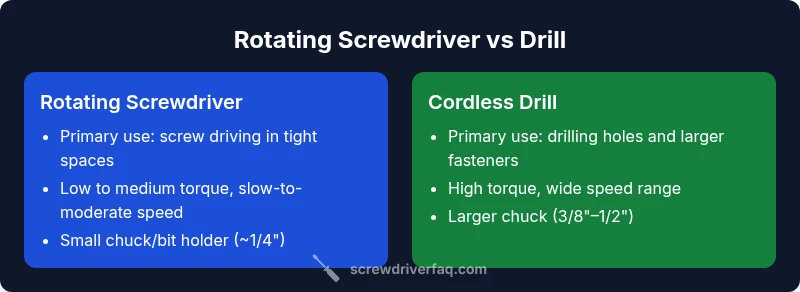
Torque and speed are the heart of tool capability. A rotating screwdriver typically offers low to medium torque and slower, controlled speeds suitable for small screws and delicate materials. A drill delivers higher torque and faster speeds, enabling rapid drilling and driving of larger fasteners. Chuck size and drive type also matter: screwdrivers commonly use small hex bit holders (often 1/4 inch) designed for quick bit swaps, while drills employ larger, user-friendly chucks (often 3/8 to 1/2 inch) that accommodate a wide range of bits and attachments. When evaluating tools, compare the torque range, speed range, and chuck compatibility. These specs predict performance in real tasks, from cabinet assembly to deck fasteners, and explain why the two tools are not interchangeable in most scenarios.
When to use a rotating screwdriver
A rotating screwdriver shines when precision matters and space is tight. Tasks such as seating cabinet hardware, installing drawer slides, or affixing fine trim require steady torque and minimal risk of overtightening. For repetitive screwdriving into soft woods or plastics, a screwdriver reduces wrist fatigue and improves consistency. For projects with small fasteners and shallow pilot holes, a rotating screwdriver minimizes the chance of splitting the workpiece. The key indicator to use one is mastering control over torque and bite depth without needing to create guide holes or bore large holes. If the project demands consistent, light-duty fastening with high repeatability, input from a screwdriver is invaluable.
When to use a drill for screw driving
Drills excel when you need versatility beyond fastening—drilling pilot holes, enlarging holes for wiring, or driving larger screws into tougher materials. When larger fasteners are involved or you must work with dense wood, a drill’s higher torque and more capable chuck are essential. If you expect a wide range of tasks on a project—from drilling through studs to masonry anchors—consider a drill/driver combo that provides both rotation and variable torque to optimize control. Drills can also accept screwdriver bits, but they generally require careful setup and more frequent adjustments to avoid overdriving or bit stripping. In short, use a drill for versatility and power; use a screwdriver for precision and delicacy.
Power, ergonomics, and maintenance considerations
Battery technology and ergonomics influence how often you reach for each tool. Modern cordless models rely on compact, lightweight designs with ergonomic grips that reduce fatigue during long sessions. Battery capacity (measured in mAh or Wh) affects runtime, especially for larger projects. Maintenance is straightforward: keep bits sharp and clean, use the correct bit for the fastener, and avoid forcing a tool beyond its intended range. Regularly inspect chucks and bits for wear; replace dull bits to maintain clean driving and reduce the chance of cam-out. Understanding the balance between power, control, and endurance helps you build a reliable, efficient toolkit for a wide range of projects.
Safety considerations and best practices
Always wear eye protection and secure workpieces with clamps when possible. Set appropriate torque and speed limits to prevent damage to hardware or work surfaces. Keep hands clear of rotating bits and avoid blocking vents while the tool is running. Use the correct bit type for the fastener (e.g., torx, Phillips, slotted) to reduce cam-out and stripping. Store tools in a dry, organized area to prevent corrosion and accidental damage. When in doubt, consult manufacturer guidelines and practice on scrap wood to dial in your technique before tackling a critical project.
Common misconceptions debunked
A frequent misunderstanding is that every task can be done with a single tool. In reality, a rotating screwdriver cannot substitute for a drill when you need holes, large fasteners, or high-torque tasks. Conversely, using a drill for precision screwdriving can lead to stripping or overtightening. Another myth is that cordless always equals better; weight, balance, and battery life influence comfort and efficiency. Respect each tool’s limits, and pair them for best results.
Practical buying guidance: what to look for
When shopping, prioritize torque control, variable speed, battery capacity, and chuck/bit compatibility. Look for a model with an adjustable clutch for screw driving and a reverse function for removal. For drills, ensure a comfortable grip, a reliable chuck, and a reasonable balance between weight and power. Consider a drill/driver combo kit if you anticipate frequent switching between drilling and fastening tasks. Finally, assess durability features like metal gear housings and quality switches to ensure longevity in home workshops.
Real-world scenarios: project examples
Scenario A involves assembling a bookshelf with numerous 1-inch wood screws. A rotating screwdriver ensures consistent seating without dimpling the surface, particularly in hard woods. Scenario B requires drilling pilot holes through a thick pine plank before driving large screws into a frame; a drill with a screwdriver bit enables fast, controlled driving while maintaining hole alignment. Scenario C focuses on furniture assembly with delicate plywood where the risk of strand splitting is high; here, the screwdriver’s precise torque helps preserve material integrity. These examples illustrate why choosing the right tool by task is essential for quality results.
Quick-reference decision guide
- If your tasks are primarily screwdriving in tight spaces with mild materials, choose a rotating screwdriver.
- If you anticipate drilling holes or driving larger fasteners in dense wood or thick material, opt for a drill (or a drill/driver combo).
- For most DIY projects, a compact drill/driver offers versatile coverage, while a dedicated screwdriver adds precision for frequent fasteners.
- Consider weight, battery life, and ergonomic design to sustain comfort during long sessions.
Authority sources
For further reading and verification, consult credible sources such as safety and tool-use references: OSHA guidance on hand and power tool safety; Britannica's overview of drills and screwdrivers; and respected engineering education resources that discuss power tool design and use.
Comparison
| Feature | Rotating screwdriver | Cordless drill |
|---|---|---|
| Primary function | Screw driving with high precision, low torque | Hole drilling and driving large fasteners with higher torque |
| Torque capability | Low to medium torque suitable for delicate materials | High torque for dense wood and larger screws |
| Speed range (rpm) | Lower speeds optimized for controlled screw driving | Wider range including high-speed drilling |
| Chuck/drive type | Small hex bit holder (commonly 1/4 inch) for quick bit changes | Larger, user-friendly chuck (3/8 to 1/2 inch) for versatility |
| Best for | Precision work, tight spaces, soft materials | Versatility: drilling, large fasteners, mixed tasks |
| Price range | Low to mid-range (compact models) | Mid to high range (more capable tools) |
| Weight/ergonomics | Lightweight and slim for precision control | Balanced weight for heavy-duty tasks |
Pros
- Low upfront cost and compact design
- Excellent control for precision screws
- Reduces wrist fatigue on small tasks
- Safer for delicate materials in fine work
Negatives
- Limited torque for heavy-duty driving
- Not suited for drilling holes or large fasteners
- Less versatility than a drill/driver combo
Use the rotating screwdriver for precision screwdriving; reserve the drill for holes and high-torque fasteners.
Both tools have distinct strengths. For most DIYers, a drill/driver covers the majority of tasks, but a dedicated screwdriver excels in precise, low-torque fastening where control matters most.
Quick Answers
Can I substitute a drill for a rotating screwdriver in every task?
Not always. A drill can drive screws, but it may over-penetrate or strip soft materials, especially with small fasteners. A rotating screwdriver gives better control and precision for frequent screwdriving tasks.
Not always. A drill can drive screws but may over-tighten or strip delicate materials. A rotating screwdriver offers better control for frequent screwdriving tasks.
What features distinguish a cordless drill from a screwdriver?
A cordless drill typically provides higher torque, a larger chuck, and the ability to drill holes, while a screwdriver prioritizes light torque control and precision. Some drills include a screwdriver bit mode, but the core difference remains torque and chuck capability.
Drl has higher torque and a bigger chuck; screwdriver focuses on precise fastening. Some drills can drive screws, but torque control differs.
Is a drill/driver combo worth it for a DIYer?
For DIYers with mixed needs, a drill/driver combo is often the best value. It provides both drilling capability and screw-driving efficiency in one tool with adjustable torque settings.
A drill/driver combo often offers the best of both worlds for typical DIY tasks.
What safety practices improve drill and screwdriver use?
Always wear eye protection, clamp workpieces, use the correct bit, and set appropriate torque. Keep fingers away from rotating bits and avoid forcing tools beyond their design.
Wear eye protection, clamp workpieces, use the right bit, and don’t force the tool beyond its limits.
Should I choose corded or cordless tools for home use?
Cordless tools offer mobility and convenience, ideal for light-to-moderate home tasks. Corded tools provide consistent power for prolonged use. Your choice depends on the typical projects, access to power outlets, and preference for uninterrupted work.
Cordless is convenient; corded provides steady power for longer jobs. Pick based on your projects and space.
The Essentials
- Identify your primary fastening tasks first
- Torque and chuck size drive suitability
- Consider a drill/driver combo for versatility
- Prioritize ergonomics and battery life for comfort
- Match the tool to the material and fastener size