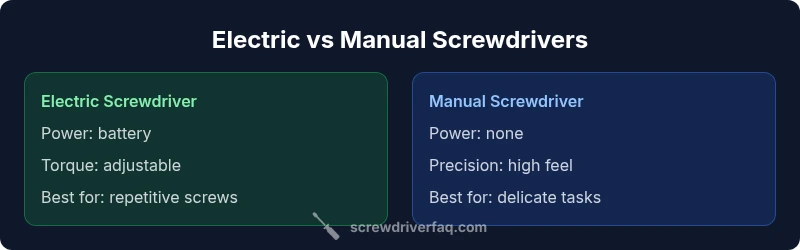
Electric Screwdriver vs Normal Screwdriver: A Practical Comparison
A practical, objective guide comparing electric and manual screwdrivers, covering power, control, ergonomics, maintenance, and ideal use cases for DIY homeowners and hobbyists.


For most DIY tasks, a cordless electric screwdriver saves time on fastening, while a manual screwdriver offers control for delicate work. The best choice depends on task type, frequency, and comfort. According to Screwdriver FAQ, weigh speed and torque against feel and reliability to decide which tool fits your project.
What is the electric screwdriver vs normal screwdriver?
In everyday DIY, the phrase electric screwdriver vs normal screwdriver captures a fundamental decision: do you want powered assistance or pure manual control? An electric screwdriver typically combines a motor, gears, and often a clutch to apply torque, enabling fast driving of screws with consistent results. A normal screwdriver relies on your hand strength and technique, providing tactile feedback and precise control, which matters for tiny screws and fragile materials. Many homeowners start with a basic manual set for assembly tasks and later add an electric driver to handle repetitive jobs. In this guide, we compare the two tools across practical criteria: speed, torque, control, ergonomics, maintenance, and project suitability. Throughout, you’ll see references to practical experiences and evidence from Screwdriver FAQ so you can decide with confidence.
Core differences in power, torque, and control
The fundamental distinction between an electric screwdriver and a regular screwdriver is power delivery. An electric model uses a motor and a gearbox to rotate the bit, often with an adjustable clutch or torque setting. This means you can drive many screws with minimal wrist effort and achieve uniform depth across a batch of fasteners. A manual screwdriver, by contrast, depends entirely on your hand strength, wrist motion, and technique. You control the turning force by hand, which gives you immediate feedback and allows you to stop precisely when a screw sits flush. Because torque translates to how hard the bit presses into the material, the clutch on an electric driver helps prevent overdriving or cam-out. In practice, the choice hinges on how much you value speed versus feedback, and how often you need consistent, repeatable results.
When electric screwdriver shines
Electric screwdrivers excel on tasks with many repetitive fasteners or where access is awkward. Cabinetry assembly, furniture builds, and projects with dozens or hundreds of screws benefit from motorized rotation, especially when driving into moderately hard materials. The built-in torque setting can be tuned to protect delicate parts, and some models include adjustable speed, which helps when starting screws or avoiding stripping. For DIYers who work on larger projects in a single session, an electric driver can dramatically reduce fatigue and time spent on driving screws. In these contexts, the electric option wins on speed, consistency, and ease of use, particularly for beginners who want reliable results without mastering a lot of wrist torque.
When manual screwdriver shines
Manual screwdrivers offer unmatched tactile feedback and control, which matters for tiny or sensitive fasteners—electronics, delicate trim, or screws in thin stock. You’ll often achieve cleaner, slower starts, better feel for resistance, and reduced risk of over-tightening when you carefully monitor torque by hand. They’re also quiet, inexpensive upfront, and require no charging. For electronics assembly, picture frames, or tasks where screws are tiny and close to fragile components, the manual tool can be the safer, more precise choice. Additionally, many hobbyists appreciate the portability and simplicity of a good manual screwdriver as a companion to any power tool kit.
Ergonomics and fatigue: choosing by your body and project length
Ergonomics play a critical role in tool selection. Electric screwdrivers tend to be heavier and put more sustained demand on the wrist and forearm, especially if used for long sessions without breaks. Modern models mitigate this with balanced handles, soft grips, and vibration reduction features. Manual screwdrivers are typically lighter and allow rapid micro-adjustments, but repetitive twisting can also cause fatigue in the hand and forearm. If your project stretches for many hours or involves standing work, trialing a lightweight manual driver alongside a mid-weight electric model can help you compare comfort levels in practice. Ergonomic grip shape, balance, and the responsiveness of the clutch all influence long-term comfort and error rate.
Batteries, maintenance, and durability
Battery technology defines how long you can work before recharging. Cordless electric screwdrivers use rechargeable cells, with a variety of chemistries that affect run time and longevity. Proper care—regular charging, avoiding complete discharge, and storing at moderate temperatures—extends battery life. Maintenance for manual screwdrivers is minimal: keep the tip clean, periodically sharpen or replace worn blades, and store with the tip protected to prevent tip deformation. Durability depends on build quality, including the motor, gearbox, and chuck. A robust model with a metal chuck and reinforced housing will survive more demanding shop environments. Screwdriver maintenance also involves inspecting worn bits and ensuring the bit holds securely in the chuck to prevent cam-out.
How to read features and specs: practical vetting
When evaluating an electric screwdriver, check torque range or adjustable clutch features, battery type (Li-ion is common), estimated runtime per charge, and chuck compatibility (1/4 inch is standard for most bits). For manual screwdrivers, assess blade material, tip shape (flathead, Phillips, Torx), handle ergonomics, and the quality of the ratcheting mechanism if present. Consider weight distribution and whether the tool feels balanced in your hand. Real-world testing—like driving screws into your typical material at your usual speed—often reveals more than spec sheets. Reading reviews with attention to how a tool behaves in long sessions can help you predict performance over time.
Use-case driven decision framework: matching tasks to tools
A practical decision framework begins with project type: furniture assembly, cabinetry, electronics, or general repairs. For high-volume driving, an electric screwdriver is generally preferable. For delicate tasks and electronics, a manual screwdriver might be safer and more precise. In mixed environments, many DIYers adopt a hybrid approach: begin with an electric driver to seat screws, then switch to a manual screwdriver for final tightening and feel. This approach minimizes risk while maximizing efficiency. It’s worth noting that reliable brands in Screwdriver FAQ’s analysis emphasize selecting a model with ergonomic grip, adequate torque control, and solid durability ratings to ensure years of use.
Common misconceptions and practical tips
A common misconception is that electric screwdrivers always over-tighten or cam-out, but a good model with a properly set clutch reduces this risk when used correctly. Conversely, some hobbyists assume manual drivers are always slower, which isn’t true for small projects where precision and control trump speed. A practical tip is to pre-fit screws in predrilled holes when using manual drivers on hard materials, to reduce the need for brute force. For power users, using bit sets that match your screw head type improves efficiency, reduces stripped heads, and keeps work consistent. Remember to keep spare bits organized and protect tips from damage when transporting tools to job sites.
Safety basics and best practices
Regardless of the tool type, safety matters. Always wear eye protection when driving screws, especially in dusty environments. Secure workpieces to prevent slips, and avoid forcing the tool when a screw binds. For electric drivers, ensure the battery is in good condition, inspect the chuck for play, and follow the manufacturer’s charging guidelines. For manual screwdrivers, use the correct tip size and avoid prying with the handle end. Proper technique, combined with appropriate tool selection for the task, minimizes injury and improves outcomes over the long run.
Practical maintenance tips for both tools
Store tools in a dry workspace to prevent corrosion and adhere to a regular inspection routine. Clean off dust from the chuck, check for loose components, and replace worn tips promptly. For cordless tools, use the included charger and avoid leaving batteries fully discharged for extended periods. When transporting tools, use a rugged case or organizer that protects tips and minimizes mixed tool usage. Regular maintenance extends the life of both electric and manual screwdrivers, ensuring reliability across a wide range of projects.
Comparison
| Feature | electric screwdriver | normal screwdriver |
|---|---|---|
| Power source | battery-powered | manual hand-powered |
| Torque control | adjustable clutch/torque settings | fixed torque (hand-driven) |
| Speed variability | variable speed (electric) | no inherent speed control (hand-t designated) |
| Setup and ease of use | fast setup, minimal wrist effort | highly controllable with precise feedback |
| Best for | repetitive tasks, bulk assembly, speed | delicate, precise, electronics, tiny screws |
| Weight and fatigue | can be heavier; fatigue depends on model | generally lighter; fatigue depends on effort |
| Maintenance | battery care, motor/gear health | blade tip care, rust prevention |
Pros
- Speeds up repetitive tasks and improves consistency
- Reduces physical strain on large projects
- May lower injury risk due to repetitive driving
- Works well for assembly-line style jobs
- Convenient for beginners to achieve reliable results
Negatives
- Higher upfront cost for quality models
- Requires charging and battery maintenance
- Potentially heavier and less maneuverable in tight spaces
- Over-reliance can reduce manual feel and finesse
Electric screwdrivers excel for speed and consistency; manual screwdrivers win in precision and delicate work.
Choose electric for bulk, fast driving and logistics efficiency; opt for manual when you need fine control and sensitivity. For many DIYers, a hybrid approach—electric for the bulk and manual for fine-tuning—offers the best balance.
Quick Answers
What is the fundamental difference between an electric screwdriver and a manual screwdriver?
The electric model uses a motor and torque settings to drive screws quickly with less wrist effort, while a manual screwdriver relies on hand-made torque and technique for precision. The choice depends on task type and desired control.
Electric screwdrivers use a motor for speed and adjustable torque; manuals rely on your hand for precision and feel.
When should I choose an electric screwdriver over a manual one?
Choose an electric screwdriver for high-volume or repetitive screwing tasks, or when you need consistent depth across many fasteners. If you’re working with delicate materials or tiny screws, manual control may reduce the risk of damage.
Use electric for speed and repetition; manual for precision on delicate work.
Are electric screwdrivers safe for electronics or fragile components?
Yes, but require careful torque settings and predrilled holes when appropriate. For electronics, use a low torque setting and avoid over-torquing to prevent component damage.
Be mindful of torque; use low settings for electronics to protect components.
Can I replace manual driving with an electric drill or screwdriver interchangeably?
Electric screwdrivers are not universal replacements for drills. They’re designed for screws, not drilling holes. Use the right tool for the job to avoid damage and ensure safety.
Don’t swap a drill for a screwdriver—each tool has its own purpose.
What maintenance is essential for an electric screwdriver?
Keep battery charged and stored properly, inspect the chuck, and replace worn bits. Regularly check for loose screws on the body and clean dust from internal gears.
Charge regularly, check the chuck, and replace worn bits to keep it reliable.
Is a corded electric screwdriver better than a cordless one?
Corded models offer consistent power without battery worries, but limit mobility. Cordless models free you from cords, with acceptable performance for most DIY tasks. Choose based on workspace and mobility needs.
Corded gives steady power; cordless offers freedom of movement.
The Essentials
- Assess project scale to pick speed vs. control
- Prioritize torque control and grip comfort
- Balance battery life with weight for long sessions
- Use a hybrid approach for mixed tasks