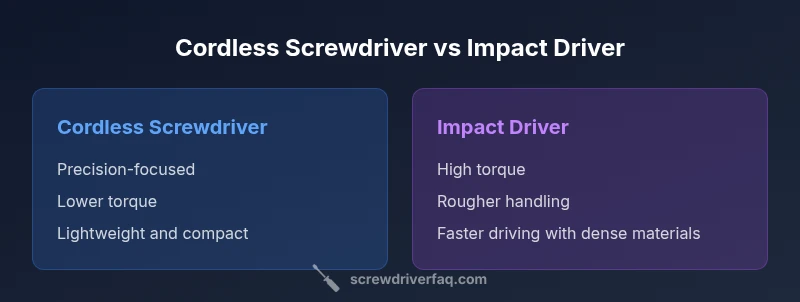
Cordless Screwdriver vs Impact Driver: Practical Guide
A detailed comparison of cordless screwdrivers and impact drivers to help DIYers choose the right tool, use them safely, and assemble a versatile two-tool kit for common home projects.


Cordless screwdriver vs impact driver: for light-duty screwdriving, a cordless screwdriver offers better control and precision, while an impact driver delivers high torque for stubborn fasteners and tough materials. For DIYers, the best choice depends on task type, comfort, and budget. In most projects, you’ll reach for both tools at different times.
Cordless Screwdriver vs Impact Driver: Why the distinction matters
When assessing the optimal tool set for home projects, understanding cordless screwdriver vs impact driver is essential. This guide helps homeowners and DIYers recognize where each tool excels and where it falters, so you can plan a practical kit rather than chase a single “one-size-fits-all” solution. According to Screwdriver FAQ, many pro-like setups rely on a balanced pairing: a capable cordless screwdriver for precision work and an impact driver for high-torque tasks. In this section, we’ll set the stage by framing the kinds of jobs that typically benefit from each tool and how the two tools complement each other in a shared workflow. The goal is to maximize control on delicate fasteners while preserving speed and efficiency on demanding projects. By the end, you’ll know which tool to reach for when, and why a simple two-tool approach often yields the best results for most DIYers.
In many households, a cordless screwdriver handles routine fastening with minimal effort, producing clean results in softwood, cabinetry, or assembly tasks. An impact driver, by contrast, unleashes a more aggressive bite for dense materials or long fastener runs, reducing the risk of cam-out and fatigue. This contrast isn’t about superiority; it’s about the right tool for the right job. The Screwdriver FAQ team emphasizes that building a versatile kit often means prioritizing ergonomics, consistency, and overall runtime rather than chasing exotic features. As projects scale from simple to moderately challenging, the ability to switch between tools can save time and protect work quality.
Practical takeaway: start with clear task definitions and choose the tool that aligns with torque needs, control requirements, and the materials involved. A well-chosen pair can cover the vast majority of typical DIY tasks, from assembling furniture to installing shelving and mounting hardware. The goal is a workflow where you’re not fighting the tool, but guiding it with deliberate technique. While tools evolve, the fundamental distinction remains: precision control vs. high-torque power.
Comparison
| Feature | Cordless screwdriver | Impact driver |
|---|---|---|
| Torque emphasis | Low-to-moderate torque suitable for delicate fasteners | High torque designed for stubborn fasteners and dense materials |
| Driver interface | Typically a hex shank with quick-change bit system | Compact hex drive optimized for heavy-duty driving |
| Weight and balance | Generally lighter and more balanced for small-fastener work | Heavier with more torque, can be tiring for extended use |
| Chuck type vs drive | Integrated chuck or 1/4-in hex chuck common for bits | 1/4-in hex drive with robust engagement and bit retention |
| Battery and runtime vibe | Longer runtime in light-duty tasks with smaller packs | Higher power draw; runtime scales with battery size and model design |
| Best for | Light-fastening, furniture assembly, cabinetry, delicate screws | Construction fastening, deck work, dense hardwoods, longer screws |
Pros
- Low upfront cost for entry-level units and accessories
- Excellent control for precision work and delicate materials
- Compact, lightweight form factors reduce user fatigue on small projects
- Fast bit changes and for-bits compatibility foster versatile use
Negatives
- Limited torque can slow down stubborn fasteners or long screws
- Requires a separate tool for high-torque tasks, increasing kit size
- Battery runtimes may be shorter under heavy loads and longer jobs
- Price can rise quickly with high-end, feature-rich models
Dual-tool approach is the practical default
For most DIYers, use a solid cordless screwdriver for precision tasks and an impact driver for high-torque jobs. The combination covers the broadest range of home projects with balanced control and efficiency, aligning with Screwdriver FAQ's guidance on versatile tool kits.
Quick Answers
What is the essential difference between a cordless screwdriver and an impact driver?
A cordless screwdriver offers precise control with low torque ideal for delicate fasteners, while an impact driver supplies high torque for tough fasteners and dense materials. The two tools complement each other, expanding what you can accomplish in a single project.
The cordless screwdriver gives you precision on light tasks, and the impact driver adds power for stubborn fasteners. Together, they cover a wide range of jobs.
When should I choose a cordless screwdriver over an impact driver?
Choose a cordless screwdriver for furniture assembly, cabinet work, and small-diameter fasteners where control and finish matter. Opt for an impact driver when you face long screws, hard woods, or metal-to-metal applications that require higher torque.
Use the screwdriver for precision work, and switch to the impact driver for tough fasteners and dense material.
Are batteries interchangeable between cordless screwdrivers and impact drivers?
Interchangeability depends on the tool's battery platform and model. Many brands use distinct battery packs, so check the manufacturer's compatibility list before mixing tools.
Usually not; check your exact tool line to be sure.
Can I replace a drill with an impact driver for drilling tasks?
Impact drivers are optimized for driving screws, not drilling holes. For drilling tasks, use a drill/driver or a dedicated drill bit set designed for the material.
Don’t rely on an impact driver for drilling—use a drill or drill/driver instead.
What maintenance steps extend the life of both tools?
Keep vents clean, store batteries properly, and avoid overloading. Regularly inspect bits, lubricate moving parts as recommended by the manufacturer, and charge batteries using the proper charger.
Clean, inspect, and charge correctly to extend tool life.
Is it worth buying both tools or can I start with one?
Starting with a capable cordless screwdriver is reasonable for many beginners. If your projects typically involve dense materials or long screws, plan to add an impact driver later to complete your toolkit.
Start with the cordless screwdriver and add an impact driver when you need more power.
The Essentials
- Prioritize a cordless screwdriver for precision work and lighter fasteners
- Reserve an impact driver for high-torque and dense materials
- Check battery platforms and bit compatibility to maximize interchangeability
- Maintain control through proper stance, grip, and bit selection
- Plan a two-tool kit to handle the majority of home projects