Broken Screwdriver Tip: Quick Troubleshooting Guide
Urgent troubleshooting guide to diagnose and fix a broken screwdriver tip. Learn safe interim fixes, when to replace, and how to prevent future tip damage with clear steps and practical tips.


A broken screwdriver tip is typically the result of over-torque or forced fits. Start by inspecting the blade and the slot, then switch to a replacement or repair if the tip is bent or snapped. Here’s a quick, 3-step approach to stabilize the job and prevent further damage. Keep safety gloves handy and avoid stubborn attempts.
What a broken screwdriver tip means
According to Screwdriver FAQ, a broken screwdriver tip is usually a sign that the tool has endured more stress than its design can handle. When the tip cracks, bends, or shears off, it compromises grip and slot fit, increasing the risk of cam-out, slipping, and stripped screws. The problem isn’t just a dull edge; it’s a damaged interface between the blade and the screw. In many DIY jobs, users push past the point of failure thinking a little extra pressure will do the trick, but that mindset accelerates wear. Understanding the basics helps you decide whether to repair, replace, or retire the tool. In this guide, you’ll learn quick checks, safe practices, and practical routes to restore reliability while keeping you out of harm’s way.
Common causes of tip damage
Tip damage happens for a few predictable reasons. The most frequent one is applying excessive torque with a poorly matched bit to a screw head, especially when the head is corroded or damaged. Using the wrong tip profile for the screw type also causes stress concentrations that fracture the metal. Accidental drops onto hard surfaces, accumulated tool fatigue, and cheap manufacturing are other culprits. Over time, repeated micro-mistakes compound into a broken tip that fails under normal operating force. Screwdriver FAQ analysis shows that many incidents could be avoided with proper bit selection and gentler, targeted turning.
Immediate safety and stopping rules
When you notice a tip fracture, stop immediately. A compromised tip can slip or break further, injuring fingers or marring the workpiece. Disconnect power tools and remove the bit from the driver before inspecting. Work in a clean, well-lit area with safety glasses and gloves. Do not force the tool to complete a stubborn fastener. If a bit is stuck or the screw head is significantly damaged, move to a replacement or dedicated extraction tool rather than prying forcefully. Prioritizing safety reduces the risk of injury and costly damage to the workpiece.
Assessing whether to repair or replace
Assessing the decision requires looking at the extent of the damage and the task at hand. A minor cosmetic chip or slight bend might be tolerable for light-duty work, but any significant deformation typically warrants replacement. If the tip no longer seats cleanly in the screw slot, or if it shows visible cracks, replacing the tip or entire driver is wiser. Repair options exist for certain tip profiles, but they require careful, controlled filing or reshaping that can alter rigidity or fit. When in doubt, err on the side of safety and tool integrity by choosing replacement.
Repair options (if feasible)
If the damage is limited to a small chip or slight bending, you can attempt conservative repair. Light filing with a fine rasp or stone to restore the broad, flat contact surface may help regain some grip. For magnetic tips, ensuring the magnet is still aligned with the shank can improve retention and reduce slipping. However, repairs are only provisional and should be tested on a scrap screw first. Avoid aggressive reshaping that destroys the original geometry of the tip, as this can create uneven contact and cam-out.
Choosing the right replacement tip or driver
When replacement is needed, match the tip geometry to the screw head type: Phillips, flathead, Torx, Robertson, or others. Verify the bit size accompanies the driver’s collet so it seats securely. If you frequently encounter varied fasteners, consider a screwdriver set that includes multiple tip profiles and a magnetic tip option for easier alignment. Insulated or ESd-rated options are worth it for electrical tasks; ensure the replacement meets the tool's torque rating and the screw material.
Tools and prep for the fix
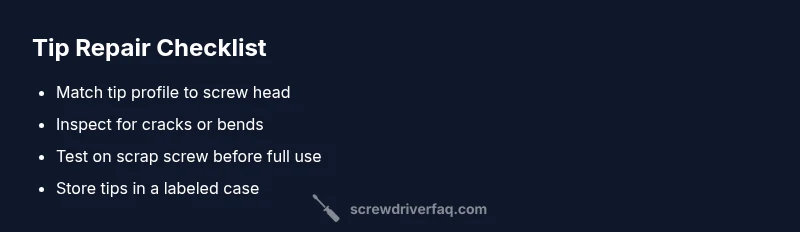
Gather a quiet workspace, safety glasses, gloves, a small file or precision stone, and a scrap wood block for testing. Have replacement tips in the correct profiles on hand. Clean any debris from the fastener head and tip so the new or repaired tip can seat firmly. If you’re using a file or reshaping tool, work slowly and check fit frequently. Label your tools and sort tips by type to prevent confusion during future projects.
Quick diagnostic tests you can run on-site
Test the tip by attempting a few light turns on an unused, fresh screw in a scrap piece of wood. The tip should seat snugly and apply consistent torque without slipping. If the screw cam-outs or the tip slides, replace the bit. For magnetic tips, check the magnet’s hold by placing the tip near a metal surface and testing retention. If you’re using an impact-rated driver, ensure the bit remains secure after initial test turns. Any wobble or looseness signals replacement is needed.
Preventing future tip damage
Preventive habits save time and money. Use the correct tip for the screw head and avoid forcing a fit. Apply steady, even pressure, and let the tool do the work rather than pushing hard with your wrist. Keep bits sharp and replace gloves or grips when they lose purchase. Store tips in a closed container to prevent bending and corrosion. Regularly inspect tips for wear and replace as part of a standard maintenance routine.
Steps
Estimated time: 30-45 minutes
- 1
Power down and secure workspace
Turn off all power tools and unplug if applicable. Clear the area of loose debris. Put on eye protection and gloves before handling tools.
Tip: Always start with safety and a stable workspace. - 2
Remove the bit and inspect the tip
Take the bit out of the driver and visually inspect for cracks, chips, or bending. Check if the tip seats firmly in the shank and whether the bit is flush with the edge of the screw head.
Tip: Use good lighting and a magnifier if needed. - 3
Decide between repair or replacement
If the tip shows obvious cracks or major bending, replacement is safer. Minor chips or slight deformation may be repaired with careful filing, then re-test.
Tip: Do not force a damaged tip to continue working. - 4
Repair (if feasible)
Gently file or stone the damaged area to restore a flat, even contact surface. Keep strokes light and perpendicular to the edge. Re-check seating after each pass.
Tip: Stop immediately if the tip worsens. - 5
Replace with the correct tip
Select the right profile and size that matches the screw head. Ensure it fits securely in the driver’s chuck or quick-release mechanism.
Tip: Avoid cheap imitation bits for critical jobs. - 6
Reassemble and align
Reinsert the tip into the driver, test fit in the screw head, and ensure the tip sits squarely. Do a few light rotations on a scrap screw to check grip.
Tip: Verify bit retention before resuming work. - 7
Test with controlled torque
Apply moderate, steady torque on a scrap fastener to confirm stability. If slipping occurs, stop and switch to another replacement bit.
Tip: Never exceed comfortable resistance; safety first. - 8
Document and maintain
Record the outcome and schedule routine maintenance. Clean and store tips properly in a case to prevent bending and corrosion.
Tip: Create a quick maintenance checklist for future projects.
Diagnosis: Machine or project halted by a visibly damaged screwdriver tip
Possible Causes
- highExcess torque with an ill-fitted bit
- mediumUsing the wrong bit for the screw head type
- lowDrop or impact on a hard surface
- lowFatigue or cheap tooling material
Fixes
- easyStop using the damaged tip and switch to a compatible replacement bit
- mediumInspect the tip for bends or cracks; if minor, attempt careful reshaping, else replace
- easyTest on a scrap screw to confirm seating and torque before resuming work
- hardIf damage is extensive or repeated, replace the entire screwdriver or invest in a high-quality set
Quick Answers
What causes a screwdriver tip to break in the first place?
Tip breakage is usually due to over-torque, using the wrong bit for the screw head, or dropping the tool onto a hard surface. Repeated misuse compounds the damage.
Tip breakage is usually caused by over-torque, the wrong bit, or a drop. Repeated misuse makes it worse.
Can I repair a broken tip, or should I replace it?
Minor chips or slight bends can sometimes be repaired with careful filing, but any significant damage warrants replacement for safety and reliability.
Minor chips might be repairable, but major damage means you should replace the tip or driver.
Is it safe to sharpen or reshape a damaged tip?
Reshaping a tip is risky and can weaken the metal. It’s best to consult guidelines and, if in doubt, replace the tip with the correct profile.
Reshaping is risky; replace the tip if in doubt.
When should I replace the entire screwdriver?
If the driver has bent shanks, the chuck is loose, or multiple tips wear out quickly, replace the entire screwdriver and consider a set with spare tips.
If the driver is unstable or tips wear out fast, replace the tool and get a multi-tip set.
How can I prevent tip damage in the future?
Always use the right tip for the screw, apply steady pressure, and store tips securely. Regularly inspect for wear and replace as needed.
Always pick the right tip and apply steady pressure; inspect regularly.
Do magnetic tips help prevent slipping?
Magnetic tips can improve grip and alignment, reducing slip, especially for small fasteners or glass-reinforced plastics.
Magnetic tips help with grip and alignment for small screws.
Watch Video
The Essentials
- Check tip compatibility before driving screws.
- Replace damaged tips promptly to avoid further damage.
- Use safety gear and test on scrap material.
- Maintain a tidy, labeled tool set for quick swaps.
- Choose high-quality tips and drivers for longevity.