Screw Gun vs Screwdriver: A Practical Guide for DIYers
A data-driven comparison of screw guns and screwdrivers for DIYers, covering torque, speed, usability, cost, and best-use scenarios to help you pick the right tool for every project.


Choosing the right tool for home projects often boils down to the task at hand. In the screw gun vs screwdriver comparison, a screwdriver is ideal for light fastening and finishing, while a screw gun (often an impact-style driver) excels on long runs and dense materials. For most DIYers, starting with a good screwdriver plus a dedicated screw gun for larger jobs delivers the best balance of control, speed, and value.
Evolution and definitions
The terms screw gun and screwdriver refer to different categories of hand-held power tools used to drive screws into materials. In common DIY practice, the phrase screw gun vs screwdriver captures the essential choice between a high-torque, fast-driving machine and a more compact, precise driver designed for finishing tasks. Throughout this guide, we compare these tools on multiple criteria—torque, speed, control, ergonomics, and value—to help homeowners and hobbyists select the right tool for a given project. According to Screwdriver FAQ, understanding the distinction between a screw gun (often an impact driver or high-torque tool) and a traditional screwdriver (manual or powered, with lower torque) is the first step in making an informed decision. For the target audience of DIY enthusiasts and homeowners, this decision influences project speed, finish quality, and long-term tool investment. The Screwdriver FAQ team emphasizes that choosing the right tool is not about labeling one as universally better; it’s about matching capabilities to the task at hand.
Core concepts: torque, RPM, and speed control
Torque, RPM, and speed control are the backbone of choosing between a screw gun and a screwdriver. A screw gun typically delivers high torque and rapid driving, enabling quick completion of long screw runs or hard materials. A traditional screwdriver (whether manual or powered) emphasizes finer control, lower risk of overdriving, and a steadier finish when delicate or precise work is required. Understanding clutch settings, bit engagement, and trigger modulation helps you predict performance. In practical terms, if you are driving many screws in dense lumber or behind drywall, a screw gun offers clear speed gains; for cabinet work, trim, and small fasteners, a screwdriver provides superior control and finish.
Design differences: form factor, weight, balance
Form factor and weight significantly impact fatigue and accuracy over time. Screw guns are generally bulkier and heavier due to their higher-torque motors and, often, larger batteries. They balance differently in the hand, encouraging a firm grip for rapid driving but sometimes sacrificing precision. Screwdrivers are smaller, lighter, and more maneuverable, with ergonomics tailored for comfort during prolonged use. The handle design, grip texture, and weight distribution all influence whether a tool feels intuitive in your dominant hand. When you compare long sessions of driving screws, a screwdriver’s slim profile can reduce wrist strain, while a screw gun’s heft is justified by speed on larger projects.
Performance in typical tasks: drywall, wood framing, cabinetry
Different tasks benefit from different tools. For drywall, light gauge screws and shorter runs can be handled efficiently by a skilled screwdriver, especially when finishing and flush countersinking are priorities. In wood framing or structural work, a screw gun shines by delivering rapid driving, enabling quicker assembly of studs and plates, particularly when working with thick stock. Cabinetmaking and fine finish work demand careful placement and controlled torque, where a screwdriver’s precision reduces the risk of overdriving and cam-out. Understanding these task-specific strengths helps you decide whether to pair a screwdriver with a screw gun or to rely on a single tool for a broader range of jobs.
Battery technology and runtime
Battery technology influences how long you can work before recharging. Modern screw guns typically use high-capacity lithium-ion cells to sustain longer sessions of heavy driving, while screwdrivers focus on efficiency and endurance for smaller tasks. Runtime is affected by torque settings, trigger control, and the battery’s age. In practice, a cordless screw gun will consume more energy under heavy load, whereas a compact screwdriver can often run longer on the same battery if you pace yourself. When planning projects, consider spare batteries or a charger compatible with your platform to prevent downtime.
Bit systems and accessories compatibility
Bit compatibility is a practical concern that affects both tools. Screw guns commonly feature hex shanks and quick-change chucks to speed bit swaps for various long screws and masonry applications. Screwdrivers also use hex bits but often have simpler chuck designs or quick-change adapters. The availability of accessory kits, magnetic bit holders, and countersink sets can dramatically influence your workflow. If you frequently drive screws into metal or dense timber, ensure your bits include carbide-tipped options and anti-slip coatings to minimize cam-out. A well-rounded kit with both tool types gives you broad capability and flexibility.
Practical buying scenarios: home projects
For a homeowner tackling a mix of tasks—from hanging pictures and assembling furniture to installing shelving and basic framing—a combined approach often makes the most sense. Start with a reliable screwdriver for precision tasks and look for a screw gun that offers adjustable torque and a comfortable grip for bulk work. If your projects are predominantly light-duty, investing primarily in a high-quality screwdriver may be more economical. Conversely, if you frequently build or remodel spaces with dense materials, a robust screw gun can dramatically cut project time. Consider your typical materials, project sizes, and storage space when deciding how to allocate your budget.
Cost considerations and value
Price is a major factor in tool decisions, but value matters more than sticker price alone. A basic screwdriver costs less upfront and remains useful for years, especially if it’s a quality instrument. A screw gun commands a higher initial investment but can pay for itself through time savings on larger jobs. When evaluating value, factor in battery life, warranty, availability of spare parts, and the ease of finding compatible bits and accessories. If you expect to undertake many projects that involve long screw runs or thick materials, the efficiency gains from a screw gun can outweigh the cost over time. If your workload is intermittent, prioritizing a high-quality screwdriver and reserving a separate screw gun for heavy tasks can be a sensible compromise.
Maintenance, safety, and long-term care
Proper maintenance extends tool life and preserves performance. Regularly inspect bits for wear, clean debris from chucks and vents, and store tools in a dry environment to prevent corrosion. Use eye protection and hearing protection as appropriate, particularly when operating a high-torque screw gun in enclosed spaces. For safety, avoid forcing either tool into materials that exceed their design capabilities; if you encounter frequent cam-out or stalling, reassess torque settings or bit choice. Long-term care includes battery maintenance: avoid deep discharge, follow charging guidelines, and store batteries partially charged in moderate temperatures. A well-maintained tool both lasts longer and delivers consistent results.
Getting started: quick-start checklist
Before your next project, establish a simple checklist: confirm material type and screw size, choose the appropriate tool for each task, inspect bits, ensure proper bit seating, verify battery charge, and wear personal protective equipment. Practice on a scrap piece to gauge torque and driving depth, then proceed to the real work. This approach minimizes mistakes and helps you tune your technique for future jobs. Remember to keep the screw gun and screwdriver in a dedicated kit with labeled bits to streamline workflow.
Comparison
| Feature | Screw gun | Screwdriver |
|---|---|---|
| Power / Torque | High torque best for long runs and dense materials | Lower torque with higher finesse for precise driving |
| Speed / RPM range | Fast driving for quick assembly | Slower, controlled driving for finish work |
| Weight / size | Heavier, bulkier, more wrist fatigue risk | Lightweight and compact, easier to maneuver |
| Bit compatibility | Hex quick-change, longer bit life for heavy screws | Standard bits with easy seating and removal |
| Ideal use case | Bulk driving, framing, dense materials, repetitive screws | Finish work, delicate placements, cabinetry |
| Cost range | Higher upfront cost, potential time savings | Lower upfront cost, broad utility |
Pros
- Screw guns speed up long fastener runs
- High torque helps drive screws into hard materials
- Cordless options offer mobility
- Screwdrivers provide precise control for delicate work
- Having both tools covers a wide range of projects
Negatives
- Screw guns are heavier and bulkier
- Higher cost and maintenance
- Less precision for finishing tasks without care
- Bit changes can slow workflow if not organized
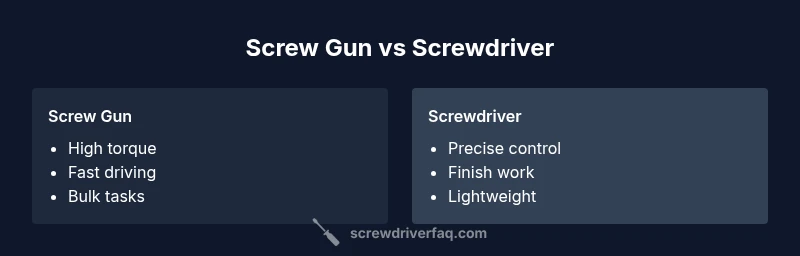
Screw gun dominates bulk driving; screwdriver remains essential for precision and finishing work.
Choose a screw gun when you tackle long runs or tough materials. Opt for a screwdriver for finesse and intricate tasks. For many DIYers, a thoughtful combination offers the best overall value and flexibility.
Quick Answers
What is the main difference between a screw gun and a screwdriver?
A screw gun offers higher torque and faster driving for bulk screws, while a screwdriver emphasizes precision and control for finishing tasks. Both can be powered or manual, but their core design goals differ. The screw gun excels in speed on dense materials, the screwdriver in finesse and accuracy.
The main difference is torque and control: screw guns drive fast and hard for bulk work, while screwdrivers are better for precise finishing.
Can I use a screw gun for delicate tasks?
A screw gun can be used for delicate work if you select low torque and use a light touch, but it’s generally not ideal for finish tasks where precision matters. For cabinetry or trim, a screwdriver is usually the better choice.
You can, but it’s safer to use a screwdriver for delicate work to avoid overdriving or splitting material.
Is a screw gun the same as an impact driver?
In many contexts, a screw gun is a broad term that includes impact drivers, which are designed for high-torque driving with rotational impact. An impact driver is a common type of screw gun, but not all screw guns are impact drivers. Check the tool’s spec sheet to confirm torque type and clutch settings.
An impact driver is a common type of screw gun, but not every screw gun is an impact driver.
What factors should guide my choice between them?
Consider project size, material density, required speed, desired control, weight, and budget. If you do frequent bulk driving, a screw gun is worth it. If precision and finish quality are priorities, a screwdriver is essential.
Think about the project type, material, speed needs, and budget when choosing.
Is it worth owning both tools?
For serious DIYers, yes. A screwdriver handles precision tasks while a screw gun tackles bulk driving. The combination covers most home projects efficiently and reduces tool-switching downtime.
Yes—having both gives you speed for big jobs and control for detail work.
What safety precautions should I follow?
Wear eye protection and hearing protection as appropriate. Keep a firm grip, secure workpieces, and avoid forcing the tool. Use the correct bits and set torque or clutch settings to reduce cam-out and kickback.
Protect your eyes and ears, use the right bits, and don’t force the tool.
The Essentials
- Assess task type first: bulk driving or precision finishing.
- Invest in a screw gun for speed on heavy-duty jobs.
- Prioritize a high-quality screwdriver for control and detail work.
- Consider battery life, weight, and ergonomics when budgeting.
- Keep both tools in a rated toolkit for versatility.