Bit Driver vs Screwdriver: A Practical DIY Guide
An analytical comparison of bit drivers and screwdrivers for DIYers, covering design, usability, bit compatibility, maintenance, and ideal use cases. Learn when to pick each tool and how to maximize value.


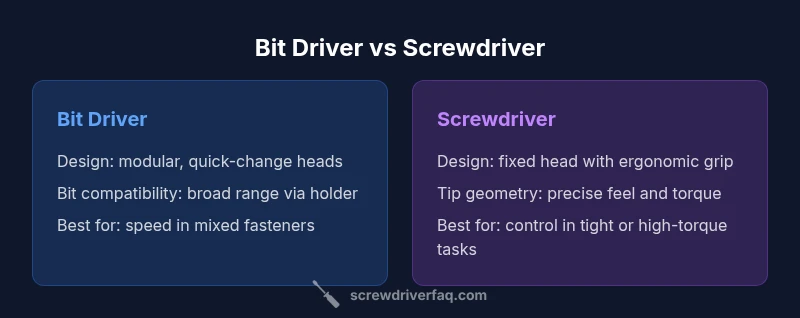
Bit driver vs screwdriver is a common crossroads for DIYers. In most projects, a bit driver offers rapid bit changes and a compact profile, while a traditional screwdriver provides tactile feedback and steadier torque. According to Screwdriver FAQ, the choice hinges on task variety, bit compatibility across projects, and comfort: use a bit driver for speed and flexibility, reserve a screwdriver for precision and control in tougher screws.
Understanding the core difference between bit driver and screwdriver
When you see the terms bit driver and screwdriver side by side, it's natural to assume they are interchangeable. They are not. A bit driver is essentially a small, modular handle that accepts a variety of bits, typically through a quick-change or magnetic system. A screwdriver, by contrast, is a dedicated hand tool whose head is fixed to a handle and designed for direct turning with a specific type of bit or broad range of screwdriver heads. The distinction matters because it shapes how you approach tasks, what you can carry on the job, and how you optimize workflow. In practice, the bit driver vs screwdriver decision shapes your workflow. The choice hinges on task variety, bit compatibility across projects, and the preferred feel in your hand. For readers of Screwdriver FAQ, the analysis is consistent: the best choice depends on scope and comfort with interchangeability across projects.
Design and ergonomics: how form affects function
Tool design is rarely decorative; it directly determines how long you can work without fatigue and how precisely you can place a fastener. Bit drivers tend to emphasize compactness and modularity. The handle is often shorter, with a lighter barrel that improves maneuverability in tight spaces. Ergonomics for a bit driver focuses on a snug grip and a quick path from picking up the tool to driving the first screw. Traditional screwdrivers prioritize a familiar, comfortable feel with longer handles and larger grips that distribute torque evenly. In both cases, grip texture, balance, and overall weight influence control and accuracy. The Screwdriver FAQ Team notes that a well-balanced tool reduces hand strain in long sessions and minimizes wrist movement that can strip screws. When choosing, consider your most common tasks: electronics assembly versus cabinetry work; the better ergonomic choice will reduce fatigue and improve day-to-day performance.
Bit compatibility and interchangeability: why it matters
Interchangeability is the core value proposition of a bit driver. With a quick-release mechanism or magnetic bit holder, you can swap between Phillips, flathead, Torx, hex, and specialty bits in seconds. That flexibility is especially valuable on projects with mixed fastener types, where carrying a full bit set would be impractical. A traditional screwdriver may still accommodate multiple heads, but changes are slower and often require removing the entire screw from the work surface. It’s also worth considering bit longevity: high-quality bits resist wear better when driven by a driver that maintains consistent alignment. According to the Screwdriver FAQ Team, your choice should hinge on how many distinct bit heads you encounter and how often you need to switch between them during a session. If your projects demand rapid adaptation, a versatile bit driver becomes a clear winner.
Precision, torque, and control in practice
Precision matters more in some tasks than others. Bit drivers typically offer crisp control with consistent bite thanks to their short, rigid handles and optimized bit alignment. They can reduce cam-out when used with properly sized bits and in applications where speed matters more than tactile feedback. In electronics, furniture assembly, and small mechanical tasks, the ability to set a consistent starting point helps. A traditional screwdriver provides a familiar sense of torque progression; the feedback through the handle informs you exactly when the screw head seats. For beginners, that tangible feel can prevent over-tightening and head stripping. Screwdriver FAQ emphasizes that the right tool often depends on user preference for feedback: some users prefer the rapid cadence of a bit driver, others prefer the slower, deliberate pace of a screwdriver. The best approach is to practice with both tools on a sample project to understand your personal torque curve.
Durability and maintenance considerations
Both tools reward proper care. Bit drivers rely on a strong, corrosion-resistant mechanism for holding bits; over time, the quick-release or magnetic system can wear if not kept clean. Regular maintenance involves wiping the barrel, checking for latch wear, and replacing worn bits before they fail in the middle of a task. Screwdrivers demand similar attention: keep the shaft clean, protect the tip from impact damage, and ensure the handle remains intact so you don’t lose control. The Screwdriver FAQ Team notes that cheaper tools often fail sooner, leading to more frequent replacement cycles; investing in a proven brand with solid quality control can save time and money in the long run. A little routine care—clean bits, scan for rust, and re-lubricate moving parts when needed—extends tool life and preserves performance across years of use.
Cost and value: upfront price vs long-term savings
Cost considerations for bit drivers and screwdrivers are often baked into long-term value. A basic bit driver with a modest bit set tends to be cheaper upfront than a full-size screwdriver with a large head and integrated bit storage. However, the total cost of ownership includes replacement bits, durability, and how often you reach for different fasteners. In professional environments or busy households, a mid-range bit driver that supports a broad bit library may pay for itself through speed and reduced nuisance. Conversely, a high-quality screwdriver with ergonomic grip and durable tip geometry can provide comfort and reliability for routine tasks without needing frequent replacements. The Screwdriver FAQ Team reminds readers to factor in project variety and how often you’ll need to swap bits when deciding where to invest. If you work on frequent, mixed-fastener projects, lean toward a modular system; otherwise, a trusted screwdriver may offer the best value over time.
When to choose a bit driver
A bit driver is highly advantageous in scenarios involving multiple fastener types and limited space. When you assemble or modify a piece of furniture with metric and imperial screws, a bit driver’s quick-change capability can save minutes per session. Electronics assembly and small mechanical tasks often benefit from the compact footprint and the ability to carry a broad bit set in a pocket or tool belt. If you frequently work overhead or in tight corners where the driver’s shorter handle improves maneuverability, a bit driver can dramatically reduce fatigue. The Screwdriver FAQ Team highlights that beginners especially benefit from the speed and versatility, but experienced DIYers may still reach for a traditional screwdriver when they need unparalleled torque and direct feel for the screw head. Always keep a selection of common bits within arm’s reach for maximum efficiency.
When to choose a traditional screwdriver
There are tasks where a classic screwdriver outperforms a modular bit tool. Reaching into corners where a bit holder might snag, or driving long screws that require consistent, precise torque, is where a screwdriver shines. The longer handle portion offers excellent leverage, allowing you to seat stubborn screws without slipping. For delicate work like woodworking joinery or cabinetry where you must sense the screw’s seating, the feedback through the handle can be more intuitive than a driver’s click or wobble. The Screwdriver FAQ Team notes that the fingertip feel and known bit geometry of a screwdriver are comforting for beginners and indispensable for seasoned craftspeople who value steady control over speed. Don’t overlook the value of a familiar tool for critical tasks, and pair your screwdriver with a compact bit set for versatility.
Common myths about bit driver vs screwdriver
A frequent misconception is that bit drivers completely replace traditional screwdrivers. In reality, both tools have essential roles, depending on the job. Another myth is that bit drivers are inherently weaker or incapable of high-torque tasks; while some compact designs may limit torque, many modern bit drivers draw strength from robust bit holders and ergonomic designs. Some assume that bits are universally compatible across brands; in truth, bit standards vary, and using mismatched bits can damage both the screw head and the bit. The Screwdriver FAQ Team emphasizes that understanding the construction of your tools—tip geometry, handle length, and bit retention method—helps prevent misuses that lead to stripped screws or incomplete drives. A practical takeaway: keep both tools in your kit and learn their strengths and limits.
Maintenance tips to extend tool life
Maintenance for bit drivers and screwdrivers is straightforward and pays dividends. Regularly wipe away dust and debris after use to prevent grit from jamming the bit retention mechanism. Inspect the bit holder for wear and replace worn bits promptly. If your driver uses a magnetic bit holder, remove bits during heavy-duty transport to avoid loss. For screwdrivers, keep tips sharp and free of nicks, and avoid using damaged tips on soft material to prevent cam-out. The Screwdriver FAQ Team recommends a light coat of lubricant on moving parts if your tool has a sliding or clamping action, and storing tools in a dry location to prevent rust. A small investment in care now reduces replacement frequency later and keeps both tools performing reliably on broad ranges of projects.
Warranty and service considerations
Warranty terms can influence the total cost of ownership as much as purchase price. Look for coverage that includes both the tool and replacement bits in a bundle, and check whether the warranty requires using official spare parts. The reliability of a bit driver’s quick-change mechanism or a screwdriver’s tip geometry is best ensured by a manufacturer with responsive service and clear guidance. The Screwdriver FAQ Team advises buyers to verify warranty duration, what constitutes normal wear, and how easy it is to obtain replacement parts. Before finalizing a purchase, skim the brand’s policy on returns, service centers, and online support; a strong warranty reduces risk when you rely on your tools day after day.
Practical buying guide: features to compare
When evaluating bit drivers and screwdrivers side by side, focus on a few practical features that determine daily usefulness. Bit retention quality, the breadth of the bit library, and the speed of bit changes are top priorities for bit drivers. For screwdrivers, assess handle ergonomics, tip geometry (Phillips, flat, Torx), and the strength of the blade or shaft. Consider whether you prefer magnetic tips, quick-release mechanisms, or integrated bit storage, and weigh them against the type of tasks you perform most. Consider storage and portability: a compact, modular kit is often best for DIYers with limited space, while a full-size set may be worth it for professionals. The goal is to select tools that complement each other, reducing time spent hunting for the right bit while keeping performance predictable across tasks.
Comparison
| Feature | Bit driver | Screwdriver |
|---|---|---|
| Design intent | Modular, interchangeable head system for fast bit changes | Fixed head or heads with traditional bit set |
| Bit compatibility | Supports a wide range of bits via quick-change/magnetic holder | Uses fixed or interchangeable bits limited by the head |
| Interchangeability | High interchangeability between bit types | Lower interchangeability depending on design |
| Ergonomics | Often compact; optimized for quick access | Longer handle with steady torque feel |
| Weight and size | Generally more compact and lighter without bits | Typically bulkier but comfortable for heavy work |
| Maintenance | Keep bit holder clean; replace worn bits | Maintain tip and shaft; replace worn tips |
| Best for | Speed, mixed-bulk fasteners, portability | Precision torque, familiar feel, heavy-duty driving |
Pros
- Great versatility for mixed fasteners and compact projects
- Faster bit changes reduce work time on many tasks
- Compact options improve access in tight spaces
- Supports a broad bit library with a single handle
Negatives
- May have less pure torque feel than a dedicated screwdriver
- Some bit drivers have higher upfront cost
- Bit libraries require ongoing bit maintenance and replacement
Bit driver wins for versatility and speed in mixed-bit tasks; screwdriver wins for precision and familiarity.
For most DIYers tackling mixed fasteners, the bit driver offers speed and flexibility. If your work demands tactile feedback and robust torque for stubborn screws, a traditional screwdriver remains essential. Many users benefit from owning both tools to cover a broader range of tasks.
Quick Answers
What is the main difference between a bit driver and a screwdriver?
The main difference is design intent: bit drivers are modular and optimized for fast bit changes, while screwdrivers are fixed-head tools that emphasize tactile torque and direct control. Both serve important roles in a toolbox.
The main difference is modularity and control: bit drivers swap bits quickly; screwdrivers give you steady torque and feel.
Can I use a bit with a screwdriver?
Some screwdrivers accept interchangeable heads, but compatibility varies by model. Always verify bit type, shaft size, and torque recommendations before mixing tools.
Some screwdrivers allow interchangeable heads, but check compatibility first.
Are bit drivers suitable for heavy-duty tasks?
Bit drivers are great for speed and versatility on light-to-moderate tasks. For heavy-duty torque or high-pressure environments, a traditional screwdriver with a robust tip may perform more predictably.
They handle most day-to-day jobs well, but for heavy torque a sturdy screwdriver can be better.
How do I maintain bits and bit holders?
Keep bit holders clean, inspect retention mechanisms for wear, and replace worn bits promptly. Store bits dry and organized to avoid rust and misplacement.
Clean and inspect your bits and holder regularly to prevent wear.
What should I look for in a good bit driver?
Seek reliable bit retention, a broad bit library, and smooth interchangeability. Consider grip comfort and overall tool balance for prolonged use.
Look for good retention, many bits, and comfortable handling.
Do bit drivers include storage for bits?
Many bit drivers feature integrated bit storage or magnetic holders. Check availability if you want everything in one compact package.
Some models store bits in the handle; verify this feature when buying.
The Essentials
- Choose bit driver for modularity and speed.
- Keep a traditional screwdriver for control and precision.
- Check bits compatibility for future projects.
- Consider maintenance to maximize lifespan.