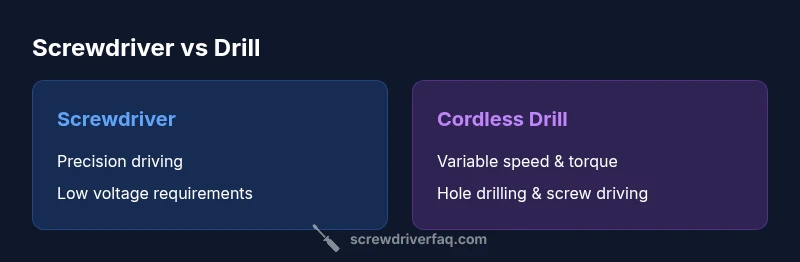
When to Use Screwdriver vs Drill: A Practical Guide for DIYers
Learn when to use a screwdriver versus a drill with practical guidelines, scenarios, and a clear side-by-side comparison to help DIYers choose the right tool for every job.


Understanding when to use screwdriver vs drill is essential for clean, durable results. If you’re wondering when to use screwdriver vs drill, start with precision: manual screwdrivers provide control and minimize material damage for small screws and fine assembly. For larger holes or long fasteners, a drill speeds up work and reduces effort. The rule of thumb: choose screwdriver for accuracy, drill for power and speed.
Core Principles: Precision vs Power in Everyday Projects
Every DIY project sits on a spectrum between precision and power. The question of when to use screwdriver vs drill isn’t about one tool being good and the other being bad; it’s about matching torque, speed, and control to the task. Small screws in cabinetry, delicate electronics enclosures, or assembly hardware benefit from the measured touch of a manual screwdriver. When you size up a project and anticipate material resistance, you’ll instinctively balance speed with care. According to Screwdriver FAQ, developing a sense for the material’s response helps you choose the right approach before the bit ever touches the screw. In practical terms, start with a mental map of the job: is the screw light and the material forgiving, or is the job high-triction and high-torque? If it’s the latter, a drill often wins for efficiency, but you still need to control depth and prevent overdriving.
In short, the core principle is to optimize outcomes by aligning tool capability with task demands. This is not a one-size-fits-all rule; it’s a decision framework that increases speed without sacrificing integrity. By understanding the trade-offs, you’ll know when to lean on a screwdriver for finesse and when to reach for a drill to push through a tougher phase of the project.
Manual Screwdrivers: Strengths, Limits, and Best Practices
Manual screwdrivers are the cornerstone of precision work. They excel at small fasteners, delicate electronics housings, and joints where overtightening could crack plastic or strip threads. The key strengths are tactile feedback, fine control, and minimal risk of damaging surrounding material. For tasks like assembling picture frames, installing hinges, or securing thin plywood, a screwdriver helps you feel the resistance and stop exactly where needed. However, the trade-off is effort and time. In dense or hard materials, the torque required to drive long screws can fatigue your hand and slow you down significantly. Screwdriver-based work shines when you have to maintain alignment, preserve surface finish, and avoid drill-induced wandering. The Screwdriver FAQ team notes that starting with a manual tool can prevent future problems from misaligned holes or under-torqued fasteners. Pro tip: use a screwdriver with a magnetic tip to keep fasteners in place for one-handed operation.
Power Drills: Capabilities, Settings, and Safe Use
Cordless drills bring speed and versatility to most projects. They are ideal for drilling pilot holes, driving longer screws, and creating holes in wood, plastic, and light metals. The key advantages are variable speed, adjustable torque, and interchangeable bits, which allow you to switch from a driving task to a drilling task quickly. But with that power comes responsibility: without proper technique, you risk overdriving, bit wandering, and material damage. Safety features such as clutch settings help prevent over-torque, while selecting the correct bit and pilot hole size protects both the workpiece and the screw. The Screwdriver FAQ team emphasizes starting at a low speed, using light pressure, and gradually increasing as needed to maintain control.
Material Considerations: Wood, Drywall, Metal, and Masonry
Material determines the right tool choice. Wood accepts both screwdriving and drilling, but soft pine is very forgiving while hardwood demands slower speeds and precise depth. Drywall or plaster walls are most safely fastened using a screwdriver for small accessories or a drill with a pilot hole for longer screws. Metal work benefits from a drill with the appropriate bit—pilot holes minimize thread stripping. Masonry requires specialized masonry bits and sometimes hammer-action drills. When to use screwdriver vs drill becomes a matter of how clean you want the hole to be, how much material you can tolerate to deflect, and whether you need to control chip-out. The general guideline is to match the action to the material’s reaction, slowing down or stopping as necessary to avoid damage.
Bit Types, Sizes, and Compatibility
Bit selection is as important as the tool itself. For screwdriving, choose screwdriver bits that fit the screw head (flat, Phillips, Torx, or square) and match the screw size. For drilling, select drill bits appropriately—wood bits for wood, high-speed steel bits for metal, and masonry bits for brick or concrete. Always confirm bit length and shank compatibility with your chuck. A mismatched bit can slip, causing marring or injury. A common pitfall is using a wood bit on metal or an overly long bit in a shallow hole. In practice, you’ll keep a small, organized set of bits for quick swaps, and rotate through them as you alternate between driving and drilling tasks.
Real-World Scenarios: Furniture Assembly, Repairs, and Electronics
Furniture assembly often benefits from a mix of tools. Start with a manual screwdriver for pilot screws and to tighten with precision; switch to a drill for penetrating hardware quickly when needed. In repair work, such as replacing cabinet hinges or fixing loose brackets, you’ll use a screwdriver for precise alignment and screw seating, while a drill accelerates tasks involving longer fasteners. Electronics work calls for gentler handling and often tighter control, favoring the screwdriver to avoid heat and vibration that could damage delicate components. By parsing the project, you’ll determine when to lean on a screwdriver for careful assembly and when to switch to a drill for efficiency.
Safety First: Handling, Clamps, and Eye Protection
Safety should guide every decision about when to use screwdriver vs drill. Secure workpieces with clamps to prevent movement, which reduces misalignment and injury. Wear eye protection to shield from potential fragments or chips, and ensure your battery is charged and the chuck is secured before operation. Keep hands away from rotating bits and use proper stance to maintain control. The discipline of safe practice extends to adjusting torque settings on drills and verifying bit integrity before use. Following these precautions helps you maximize tool performance while minimizing risk.
Building a Practical Tool Kit: Essentials and Upgrades
A compact toolkit should include a quality manual screwdriver set, a cordless drill with variable speed and clutch, a bias toward ergonomics, and a small selection of bits. Upgrades may include a magnetic bit holder, a compact drill/driver combo, and specialty bits for metric and Phillips sizes. An organized approach to tool selection reduces decision fatigue and increases project speed. Screwdriver FAQ advocates building a balanced collection that covers common tasks—this approach helps you handle simple upgrades and maintain project momentum.
Maintenance, Longevity, and Battery Care
Regular maintenance extends tool life and keeps operations smooth. Keep bits sharp and clean, wipe away dust after use, and store tools in a dry, cool location. For cordless drills, manage battery health by avoiding deep discharges and storing at half-charge in long-term storage. Periodically test torque settings and lubricate moving parts per manufacturer guidance. A well-maintained drill remains reliable for heavy drilling, while a well-kept manual screwdriver remains precise and dependable for finesse work.
Common Mistakes and Quick Fixes
Common mistakes include using too much torque, drilling too aggressively in soft woods, and choosing an oversized bit for the screw. When misalignment occurs, stop, back out gradually, and reassess bit selection and depth. Quick fixes include adjusting clutch settings on the drill, using pilot holes to reduce resistance, and ensuring screws are seated straight. By recognizing typical missteps early, you can correct technique quickly and preserve material integrity.
Quick-Start Decision Guide: A Flowchart for Your Project
When deciding between a screwdriver and a drill, start with the question: Is there a high risk of splitting the material or stripping the screw? If yes, begin with the screwdriver to gauge resistance. If you need to drive many screws quickly or drill through a thicker material, switch to the drill with appropriate bit. Always set a conservative speed and torque, then increase gradually. This flow preserves material quality while optimizing task completion.
Training Your Eye: Practice, Plans, and Realistic Expectations
Practice with scrap material to calibrate how much pressure you apply and how the material responds to a given torque. Create simple plans before you start—a dry run can reveal whether you should start with a pilot hole or a debug seating for a screw. Realistic expectations include recognizing that some tasks will require both tools in sequence and that speed comes with skill. Consistent practice will improve your判断 on when to use screwdriver vs drill and reduce trial-and-error in future projects.
Comparison
| Feature | Screwdriver (manual) | Cordless Drill |
|---|---|---|
| Typical tasks | Fine screw driving and precision assembly | Drilling holes and speed-driven screws |
| Power source | Manual crank/handle | Battery-powered or corded |
| Speed control | Limited, tactile guidance | Variable speeds with clutch settings |
| Hole capability | No drilling capability | Drills holes in wood/metal and drives screws |
| Best For | Precision, alignment-sensitive work | Speed, versatility for larger tasks |
| Cost | Low upfront cost | Moderate to high depending on model |
| Maintenance | Minimal, simple care | Battery care and bit replacement |
| Ease of use | Requires technique, slower pace | Intuitive for most users, faster results |
Pros
- Low up-front cost and gear simplicity
- Excellent control for delicate tasks
- Low risk of damaging workpieces when used correctly
- Quiet operation and minimal setup
Negatives
- Limited torque and speed for heavy drilling
- Slower for large screws or long pilot holes
- No drilling capability without a separate bit set
- Requires manual effort and time for long tasks
Screwdriver wins for precision, drill wins for speed; most projects benefit from having both.
For tasks demanding accuracy and material care, a manual screwdriver is preferred. For fast, repetitive drilling and driving, a cordless drill is superior. The best practice is to use the screwdriver for delicate work and the drill for bulk or heavy-duty tasks, as recommended by the Screwdriver FAQ team.
Quick Answers
What tasks are best suited for a manual screwdriver?
Manual screwdrivers excel at precision tasks, such as assembling small furniture parts, tightening delicate hardware, and avoiding damage to soft materials. They are ideal when you need control and don’t require rapid screw insertion.
Manual screwdrivers are best for small screws and delicate parts where precision matters.
Can I replace a drill with a screwdriver for all tasks?
No. A screwdriver cannot replace a drill for drilling holes or driving long screws quickly. For larger diameters or deeper holes, the drill’s speed and torque are essential.
A screwdriver isn’t a substitute for a drill when you need to bore holes or drive fasteners fast.
Is a drill necessary for cabinet installation?
Cabinet installation often requires pilot holes and longer screws. A drill helps speed up this process and reduces the effort required, but use a clutch setting to prevent over-torque.
Yes, a drill is usually needed for cabinet work to speed up drilling and screw driving, with careful torque control.
What safety precautions should I consider?
Always wear eye protection, clamp workpieces, and keep fingers away from the rotating bit. Check the drill bits and screws for damage, and respect the material’s limits to avoid cracks or stripping.
Wear eye protection and clamp your work—safety first when using drills and screwdrivers.
The Essentials
- Use precision first for small screws and delicate joints
- Switch to a drill for speed on larger holes and long screws
- Always match bit type to fastener to prevent damage
- Maintain a balanced tool kit with both options
- Practice safe technique to avoid over-torquing or bit wandering