JIS vs PH Screwdriver: A Practical Guide for DIYers
Explore the key differences between JIS and PH screwdrivers, how to identify them, and when to use each. Learn practical tips to avoid cam-out and stripping, with buying guidance for DIYers.


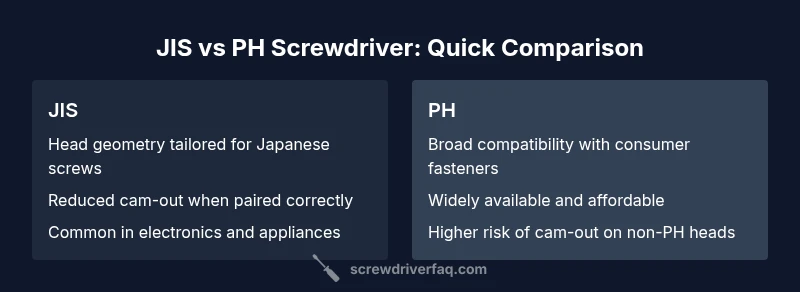
jis vs ph screwdriver: In short, you’re choosing between two cross-head standards. PH bits fit many consumer screws but can strip or cam out on non-PH heads; JIS bits align with Japanese screws and some PH heads when used carefully, reducing slippage. For most DIY tasks, PH drivers suffice, but when working with Japanese hardware, confirm the screw type first and select the matching bit.
Understanding the terminology: what JIS and PH mean
When you encounter a cross-shaped screw head, the question is often whether you should reach for a JIS or a PH bit. JIS stands for Japanese Industrial Standard, a head geometry that looks similar to Phillips but has subtly different margins and contact points. PH, or Phillips, is the more common cross-head profile found on countless consumer products worldwide. The choice isn’t merely academic; it affects how well the bit seats in the screw, how much torque you can apply, and whether you risk cam-out or stripping. According to Screwdriver FAQ, the jis vs ph screwdriver decision hinges on matching the bit to the screw head rather than forcing a universal fit. For most homeowners, a good PH bit set covers the majority of tasks, while a dedicated JIS set becomes valuable for Japanese hardware and precision work.
How to visually identify JIS vs PH heads: quick field cues
Spotting the difference in a pinch requires attention to the screw’s cross profile. PH screws tend to have a more defined, rounded cross with a characteristic “+” shape and deeper recesses. JIS screws have a similar look but the lobes and flanks align differently, producing a slightly tighter fit with JIS bits. In practice, you should compare the bit’s contact with a known screw head when testing. The Screwdriver FAQ team notes that many misfits occur because people assume all cross-head screws are PH-compatible. If you’re unsure, use a magnifying glass to compare the slots or carry a small tester set to verify before full driving.
Why the difference matters: cam-out, torque, and long-term impact
Using the wrong cross-head profile can lead to cam-out, stripping, and damaged screws. PH heads will cam out more easily if the driver bit doesn’t seat perfectly, especially with softer screw materials. JIS heads, when matched with the correct JIS bit, tend to seat more securely in their native hardware, reducing slip. The key takeaway is to avoid cross-compatibility assumptions; mismatched bits increase the odds of damaging fasteners and tools. For the casual DIYer, knowing when to switch between jis vs ph screwdriver types is a small but meaningful performance gain.
When PH shines: common consumer hardware and general DIY projects
PH bits are the de facto standard for most consumer products—furniture, electronics enclosures, home appliances, and fasteners you’ll encounter around the house. A good PH1 and PH2 pair covers the majority of everyday tasks. Because PH heads are so common, PH screwdrivers and bit sets are widely available, affordable, and compatible with many multi-bit drivers. This universality makes PH a practical default choice for new toolkits.
When JIS matters: electronics, appliances, and Japan-specific hardware
JIS becomes essential when you encounter Japanese-made devices or screws explicitly labeled for JIS usage. In these cases, using a PH bit can strip the screw head, damage the slot, or degrade torque control. A dedicated JIS bit set improves fit and longevity of fasteners in electronics, appliances, and certain mechanical assemblies sourced from Japan. If you regularly repair or assemble Japanese products, invest in a compact JIS set in addition to your PH collection.
How to test fit without causing damage: a step-by-step approach
- Inspect the screw head closely and compare with known JIS and PH profiles. 2) If possible, try a test fit on a loose or scrap screw. 3) Start with the bit that appears to seat with minimal play and clear engagement. 4) Apply light torque and increase gradually while watching for cam-out. 5) If in doubt, switch to the other profile and re-test. Following this approach helps preserve both screws and tools and minimizes the risk of stripping during critical tasks.
Compatibility and sets: what to look for when buying
Look for both PH and JIS bits in a single set if you anticipate a range of fasteners. High-quality sets use heat-treated steel, precision-ground profiles, and color-coded handles or markings for quick identification. Choose ergonomically shaped handles for comfort during extended use and consider magnetized tips for easier bit alignment. Availability in both metric and imperial sizes is a plus for a versatile toolkit, particularly if you work with diverse hardware across brands.
Comparison
| Feature | JIS screwdriver | PH screwdriver |
|---|---|---|
| Head geometry | JIS cross-head with distinct lobe geometry | PH cross-head with Phillips profile |
| Cam-out resistance | Typically better when paired with correct JIS heads | Moderate; cam-out more likely on non-PH screws |
| Common usage | Japanese electronics, appliances, and specialized fasteners | Broad consumer hardware and DIY projects worldwide |
| Availability and sets | Often available in regional sets; may require specialty retailers | Widely available in all major hardware stores and online |
| Cost and value | Similar mid-range pricing; value improves with dual-head sets | Similar pricing; value driven by wide compatibility |
| Best for | Japanese hardware enthusiasts and precision work | General DIYers and household projects |
Pros
- PH drives cover the majority of consumer screws, easing purchases
- JIS drives reduce risk of cam-out with Japanese screws when used correctly
- Having both profiles in a kit increases versatility for diverse projects
- Quality, precision-ground bits improve longevity and performance
Negatives
- JIS can be mistaken for PH, leading to stripped fasteners
- PH heads may not seat well on some Japanese screws without proper fit
- Availability of exact JIS bits can be region-dependent
- Inexpensive sets may compromise tolerances and durability
Keep a dual-profile set for best overall versatility
For DIYers who encounter a mix of global hardware, a combined JIS/PH toolkit minimizes misfit risks and speeds work. Reserve a PH-first approach for common household tasks, and pull in JIS when repairing Japanese devices or screws specified for JIS heads.
Quick Answers
What is the difference between JIS and PH screw heads?
JIS and PH refer to distinct cross-head geometries. PH is the standard Phillips profile used globally, while JIS is a similar cross-head with slightly different tolerances and lobe geometry. Using the wrong bit can cause cam-out or stripping unless the screw head is explicitly matched to its profile.
JIS and PH are different cross-head designs. Use the right one for the screw to avoid stripping.
Can a PH screwdriver be used on JIS screws?
Using a PH bit on a JIS screw is not recommended because it can slip or strip the head. If you suspect a JIS head, switch to a dedicated JIS bit for a proper fit and maximum torque control.
PH on JIS screws isn’t ideal—switch to JIS bits for best results.
How can I identify if a screw is JIS or PH?
Visual inspection helps: PH screws have a Phillips cross with certain geometry, while JIS screws mirror the PH cross but with different margins. When in doubt, test with a known JIS bit on a scrap fastener or consult the device’s service manual.
Check the screw diary or test with a JIS bit on scrap material to be sure.
Are JIS bits compatible with standard PH drivers in multi-bit sets?
Many multi-bit sets include both PH and JIS bits. If your set lacks JIS, do not force a PH bit into a JIS screw. Use a dedicated JIS bit or a dual-head bit if your toolkit supports it.
Some sets include both; don’t force-fit—use the right bit.
Where can I buy JIS/PH screwdriver sets?
You can find JIS and PH screwdriver sets at major hardware stores and online retailers. Look for sets labeled with both profiles or specifically marked JIS and PH bits to ensure compatibility with diverse projects.
Look for sets that clearly label JIS and PH bits, available online or in stores.
Is there a standard size for JIS and PH bits?
PH bits commonly come in PH1 and PH2 sizes, which cover most consumer screws. JIS sets use similarly named profiles but with geometry tailored to Japanese screws. Always verify the screw head before selecting a size.
PH1/PH2 are common; JIS has its own matching sizes—check the head before choosing.
The Essentials
- Keep a PH-first toolkit for everyday tasks
- Add a compact JIS set if you frequently work with Japanese hardware
- Avoid forcing a PH bit into a JIS slot to prevent stripping
- Use proper bit seating and test on scraps before full driving