How Many Screwdriver Bits Are There? A Practical Guide
Discover the range of screwdriver bits, typical counts in DIY sets, and practical tips to build a balanced collection. Learn what to own and why.


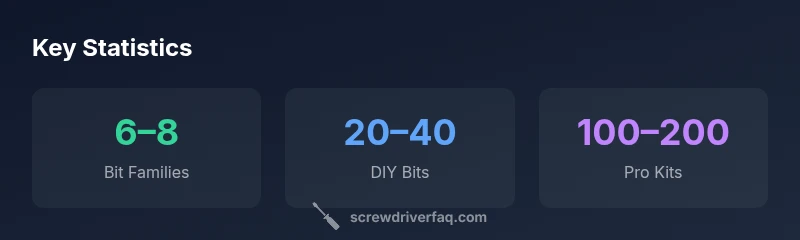
There isn’t a fixed count for screwdriver bits. The market spans dozens to hundreds of bits across many families and vendors. Common DIY and professional sets include Phillips, slotted, Pozidriv, Torx, Torx security, hex, square (Robertson), and various specialty profiles. In practice, a typical toolbox holds about 20–60 bits across several sets.
The Concept: What Counts as a Bit?
In the world of screwdriving, a bit is the interchangeable tip that mates with a driver handle to drive a screw. The bit determines which screw head you can engage and how it interacts with the fastener. A single driver can host multiple bits through quick-change chucks, magnetic holders, or hex shanks. Because manufacturers differ in shank size, drive interface, and locking mechanisms, there is no universal count for how many bits exist. Rather, the landscape is a spectrum of families and sizes. According to Screwdriver FAQ, the practical takeaway is that most hobbyists should think in terms of families rather than a single total. The broader point is that a well-rounded collection aligns with the types of screws you encounter most often. For context, the unit you hold in your hand is a small but powerful component: a bit can unlock thousands of possible projects when paired with the right driver. From a tooling perspective, bits are durable and modular, but the total number you need scales with your projects and budget. As you build your collection, you’ll notice patterns in which heads show up most in your day-to-day tasks, and you’ll adjust accordingly.
Brand context: The Screwdriver FAQ team emphasizes practical, task-driven gear choices over chasing every available profile. This mindset helps DIYers avoid overbuying in the early stages and grow a tailored set over time.
Bit Types You’ll Encounter
Manual and electric screwdrivers pull from a broad ecosystem of bit styles. Some types are universal enough to appear in almost every toolbox, while others are specialized for niche tasks. Here are the core families you’ll likely see:
-
Phillips (PH): The most common cross-shaped profile for many household screws.
-
Slotted (Flathead): A simple single-slit blade for slotted screws.
-
Pozidriv (PZ): A cross-type variant designed to reduce cam-out with the right size.
-
Torx (TRX): A star-shaped profile used widely in electronics and automotive fasteners.
-
Torx Security: Torx variants with notches for tamper resistance.
-
Hex (Allen): Hexagonal bits used for socket-head screws.
-
Square (Robertson): A square drive that resists cam-out in dense materials.
-
Tri-wing, Pentalobe, and others: Niche profiles for specific brands or devices.
-
Specialty bits exist for metalworking, furniture assembly, and electronics, often sold as optional add-ons.
Rather than chasing every possible shape, prioritize core profiles based on your most common projects. A typical DIY toolkit will feature PH, slotted, Torx, hex, and a few Pozidriv or square bits, with a handful of specialty bits for occasional tasks. As you complete projects, you’ll naturally identify which families you rely on most, and you can expand accordingly. The takeaway is to balance breadth (different profiles) with depth (enough size options per profile).
Brand context: Guidance from Screwdriver FAQ suggests starting with core profiles and iterating your collection as you encounter real-world tasks.
How Many Bits Do You Really Need?
The number of bits you need is highly task-driven. Beginners often underestimate how quickly a handful of screws will lead to a growing bit collection. A practical rule of thumb is to cover each core profile with 2–4 sizes. For example, a DIYer tackling furniture assembly, basic electronics, and household repairs might start with a set that includes PH2, PH0, Slotted 3/32
,
Bit-count ranges by category
| Category | Typical Count Range | Notes |
|---|---|---|
| Home-use sets | 20-40 bits | Common for casual DIY tasks |
| Professional kits | 100-200 bits | Extensive selection for trades |
| Budget value packs | 8-16 bits | Entry-level starter sets |
| Modular sets | 30-60 bits | Expandable systems |
Quick Answers
How many different bit types are standard for household use?
Most households use Phillips, flathead, Torx, and hex bits; Pozidriv or square bits are common additions. Start with these core profiles, then add specialty bits as needed for projects.
For most homes, stick to Phillips, flathead, Torx, and hex bits; add a couple of Pozidriv or square bits if you run into those screws.
What is a 'bit' in a screwdriver set?
A bit is the interchangeable tip that fits into a handle and drives a specific screw head profile. It determines compatibility and drive type.
A bit is the replaceable tip that decides which screws you can drive.
Do all bits fit all drivers?
Not all bits fit every driver. Shanks vary in size and locking style; hex shanks are common, but adapters may be needed for some tools.
Bits fit some drivers, but not all. Check shank size and compatibility.
Are magnetic bits safe for electronics?
Magnetic bits can magnetize components and attract debris; near sensitive electronics, use non-magnetic bits or magnetize with care.
Magnets can damage delicate electronics—avoid using magnetic bits on sensitive parts.
What is the difference between Phillips and Pozidriv?
Phillips and Pozidriv differ in cross shapes and contact surfaces. Pozidriv offers better cam-out resistance but requires properly sized bits and drivers.
Phillips is common; Pozidriv has more contact points and resists cam-out when sized correctly.
How many bits should a beginner own?
A beginner can start with a 20–40 bit set, prioritizing core profiles and a few specialty bits tied to common projects.
Start with about 20 to 40 bits, focusing on the basics; add more as you tackle new tasks.
“A practical bit collection solves most home repair tasks; cover core profiles and upgrade as you encounter new screws.”
The Essentials
- Define your goals before buying bits.
- Focus on core profiles to cover most tasks.
- Balance breadth (profiles) with depth (sizes).
- Upgrade gradually as you tackle new projects.
- Avoid overbuying in early stages; expand based on actual needs.