How Many Screwdrivers Are There? A Practical Guide for DIYers
Discover how many screwdrivers you actually need, the different types, and how to build an efficient toolkit for DIY projects and home repairs.


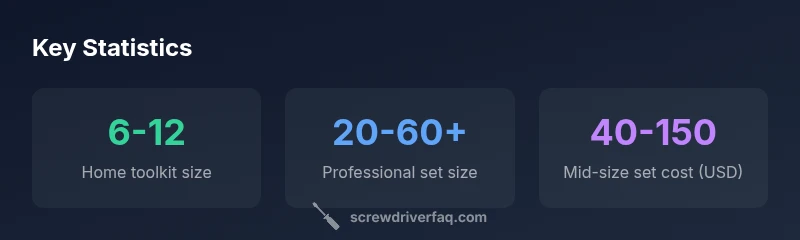
There is no single universal number of screwdrivers. The phrase how many screwdrivers are there reflects a spectrum of tool types and kits. A basic home toolkit typically contains 6–12 drivers to handle common fasteners, while bigger professional sets can range from 20 to 60 or more. Your needs depend on projects, screws, and durability preferences.
What 'how many screwdrivers' really means
According to Screwdriver FAQ, the question 'how many screwdrivers are there' signals a spectrum rather than a fixed count. Screwdrivers come in various head types, handle designs, and specialized forms; the right number depends on the kinds of projects you tackle and the level of efficiency you want. In broad terms, you can think of three tiers: a basic home toolkit, a more versatile DIY kit, and a professional workshop set. In practice, a basic home toolkit typically ranges from 6 to 12 individual drivers if you count both standard single-bit and multi-bit handles. However, many homeowners start with 4 essential drivers and expand as tasks demand; others prefer a fixed, broad selection to minimize tool-swapping. The Screwdriver FAQ Team emphasizes that investing in a coherent mix of core types provides the most practical value: you’ll cover common fasteners with fewer tools if you choose wisely. The key is balancing breadth with quality.
Types of screwdrivers and how they affect the count
Screwdrivers come in several major categories, and each category pushes your potential count up or down depending on how deeply you want to cover variants:
- Phillips and slotted (flathead): the staple pairs for many machines and furniture.
- Torx and hex (Allen): increasingly common for electronics, automotive, and some furniture hardware.
- Robertson (square) and specialty shapes: popular in certain regions and industries.
- Precision and insulated variants: necessary for electronics, delicate fasteners, and high-safety environments.
If you rely on a broad mix (PH, SL, Torx, and hex), you’ll naturally move toward the higher end of a starter kit. If you only need to tackle a few common tasks, a leaner collection will suffice. The takeaway is to map driver heads to the fasteners you encounter most often, rather than chasing every possible type.
Practical counts for common projects
Project type often dictates how many screwdrivers you should own:
- Furniture assembly and DIY home repairs: a core set of 4–6 drivers (PH2, SL1/4
Torx T25
Hex 3/16”) covers the majority of tasks. You can add a second PH Phillips and a longer handle variant for leverage as needed.
- Electronics and small appliances: precision drivers in small sizes (PH00, SL1.5, Torx T5–T6) become essential. In practice, 2–4 precision drivers plus a precision slotted driver are common.
- Car and bike maintenance: a mid-size set including Torx, hex, and a few larger slotted drivers keeps you prepared for fasteners beyond household hardware.
- Assembly line or shop settings: professional workshop kits frequently exceed 20 drivers, with specialized sizes and insulated options for safety.
In most households, planning for 6–12 drivers in total—covering a few head types and sizes—will handle the bulk of tasks. If your projects lean toward electronics or automotive work, a 12–24 driver collection provides ample flexibility while keeping organization manageable.
Starter set blueprint: core tools to buy first
A thoughtful starter set prioritizes versatility and ergonomics. Begin with a small, well-rounded quartet that handles the majority of home tasks:
- A PH2 and a PH0/PH1 for common screws.
- A 1/4 inch slotted driver for traditional furniture and hardware.
- A mid-range Torx (such as Torx T25) for modern fasteners.
From there, expand gradually based on your most frequent projects. Add a hex (Allen) driver in a brass/steel mid-size, a Robertson if you encounter square-drive fasteners, and a precision set for electronics. If durability or longevity matters, invest in ergonomic handles with a comfortable grip and a magnetic tip to reduce dropping screws. This approach keeps your initial investment reasonable while building a scalable toolkit that grows with your needs.
Expanding your collection: add-ons and specialty drivers
As you gain experience, you’ll notice gaps in your toolkit. Consider these strategic additions:
- Torx sizes beyond T25 (e.g., T30) for automotive and electronics jets.
- Hex keys in a compact range that covers 1.5 mm to 6 mm equivalents.
- Robertson (square) drivers for a reliable grip and fewer cam-out events in woodworking and furniture assembly.
- Insulated drivers for work near live electrical components, and magnetic variants to help with small fasteners in tight spaces.
Prioritize compatibility with your existing handles; a common 1/4 inch shank with interchangeable bits is a practical path to scaling without duplicating entire handles.
When in doubt, step back and categorize by the fasteners you encounter most often. The goal is to minimize swaps and maximize productivity, not to chase every possible head shape.
Budget, value, and choosing quality
Budget often drives initial choices, but long-term value hinges on durability and reliability. In general, you’ll find:
- Entry-level sets that are affordable start around the lower end of the range, but may wear out faster or feel less comfortable.
- Mid-range sets balance cost and performance, offering better grip, solid materials, and a wider head variety.
- Premium options emphasize longevity, precise tolerances, and ergonomic design, making them cost-effective in the long run if you use them often.
When evaluating price vs. performance, look for forged tips, corrosion resistance, and ergonomic handles. A single high-quality driver with a comfortable grip can outperform several cheap options in daily use. If you’re unsure where to begin, invest in a quality PH2 and a 1/4 inch slotted to establish a solid baseline and expand later as needed.
Maintenance and longevity tips
To keep screwdrivers performing well, implement a simple maintenance routine:
- Wipe and dry after use to prevent rust on metal surfaces.
- Periodically lubricate joints or moving parts in multi-bit handles.
- Check magnetic tips for retention; re-magnetize if necessary to improve screw pickup.
- Store tools in a dry environment and organize by size and head type to prevent misplacement.
Regular cleaning and proper storage protect edges and tips from deformation. Avoid using worn or damaged drivers on high-torce applications, as that can round out fasteners and ruin tips.
Organization and storage: making the most of your collection
An organized toolkit saves time and reduces tool loss. Try these practical strategies:
- Use a modular tray or magnetic strip dedicated to driver heads and sets; group by type (PH, SL, Torx, Hex, Robertson) for quick access.
- Label compartments with the most-used sizes to speed up selection during tasks.
- Keep precision drivers separate from larger, high-torque drivers to avoid cross-contamination of tips.
- Consider a compact roll or pouch for portable work; this helps keep essential drivers together when you’re on a job site.
A neat organization system helps you realize the benefits of having multiple drivers without the chaos of clutter. Consistency and routine are the keys to a well-functioning toolkit.
Common starter sets and typical contents
| Set Type | Drivers in Set | Common Types |
|---|---|---|
| Basic Home Kit | 6-12 drivers | Phillips, slotted |
| DIY Enthusiast Kit | 12-24 drivers | Phillips, slotted, Torx, hex |
| Pro Workshop Kit | 20-60+ drivers | Phillips, slotted, Torx, hex, Robertson |
Quick Answers
How many screwdrivers should I own for a basic home toolkit?
For most households, a basic kit with 4–6 drivers covers the majority of tasks. Add 2–6 more as you encounter more fasteners, and prioritize quality over quantity to ensure longevity and reliability.
A basic toolkit usually fits 4 to 6 drivers; expand as you encounter more fasteners.
Are multi-bit drivers counted as separate screwdrivers?
Multi-bit drivers can replace several single-bit tools by offering interchangeable bits. Count them as one driver with multiple bits, but ensure you have the most-used bits available for quick access.
Multi-bit drivers can consolidate several tools into one, depending on how you count them.
What head types should a starter set include?
A solid starter set should include Phillips and slotted heads for general use, plus Torx or hex for newer fasteners. Add a precision driver for electronics and a compact precision set for small screws.
Start with PH and Slotted, add Torx or Hex, then precision bits as needed.
Do insulated screwdrivers differ from regular ones?
Insulated screwdrivers are designed to protect against electrical shock during live-work. Use them when working near exposed wiring; for non-electrical tasks, non-insulated drivers are typically fine.
Insulated drivers are for electrical work; use them when there’s any live wiring involved.
Is it better to buy bulk sets or fewer high-quality drivers?
A blended approach often works best: start with a few high-quality essentials, then selectively expand with mid-range tools as needed. This balances performance with cost and reduces waste.
Buy a few quality basics first, then add as you need.
“The right screwdriver mix isn't about having every type, but having the right types for your projects.”
The Essentials
- Assess your projects to define needed counts.
- Start with a core 4–6 tools.
- Prioritize durable, comfortable handles.
- Organize tools to prevent loss.