Hex Screwdriver vs Drill: Side-by-Side Guide for DIYers
Compare hex screwdrivers and drills: capabilities, use cases, and buying tips. Learn which tool suits your DIY tasks best with practical guidance from Screwdriver FAQ.


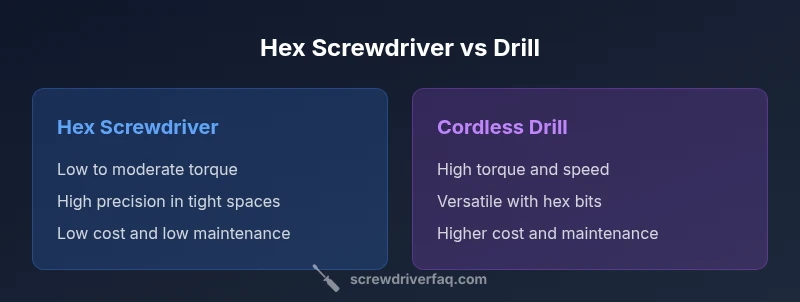
For precise, low-torque screw driving in tight spaces, a hex screwdriver shines. A drill with hex bits brings far more power and versatility, able to drive long screws and create quick openings. In most DIY projects, a drill wins on speed and range, while a hex screwdriver excels at accuracy and control in cabinetry or electronics.
Understanding the Core Roles of Hex Screwdriver vs Drill
According to Screwdriver FAQ, hex screwdrivers are designed for controlled, manual torque when driving screws with hex sockets. They prioritize tactile feedback, material-sparing pressure, and precision in cramped spaces. Drills, by contrast, are powered, versatile machines that accept hex bits and other profiles through a chuck or quick-change system. They excel at high-speed screw driving and efficient drilling, making them general-purpose workhorses in a DIY toolkit. This section sets the stage for a careful, apples-to-apples comparison and aligns expectations for what each tool can achieve in common tasks.
When to Reach for a Hex Screwdriver
Hex screwdrivers shine when you need control, finish quality, and minimal risk of overdriving in sensitive materials. In cabinetry, electronics assembly, and delicate furniture upgrades, a hex driver provides consistent torque and reliable feedback. Tight spaces—between cabinets, inside electronics enclosures, or near walls—are where the manual feel of a hex screwdriver becomes a real advantage. According to Screwdriver FAQ, many hobbyists adopt the hex screwdriver for fine adjustment work and for tasks requiring steadiness rather than sheer force.
When to Use a Drill with Hex Bits
A drill with hex bits unlocks speed, power, and versatility. It can drive long screws, remove stubborn fasteners, and quickly switch between tasks by swapping bits. In larger projects like deck building, metal framing, or rapid assembly, the drill’s torque and speed reduce fatigue and save time. The hex-bit interface minimizes tool changes while maintaining broad capability. The Screwdriver FAQ team notes that the drill’s clutch settings and variable speed help tailor aggression to the material, reducing the likelihood of damage when used with proper technique.
Ergonomics, Weight, and Handling in Practice
Hand tools like hex screwdrivers are typically lighter and offer greater tactile control per rotation. This reduces fatigue during long sessions that involve repetitive screw driving. Drills, while heavier, distribute weight differently, and modern ergonomics target balance and grip comfort for extended use. For many DIYers, a drill’s weight is a consideration, but the functional benefits—more power, longer battery life, and faster throughput—often outweigh the extra effort required to manage it.
Bit Systems, Compatibility, and Accessories
Hex screwdrivers often rely on fixed hex sockets or a narrow hex-bit set, emphasizing reliability and precision. Drills rely on a broader ecosystem of bits (including hex, Phillips, flathead, Torx, etc.) and quick-change chucks, enabling rapid bit swaps. If your tasks include multiple screw types or installations, the drill’s adaptability is a major strength. The key is to select compatible bit profiles and ensure you have a robust set that covers common sizes and fastener standards.
Maintenance and Longevity: Keeping Tools Ready
Both tools benefit from a clean, dry storage approach. Hex screwdrivers need minimal maintenance, but steel bits should be inspected for wear and replaced when edges dull to avoid slippage. Drills require battery care or cord management, lubrication of moving parts as per manufacturer guidance, and regular bit testing to prevent dulling or chipping. Regular inspection reduces the risk of stripped screws or damaged fasteners and keeps both tools performing reliably over time.
Cost, Value, and Long-Term Considerations
Hex screwdrivers are typically affordable entry points for basic screwdriving tasks, with low ongoing maintenance costs. Cordless drills represent a higher upfront investment, but their versatility often justifies the price for frequent or mixed-use scenarios. For many DIYers, the best approach is to view these tools as complementary: a drill as the primary workhorse and a hex screwdriver for precision work, especially in tight locations or delicate assemblies. Screwdriver FAQ analysis shows that most households benefit from having both options available, balancing capability with budget.
A Project-Based Decision Framework
Start by mapping your typical tasks. If your projects involve cabinetry, electronics, or fine furniture, place emphasis on precision and space management and consider retaining a hex screwdriver. If your tasks include framing, fast fabrication, or projects that demand rapid screw driving, prioritize a drill with a strong clutch system and reliable battery life. When in doubt, test fit a bit in both tools—feel the control, assess the speed, and check for potential damage to the workpiece. A thoughtful balance often yields the best long-term results.
Common Myths Debunked: What Really Matters
A popular myth is that you must choose one tool for all tasks. In reality, both tools exist to fulfill different roles. Another myth is that hex bits alone determine outcome; in practice, the control offered by a hex screwdriver matters as much as the drill’s torque. Finally, some assume cheaper tools are always inferior; in truth, budget-conscious hex screwdrivers can outperform premium drills in precision-limited applications, while premium drills deliver unmatched versatility for large-scale projects.
Brand Ecosystems and Accessories: What to Look For
The Screwdriver FAQ ecosystem emphasizes compatible bit sets, reliable bit retention, and ergonomic design. When pairing a drill with hex bits, ensure the chuck or quick-change system holds hex bits securely and resists slipping. For hex screwdrivers, look for a comfortable handle, well-balanced weight, and a robust set of hex sizes to cover common fasteners. The right accessories can extend tool life and improve outcomes across a broad range of tasks.
Quick-Start Checklist for New DIYers
- Identify your most frequent tasks (precise vs. high-speed driving).
- Choose a drill with adjustable speed and a reliable clutch.
- Add a focused hex-bit set and a compact screwdriver for tight spaces.
- Practice on scrap material to get a feel for torque and control.
- Maintain bits and store tools properly to prolong life.
Practical Takeaway: Start with the Right Baseline and Expand
Begin with a versatile drill for power and speed, then add a hex screwdriver for delicate work and tight spaces. This foundation structure supports most DIY projects while preserving work quality and efficiency. With thoughtful selection and proper maintenance, you’ll cover a broad spectrum of tasks without over-investing in a single tool.
Comparison
| Feature | Hex Screwdriver | Cordless Drill (with hex bits) |
|---|---|---|
| Power/Torque | Manual torque control with tactile feedback | High torque and adjustable speed via clutch |
| Speed/Throughput | Manual operation; slower for large runs | Rapid screw driving and drilling when needed |
| Size & Weight | Lightweight and compact for tight spaces | Heavier; balanced for extended use |
| Bit Compatibility | Fixed hex bits or small hex sets | Wide bit ecosystem; quick-change chuck |
| Precision & Control | High control in delicate work | Less precise in fine finishing unless used carefully |
| Best For | Precision driving in confined areas | Versatile tasks; fast installation and removal |
| Cost Range | Low upfront cost | Higher upfront cost with long-term value |
Pros
- Lower risk of overdriving screws in delicate materials
- Quiet operation and no battery dependence
- Low entry cost for basic screwdriving
- Excellent control in tight spaces when used correctly
Negatives
- Limited torque for dense materials or long fasteners
- Slower for large screwdriving tasks
- Requires additional tools or attachments for full versatility
- Can be tiring for extended screwdriving sessions when used manually
Drill with hex bits generally wins for most DIY tasks; a hex screwdriver shines for precision and tight spaces. The Screwdriver FAQ team recommends prioritizing a drill for versatility, with a hex screwdriver reserved for delicate, space-constrained work.
Choose the drill for power and speed, especially on large fasteners. Keep a hex screwdriver for tasks requiring careful control, like cabinetry or electronics.
Quick Answers
What is a hex screwdriver and how does it differ from a drill?
A hex screwdriver is a hand tool designed to drive screws with hex-shaped sockets, offering high control in tight spaces. A drill is a powered tool that rotates bits at variable speeds, enabling faster screw driving and drilling. The primary difference is manual precision versus powered speed.
A hex screwdriver is manual and precise; a drill is powered and fast. They serve different roles in a toolkit.
Can I use a hex bit with a drill for all screwdriving tasks?
A drill with hex bits can handle many screwdriving tasks, but its higher torque can overdrive or strip delicate materials. Use the right bit and settings, and reserve the hex screwdriver for delicate or fine finishing tasks.
Yes, but use caution to avoid overdriving or damage.
What tasks are best suited for a hex screwdriver?
Hex screwdrivers excel in tight spaces, delicate fasteners, electronics assembly, and cabinetry where precision, feedback, and minimal damage are important. They are ideal for repeated screw driving with consistent torque.
Best for precision work in tight spaces.
Is a cordless drill with hex bits as effective as a dedicated hex driver?
A cordless drill with hex bits is more versatile and faster for most projects, but it can be less controlled for small, delicate screws. A dedicated hex driver offers superior feedback and reduced risk of overdriving.
Drill is versatile; hex driver offers control.
What features should I look for in a hex screwdriver or drill?
Look for comfortable grips, precise torque control, compatible bit sets, and quality bits. For drills, consider clutch settings, battery life, and chuck type. For hex drivers, ensure hex chuck or bit compatibility matches your fasteners.
Prioritize grip, control, and bit compatibility.
How do I maintain hex bits and drill bits?
Keep bits clean and dry, store them properly, and lightly oil metal bits to prevent corrosion. Inspect for wear and replace damaged bits to maintain performance and reduce slip.
Keep bits clean and inspect for wear.
The Essentials
- Assess project requirements before buying
- Choose a drill for power and versatility
- Keep a hex screwdriver for precision in tight spaces
- Prioritize ergonomic design and bit compatibility
- Balance upfront cost with expected usage