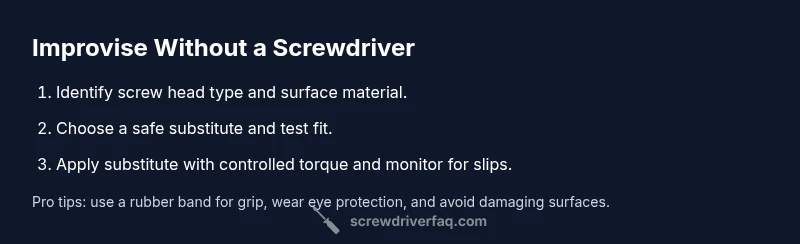
What to Do Without a Screwdriver: Practical Substitutes
Learn practical, safe substitutes for common screw heads when you’re without a screwdriver. This guide covers quick improvisations, step-by-step methods, tool substitutions, and essential safety tips for DIYers.


Without a screwdriver, you can still tighten or loosen many screws using common household items and proper technique. Match the substitute to the screw head: a coin or flat metal edge for slotted heads, pliers or a multitool for stubborn screws, or a rubber band to improve grip. This guide shows safe, effective improvised methods for quick fixes.
What to know about improvising with no screwdriver
If you're wondering what to do without a screwdriver, start by identifying the screw head type and the surrounding material. According to Screwdriver FAQ, improvisation is a common DIY skill that can save time when the right tool isn’t available. The key is to avoid forcing a bad substitute that could strip the screw or damage the work. In this article, you’ll learn practical, safe approaches, how to choose the best substitute for the head, and how to protect both your project and yourself during improvised fixes.
- The right mindset matters: treat improvisation as a temporary bridge, not a replacement for proper tools.
- Always assess material type (wood, metal, plastic) because different substrates respond differently to substitutes.
- Start with the gentlest method and increase torque only as needed to avoid damage.
Common substitutes for flat-head and Phillips screws
For slotted (flat-head) screws, a coin or a thin flat blade can serve as a temporary driver for light tasks. If you encounter a Phillips head, you can use a small flat-blade tool or a pair of pliers to grip the edges and turn very slowly. A rubber band wrapped around the screw head before using an improvised tool can dramatically improve grip without marring the head.
- Slotted head substitutes: coin (penny or similar), thin metal shard, or a flat-blade blade from an old screwdriver.
- Phillips head substitutes: small flat-head driver, needle-nose pliers, or a tight grip with pliers.
- Grip enhancers: rubber bands, friction tape, or a small piece of sandpaper for better contact.
Techniques for turning screws without a traditional driver
The most reliable improvised approach combines fit, grip, and controlled torque. Start by seating the substitute securely in the screw head and ensuring it sits flat without wobble. Use pliers or a multitool when the substitute cannot maintain torque with your fingers alone. The rubber band trick creates extra friction and can save you from slipping and slipping can strip the head.
- Always verify alignment before applying torque to prevent cam-out.
- Turn slowly and evenly; rapid twists increase the chance of head stripping.
- If you feel slip or hear a grind, stop and re-evaluate the substitute fit.
Safety considerations and risk management
Improvising with substitutes carries risks. Metal objects can scratch, mar, or damage the surrounding material, and aggressive torque can strip screws or welds. If dealing with delicate plastics or electronics, the risk of permanent damage is higher, so limit torque and avoid metal-to-plastic contact that could gouge parts. Always wear eye protection and work in a well-lit area.
- Keep hands dry and steady to prevent slips.
- Avoid heavy torque on soft materials like certain plastics or thin wood.
- When in doubt, stop and switch to the proper tool to minimize damage.
When improvisation isn’t safe and you should switch tools
Not every situation is suitable for improvisation. Electrical devices, sensitive electronics, or load-bearing assemblies demand the correct screwdriver to maintain safety and integrity. If you encounter a stubborn screw, or if the head is already damaged, it’s wiser to pause and use an appropriate driver or a professional service. Returning to the right tool avoids cascading problems later.
- If you’ve stripped a head, do not keep forcing the substitute.
- For high-torque or critical applications, use the right tool to ensure proper torque specs.
- Consider keeping a small emergency toolkit with a universal screwdriver bit set for future projects.
How to prepare for future projects and avoid improvisation
Preparation reduces the need to improvise. Before you start a project, identify all fasteners, check the head types, and keep a compact, versatile toolkit within reach. A few reliable substitutes—such as a small coin for quick fixes, a stubby flat-head blade, and a compact set of needle-nose pliers—can cover many common tasks. Practicing on scrap material helps you build confidence without risking your actual project.
- Practice inserting substitutes at low torque on waste wood to gauge compatibility.
- Label any improvised tools so you remember their limitations.
- Keep safety gear handy to protect eyes and hands during improvised work.
mainTopicQuery :
Tools & Materials
- Pliers (needle-nose or slip-joint)(Grip and twist screws when no driver is available)
- Coins or flat metal substitute(Small slotted screws; avoid over-torquing to protect the head)
- Rubber band(Wrap around screw head to improve grip with substitutes)
- Flat metal blade (from old screwdriver)(Use with care to avoid slipping and damage)
- Tweezers or small forceps(Assist with alignment and positioning of tiny screws)
- Safety glasses(Eye protection when improvising near moving parts)
- Magnet pickup tool(Helpful to retrieve dropped screws and hold fasteners in place)
Steps
Estimated time: 25-45 minutes
- 1
Identify head type
Begin by inspecting the screw head to determine whether it is slotted, Phillips, hex, or another type. Knowing the head helps you select the best improvised substitute and reduces the risk of damage. If the head is damaged or worn, proceed with extra caution and consider stopping to seek the proper tool.
Tip: Check for signs of wear or rounding around the slots or edges. - 2
Clear the workspace
Remove any debris, dust, or objects around the screw to ensure a clean engagement surface. A clear area reduces the chance of the substitute slipping and causing accidental injury or damage. If visibility is poor, use a headlamp or flashlight.
Tip: Good lighting makes the substitute fit better and improves control. - 3
Choose an improvised substitute
Select a substitute that matches the head type. For slotted screws, a thin coin or flat blade may work; for Phillips screws, pliers can grip the edges. Always preview the fit without applying torque.
Tip: Test the fit by pressing the substitute gently into the head without twisting. - 4
Position and secure the substitute
Place the substitute in the screw head and hold it steady. If possible, wrap a rubber band around the head to increase friction. For small screws, use tweezers to keep the substitute aligned.
Tip: Stability is key; wobble invites cam-out. - 5
Turn with controlled force
Apply slow, even pressure to turn the screw. Avoid sudden bursts of force, which can strip the head or slip and damage surrounding material. If the substitute slips, stop and re-seat it.
Tip: If it won’t bite, don’t force it—reassess your approach. - 6
Assess results and adjust
Check the screw engagement after a few turns. If it’s not seated properly, back it out and reattempt with a better fit or switch to the proper tool. For delicate work, reduce torque to prevent cracking.
Tip: Back off slightly if you feel resistance. - 7
Finalize and restore proper tooling
Once the task is complete, switch to the appropriate screwdriver for final tightening to the recommended torque. This preserves the integrity of the fastener and the surrounding material.
Tip: Mark the project to verify tightness later.
Quick Answers
Can I use a coin to turn screws?
Yes, for small slotted screws and light tasks, a coin can work briefly. Avoid using coins on larger screws or high-torque situations, and monitor for slipping or damage.
A coin can work for small slotted screws, but monitor for slipping and avoid over‑torquing.
What substitutes work best for Phillips screws?
A small flat-head blade or needle-nose pliers can grip Phillips screws in a pinch, but precision is limited. If you can, switch to a proper Phillips driver for reliability.
A flat-head blade or pliers can help, but use a proper Phillips driver when possible.
Is improvising safe for electrical devices?
Improvise with caution on electrical devices. There’s a higher risk of shorting or damage—prefer the correct driver and disconnect power before attempting any fastener work.
Be cautious around electrical devices; disconnect power and use the right tool when possible.
What if the screw head is stripped?
If the head is stripped, improvisation becomes risky. Stop, assess alternatives, and consider using a screw extractor or replacing the fastener rather than forcing a substitute.
A stripped head is a cue to stop and choose a better method or tool.
When should I replace the screw or tool?
If the screw shows signs of damage or the tool head is worn, replace the fastener or tool. Continuing to work with damaged parts increases the chance of failure.
If damage is evident, replace—don’t push through.
Are there risks of damaging surfaces when improvising?
Yes. Improvised methods can scratch, gouge, or crack materials. Use protective barriers and test on scrap before working on the final piece.
There is a real risk of surface damage; test first and proceed with care.
Watch Video
The Essentials
- Identify the screw head before improvising.
- Choose safe substitutes and test on scrap material.
- Apply slow, controlled torque to avoid damage.
- Switch to the proper screwdriver when possible.
- Wear eye protection and maintain a clean, stable workspace.