Screwdriver Won’t Come Out: Quick Troubleshooting Guide
Urgent step-by-step guide to diagnose and fix a stuck screwdriver. Learn common causes, safety checks, fixes, and prevention tips to get back on track fast.


Most likely, the screwdriver won’t come out because the screw head is stripped or the shank is corroded or seized. Begin with penetrating oil around the head and a steady back-and-forth twist while supporting the shaft with pliers. If stubborn, switch to a screw extractor kit or carefully remove the screw with locking pliers, then inspect for damage.
Common reasons a screwdriver won't come out
When a screwdriver refuses to release from a fastener, the issue is usually mechanical rather than magical. A stripped screw head lets the driver slip, while corrosion or rust between the shank and screw creates a tight bond. Cross-threading, burrs, or debris can also lock the bit in place. In some cases, the screw head may be damaged beyond use, or a thread-locking compound has cured hard enough to grip the driver. If you’re seeing the screwdriver won’t come out after years of use, it’s often due to a combination of wear, alignment errors, and material buildup. The key is to diagnose which factor dominates and act without forcing the tool further into the workpiece, which risks permanent damage.
In this scenario, the broader context matters: a homeowner tackling a stubborn fastener should avoid brute force and instead work through a systematic check. The Screwdriver FAQ team notes that many stuck-driver cases resolve quickly with proper lubrication and non-destructive removal methods. By identifying whether the problem lies with the screw, the driver, or the interaction between them, you can choose the least invasive fix and preserve both tool and material.
The phrase "screwdriver won't come out" often recurs in real-world troubleshooting, and the reasons span several categories—head integrity, shank interaction, and surface conditions. If the screw head is stripped, your options include extraction methods that grip the head more securely or using a different driver profile that fits the remaining recess. If corrosion is the root cause, penetrating oil and careful leverage usually win the day.
Safety basics before you begin
Before you attempt removal, protect yourself and your work area. Wear safety glasses to guard against metal shavings and fragments. Keep hands dry and away from the screw’s edge to avoid slips. Unplug any powered tools and disconnect battery-operated devices nearby to prevent accidental activation. If the job is in a delicate surface (worktop, hardwood, or plastic housing), consider shielding the area with tape or a thin wooden block to prevent gouges. Remember, forcing a stuck screwdriver can cause more damage and create a bigger repair job.
In cases where the screw is in a sensitive or load-bearing component, or if you notice cracking, splintering, or excessive force is required, stop and seek professional help. The goal isn't to win a stubborn battle with the tool, but to remove the fastener without compromising the component or tool resilience.
Inspect the bit and screw interaction
Begin by visually inspecting both the screwdriver tip and the screw head. Check for rounding, chips, or deformities in the screwdriver blade that indicate wear. Compare the tip shape to the screw head (flathead, Phillips, Torx, etc.) to ensure proper engagement. If the driver doesn’t seat fully or wobbles in the screw, it’s a sign of a mismatched profile or a damaged head, which increases the chances that the screwdriver won’t come out cleanly. Clean any debris from the screw recess; dust or grit can act like tiny wedges and lock the bit in place. If you discover corrosion around the interface, apply a penetrating oil and let it soak before retrying.
This step matters because even subtle misalignment can give the impression that the screwdriver won’t come out, when in fact the driver is simply not seated correctly. Correct seating reduces tips-out forces that bite into the screw head and facilitate easier removal.
Immediate remedies you can try (gentle methods)
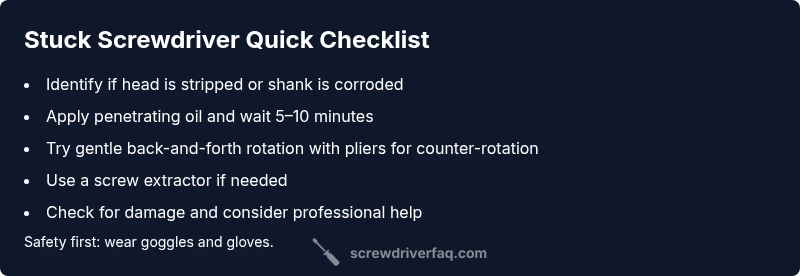
Start with a non-destructive approach: spray a light amount of penetrating oil around the head and allow 5–10 minutes for the oil to penetrate. Then attempt a gentle back-and-forth twist using controlled force, supported by locking pliers on the shank or a second driver for counter-rotation. If the head remains stuck, switch to a screw extractor kit designed to bite into damaged heads while offering a secure grip for removal. Avoid prying with metal tools that can gouge the surrounding material. For added leverage, you can sometimes twist the screw slightly in the opposite direction to realign threads before trying again.
If this doesn’t work, reapply penetrating oil, try a different extractor bit, and confirm that the screw and driver are clean and free of burrs. Do not force the instrument deeper into the workpiece; apply steady, measured pressure to minimize damage. In some cases, warming the surrounding area gently with a heat source can loosen seized metal—but only if the material can safely withstand temperature changes.
Prevention tips to avoid future jams
Keep your screwdriver tips sharp and properly matched to the screw head. Regularly clean out debris from drive recesses and store tools in a dry, rust-free environment to prevent corrosion. Lubricate screw threads when appropriate, especially in metal-to-metal assemblies, to reduce friction on future removals. If you frequently encounter exposed fasteners, consider carrying a small extractor kit and penetrating oil in your toolkit. Use the correct torque for fasteners and avoid overtightening, which often contributes to binding and makes a screwdriver won’t come out scenario more likely in subsequent tasks.
Finally, give each job a quick post-mortem check: was the screw removed cleanly, or is there visible damage that suggests an extractor will be needed next time? Learning from each instance reduces the likelihood of future stuck screwdriver moments and improves overall DIY efficiency.
Steps
Estimated time: 30-60 minutes
- 1
STOP applying force and assess safety
Cease twisting immediately to avoid snapping the driver or damaging the workpiece. Put on eye protection and clear the area of loose debris. Confirm the area is stable before proceeding.
Tip: Bracing the workpiece with a clamp reduces slip. - 2
CLEAN and inspect the interface
Remove visible debris from the screw head and drive recess. Look for rounding or chipping on the tip and head that could prevent engagement.
Tip: A bright light helps reveal wear you might miss. - 3
Apply penetrating oil and wait
Lubricate around the head and let the solvent work for several minutes to loosen binding, especially if corrosion is present.
Tip: Do not over-saturate; a light coat is enough. - 4
Try gentle back-and-forth rotation
Use controlled turns with counter-pressure from pliers on the shank. If the head spins instead of the screw moving, stop and switch approaches.
Tip: Small, repeated motions beat brute force. - 5
Engage a screw extractor if needed
Choose an extractor bit matching the screw head type. Drill or drive the extractor per kit instructions to bite into the damaged head.
Tip: Follow safety guidelines to avoid snapping the extractor. - 6
Reassess and finish removal
Once the driver or screw head engages, apply steady pressure to back the screw out. If you still can't remove, stop and seek professional help to prevent material damage.
Tip: Document the process for future projects.
Diagnosis: Screwdriver won't come out after tightening or during removal attempt
Possible Causes
- highStripped or damaged screw head causing poor engagement
- highRust, corrosion, or debris binding the shank with the screw
- mediumMismatched screwdriver profile or worn tip
- mediumThread-locking compound or adhesive between driver and screw
- lowCross-threading or a damaged screw thread blocking rotation
Fixes
- easyApply penetrating oil and allow to soak; retry with gentle, controlled turns
- easyClamp the shank with locking pliers and rotate the driver to back out the screw
- mediumUse a screw extractor kit to bite into the damaged head and remove
- easyClean the drive recess and switch to a correctly matched tip
- easyIf removal remains impossible, stop and seek professional help to avoid further damage
Quick Answers
Why won't my screwdriver come out even after removing the screw?
Often the driver is still wedged by a damaged head, corrosion, or debris. Check seating, use penetrating oil, and consider an extractor if the head remains bound. Do not force the driver further into the workpiece.
The driver may still be gripped by corrosion or a damaged head. Try lubrication, realigning the driver, and, if needed, an extractor kit.
Can a damaged screw head be saved?
If the head is stripped, you may need a screw extractor or a compatible driver with a tighter fit. In some cases, drilling out the screw is necessary. Always prioritize tool integrity and avoid forcing the head further.
With a damaged head, use an extractor or a drill-out approach if needed, but avoid forcing it.
Is it safe to tap the screwdriver with a hammer to loosen it?
No. Hammering can damage the screwdriver, screw, and surrounding material. If gentle taps are needed, use a rubber mallet on the workpiece, not the screwdriver, and rely on lubricant first.
Don’t hammer or pry aggressively; use lubricant and controlled movements.
What tools help remove a stuck screwdriver?
Penetrating oil, locking pliers, a compatible screwdriver, and a screw extractor kit are the primary tools. In difficult cases, a drill or professional extraction may be required.
Penetrating oil, locking pliers, and an extractor kit are your best bets; call for help if needed.
When should I seek professional help?
If the screw is in a fragile surface or critical component, or if repeated attempts risk further damage, a professional should handle removal to prevent structural or cosmetic injury.
If in doubt, get a professional to avoid more damage.
Watch Video
The Essentials
- Identify root cause: head damage, corrosion, or misfit.
- Start with lubrication and gentle leverage, not brute force.
- Use extraction tools when needed to avoid further damage.
- Prevention matters: proper storage and matching tips save time.
- When in doubt, seek professional help to avoid costly mistakes.