How to Remove Torx Screws Without a Screwdriver
Learn practical, safe techniques to remove Torx screws when you don't have the proper Torx driver. This step-by-step guide covers improvised tools, safety tips, and troubleshooting to minimize damage and complete the job.


With the right improvised tools and careful technique, you can remove Torx screws without a dedicated Torx driver. Start by evaluating the screw head visibility, secure the workpiece, and choose a safe substitute tool (like a coin or small pliers). Avoid excessive force to prevent head stripping, and switch methods if the head slips.
What is a Torx screw and when might you need to remove one without a screwdriver\n\nTorx screws feature a six-point star-shaped pattern designed for high torque and reduced cam-out. In field repairs or DIY tasks, you might not have a dedicated Torx driver on hand. The question how to remove torx screws without screwdriver becomes practical when you need a quick fix using what’s nearby. This section explains the fundamentals, why Torx heads resist slipping, and how improvised tools can help without damaging the surrounding material. Remember that success depends on visibility of the head, the material you’re working with, and your steadiness during rotation; always start with the least invasive method and proceed with care.
Safety first: risks and precautions\n\nSafety should guide every improvised removal. Wear safety glasses and, if possible, gloves to prevent cuts when the head slips. Secure the component to prevent other parts from moving, and work on a stable surface with adequate lighting. Torx screws can slip or strip if you apply too much torque or use the wrong substitute tool. If you’re dealing with electronics or plastics, discharge any static before touching components. If in doubt, pause and reassess; forcing a stubborn fastener usually makes the problem worse.
Tools you can use in lieu of a screwdriver\n\nYou don’t always need a Torx bit to back out a Torx screw. Household substitutes can work in a pinch: a flat coin, a small flat-head blade, or a precision needle-nose plier. A bent paperclip or a tiny multitool tip can also engage a few hex-shaped or recessed areas. The key is to distribute torque evenly and avoid gouging the head. Test-fit any improvised tool in a dry, controlled way before turning.
Improvised methods overview: choose your path\n\nThere are several legitimate options when you lack a Torx driver. The coin method relies on the flat edge to engage the peripheral notches; the pliers method uses grip to rotate the screw if enough head is exposed; the spudger or plastic pick approach can be used for shallow screws where the head is slightly proud. Each method has pros and cons depending on head depth, material, and screw size. Start with the least destructive option and progress as needed.
When to avoid improvised tools\n\nIf the screw head is deeply recessed, heavily stripped, or the surrounding material is soft or valuable, improvisation may cause more harm than good. In those cases, consider trimming or drilling as a last resort, or seek professional help. Always aim to preserve the fastener for possible reuse; if you damage the head, you may need to replace the screw entirely.
Common mistakes and how to avoid\n\nCommon errors include applying excessive torque, using a tool that can’t grip, or slipping and scratching the surface. To avoid these, ensure the tool has a stable grip, use light, incremental turns, and stop immediately if the head shows signs of cam-out or rounding. If you feel resistance, switch to a different method rather than forcing.
Maintenance and prevention after removal\n\nAfter a successful removal, inspect the thread for damage and clean out debris. If the screw is reusable, apply a light lubricant or anti-seize compound, and consider using a screwdriver or driver with a proper Torx bit next time to prevent damage. For future projects, store a small selection of Torx bits and adaptors to reduce reliance on improvised tools.
Authority sources and further reading\nFor safety and best practices, consult authoritative resources on tool use and material handling. See OSHA guidance on general tool safety and CPSC guidelines on consumer product safety, which emphasize safe handling of fasteners and protective gear. These references help frame sensible, risk-aware DIY work.
Tools & Materials
- Needle-nose pliers(Grips exposed screw heads or corners; avoid squeezing too hard.)
- Flat coin (e.g., penny or dime)(Use the edge to engage the Torx perimeter if head is exposed.)
- Small flat-head screwdriver substitute (blade)(Only if it fits without slipping; avoid marring.)
- Plastic spudger or flexible pry tool(Useful for shallow heads and plastic components.)
- Safety glasses(Protect eyes from potential slips.)
- Gloves(Add grip and protect skin in rough work.)
Steps
Estimated time: 15-30 minutes
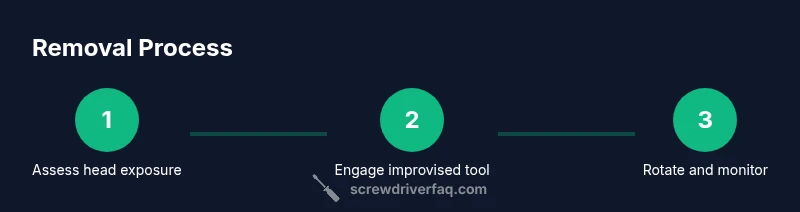
- 1
Assess screw head exposure
Inspect how much of the Torx head is visible and determine if your improvised tool will reach the edges. Confirm the surrounding material is stable and won't crack or bend under light torque. Plan your approach before touching the fastener.
Tip: Choose the least invasive method first and test fit without turning. - 2
Pick a safe substitute tool
Select a tool that offers the best grip and least chance of slippage for the given head depth. A coin works for slightly exposed heads; needle-nose pliers can grab quick edges for more exposed heads.
Tip: Practice a dry-fit to confirm the tool engages properly. - 3
Engage and rotate gently
Position the tool, align with the head, and apply light torque. If the head slips, stop and switch to a different tool rather than forcing the screw.
Tip: Use incremental turns; patience reduces damage. - 4
Monitor for cam-out and damage
Watch for metal burrs, surface scratching, or the head rounding. If you see any, back off immediately and reassess.
Tip: A little oil or lubricant can help in metal-to-metal interfaces, but use sparingly. - 5
Proceed to extraction
Once the head is adequately engaged and turning freely, continue rotating until the screw backs out. If it stops, reorient and try another method.
Tip: Don’t twist past a gentle bite; continue in small increments. - 6
Remove and inspect
Take the screw out slowly, examine the thread condition, and clean any debris. Decide whether to reuse or replace the screw based on head integrity.
Tip: If the screw is compromised, replace it to avoid future issues.
Quick Answers
Can I remove a Torx screw without any tool?
Yes, in some cases a screw with visible head can be manipulated using household substitutes like a coin or pliers. If the head is recessed or damaged, improvised methods may fail and risk damage.
You can try, but don’t force it if the head looks damaged.
Is it safe to use a coin on a Torx screw?
A coin can engage the outer edge for certain head depths, but it’s easy to slip and scratch. Use caution and only on shallow, accessible heads.
A coin can work on shallow heads, but watch for slipping.
What should I do if the screw head is stripped?
If the head strips, stop and switch methods or consider professional help. Replacing the screw is often safer than forcing it.
If stripped, stop and reassess. Replacing may be necessary.
Will improvised tools damage plastic components?
Yes, metal tools can gouge or crack plastic parts. Use protective pads and avoid excessive force near delicate surfaces.
Be careful with plastics; protect surrounding parts.
Are Torx screws harder to remove than Phillips screws?
Torx heads are designed for higher torque, but removal difficulty depends on the manufacturing quality and head condition rather than the head type alone.
Torx can be tougher, but it depends on the head condition.
Can I reuse a screw removed by improvised methods?
If the head or threads show any damage, replace the screw to avoid future issues. Reuse is only safe when the fastener remains intact.
Only reuse if it’s undamaged.
Watch Video
The Essentials
- Assess risks before attempting improvisation.
- Start with the least destructive method.
- Protect yourself with safety gear and good lighting.
- Stop if the head strips and switch approaches.