Substitute for Star Screwdriver: Practical Alternatives and Tips
Discover practical substitutes for a star screwdriver, including Torx-compatible options, flats, and hex keys. Learn safe, effective techniques with step-by-step guidance for DIY projects.


Discover practical substitutes for a star screwdriver (Torx). When a Torx bit isn’t available, you can often use a compatible bit with an adapter, a carefully chosen flathead or Phillips tip, or a precision hex key as a last resort. This guide explains safe, effective options and how to avoid damaging screws.
What is a star screwdriver?
According to Screwdriver FAQ, a star screwdriver typically refers to a Torx driver, recognized by a six-point star-shaped recess. Torx fasteners are designed to resist cam-out and distribute torque more evenly than older slot or Phillips heads. In many DIY projects, homeowners encounter star screws on furniture, electronics casings, and automotive components. Understanding what constitutes a star screwdriver helps you identify legitimate substitutes quickly, without risking stripped screws or damaged threads. The key is recognizing the exact shape and size of the recess and matching it with a compatible tool or a safe substitute when the original Torx bit isn’t at hand. This knowledge is foundational for choosing the right substitute for star screwdriver tasks.
When you might need a substitute
There are situations where you won’t have a Torx bit handy, yet you still need a working tool. A missing star bit can stall a repair, especially if the fastener is buried in a tight space or part of a sensitive assembly. In these moments, substitutes become a practical workaround. The best substitutes are those that engage the screw head securely, minimize wear on the recess, and allow controlled torque application. Your goal is to avoid cam-out, stripping, and slips that could render the fastener unusable or damage the surrounding material. This section outlines safe, reliable substitutes you can rely on in a typical home workshop. As noted by the Screwdriver FAQ team, planning ahead with a small set of compatible bits dramatically reduces friction during a project.
Common substitute options (Torx-compatible and alternatives)
There are several strategies for substituting a star screwdriver, depending on what you have in your toolbox and the screw size. The most reliable option is a Torx bit that matches the screw head paired with an adapter or driver that holds the bit securely. If a Torx bit isn’t available, a flathead or Phillips tip of the correct profile can sometimes work, but only when the recess is sufficiently wide and the tip can seat fully without touching the sides of the recess. Another option is a hex/Allen key if the screw head has a compatible internal geometry or if you can engage multiple tiny flats safely. Each method carries a trade-off between torque, control, and risk of damage. In practice, the safest substitutes are those that maximize contact area and fit flush with the head, reducing the chance of slips.
Assessing the screw head size and type
Before attempting any substitute, identify the exact screw head type and size. Torx head sizes are labeled T5, T6, T7, up through larger numbers; the goal is to match the bit profile as closely as possible. If you’re unsure, test on a scrap fastener with a similar profile to gauge engagement. Misidentifying a star screw as a standard hex or Philips can lead to cam-out and permanent damage. Use a loupe or magnifier in tight spaces and compare the head to size charts from reputable sources. This careful assessment reduces the risk of damaging the fastener or the parts surrounding it.
Using adapters and multi-bit drivers safely
Adapters and multi-bit drivers expand your options without committing to a single bit. Attach a Torx bit to a driver with a compatible chuck, then secure the bit with a bit holder or magnetic insert to prevent dropping the bit in hard-to-reach spaces. Ensure the driver’s torque is appropriate for the screw material. If the bit doesn’t seat evenly, stop and consider an alternative. The goal is to maintain alignment and provide steady pressure rather than brute force. When in doubt, switch to a different substitute rather than forcing a poor fit.
Tips to avoid cam-out and damage
Cam-out happens when the bit slips out of the screw head under torque. To minimize this, start with the smallest possible substitute that fits, maintain straight alignment, and apply gradual, controlled torque. Use a driver with a comfortable grip and, if possible, a low-torque setting for initial engagement. Keep the workpiece stable with clamps and a non-slip mat. If you hear slipping or see the bit slipping along the edges of the recess, stop immediately and reassess the fit. Re-check alignment, bit size, and seating depth before reapplying force.
Choosing substitutes by screw size and material
Screw material (wood, metal, plastic) affects how much torque you should apply and how forgiving a substitute can be. In wood, threads often tolerate a slightly looser fit; in metal, a precise engagement is critical to avoid stripping. For larger screws, Torx bits with proper adapters are typically best. For smaller screws, precise flathead or Phillips tips may work if the head recess allows full seating. Always practice on a spare fastener or scrap material when possible, and avoid forcing any substitute into a head it cannot securely engage.
Real-world scenarios and examples
Imagine you’re assembling a piece of flat-pack furniture with star screws and you don’t have a Torx bit in the exact size. A common workaround is to use a Torx bit slightly larger in a low-torque driver with an adapter, testing on a scrap piece first. In electronics, tiny star screws can often be addressed with a precision hex key or a max-fit flathead, provided the recess is wide enough. For automotive electronics, where the stakes are higher, always check the recommended torque specs and consider replacing the fastener if the head shows wear. These real-world examples illustrate why a small set of substitutes is a smart investment for DIYers.
Maintenance and prevention
To prevent future stalls, maintain a small, organized set of substitutes: a Torx bit set with a universal adapter, a few flathead and Phillips tips that fit common sizes, and a handful of hex keys. Keep bits clean and dry to avoid corrosion, and label storage so you can quickly grab the correct size. Regularly inspect bits for rounding or slippage indicators and replace worn tools promptly. Proper organization reduces search time, helps you select the correct substitute, and keeps project momentum going.
Authority Sources
For further reading and safety foundations, refer to these reputable sources:
- OSHA: https://www.osha.gov
- NIST: https://www.nist.gov
- ANSI: https://www.ansi.org
These sources provide guidelines on hand-tool handling and standardization that support careful substitution practices in everyday DIY work.
Tools & Materials
- Torx bit set (T8–T60 range)(Choose sizes matching common star screw heads)
- Bit adapter or quick-release handle(Allows using Torx bit in non-Torx drivers)
- Flathead screwdriver (slotted)(Use only if tip size matches; may damage edge锐 if misfit)
- Phillips screwdriver (PH) with compatible size(Can substitute for some star screws with matching profile)
- Hex/Allen keys (matching sizes)(Use only if the screw head supports this engagement)
Steps
Estimated time: Total time: 25-45 minutes
- 1
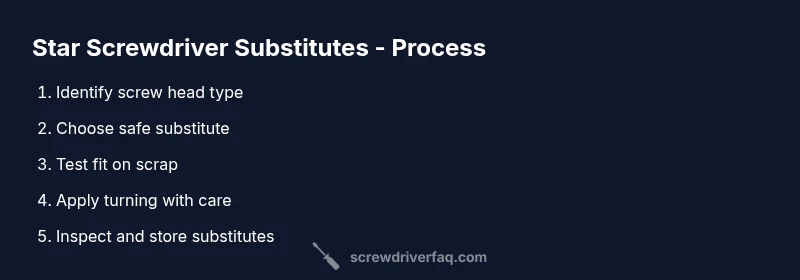
Identify the screw head type
Inspect the screw head to confirm it is a star/Torx type and note the approximate size. Compare with a Torx size chart and, if needed, use a loupe for closer inspection. Correct identification reduces the risk of choosing an incompatible substitute.
Tip: Use good lighting and a magnifier to avoid misidentification. - 2
Choose an appropriate substitute option
Select a substitute based on the head size and available tools—prefer a Torx bit with an adapter, then consider flathead or Phillips only if they truly fit without wobble.
Tip: Start with the smallest compatible bit to test engagement. - 3
Secure the bit in your driver
Insert the bit firmly into the driver and ensure it seats fully. A loose bit increases cam-out risk and can strip the screw head.
Tip: Use a bit holder or magnetic tip to prevent dropping the bit in tight spaces. - 4
Test fit on a scrap screw
Before touching the real fastener, test the bit in a scrap screw to verify engagement and seating depth. If it doesn’t fit snugly, stop and switch to another option.
Tip: Testing on scrap helps save the finished piece from damage. - 5
Begin turning slowly with steady pressure
Apply gradual, steady torque, keeping the tool aligned with the screw head. If you feel slippage, stop and reassess the fit.
Tip: Use low torque settings for beginning engagement. - 6
Watch for cam-out and adjust
If the bit starts to slip, do not push harder. Re-seat, switch to a better-fitting substitute, or switch to a different bit size.
Tip: Better to stop and switch than to force a bad fit. - 7
Finish the job and inspect
Complete the turn, check that the screw is seated flat, and inspect for any signs of head wear. If the head shows damage, replace the fastener.
Tip: Inspect the screw and surrounding material for damage after removal. - 8
Store substitutes properly
Return bits to their holder, label by size, and keep the kit dry. A well-organized set improves speed and reduces errors on future projects.
Tip: Labeling saves time and avoids mismatched substitutions later.
Quick Answers
What is a star screwdriver?
A star screwdriver refers to a Torx driver with a star-shaped recess. Substitutes are possible when you can securely engage the head without stripping the recess.
A star screwdriver is a Torx driver with a star head. Substitutes can work if they fit snugly and engage securely.
Can I use a flathead or Phillips instead of a star screw?
Only if the head size matches and the bit seats fully without slipping. Mismatches can strip the head and damage the fastener.
Only if the tip fits the head properly; otherwise avoid the substitute.
What substitutes are safest?
Torx bits with an adapter are the safest first choice. If unavailable, use a precisely matched flathead or Phillips tip as a last resort.
Torx bits with an adapter are usually safest; otherwise, use other precise fits.
Will substitutes damage screws or components?
Yes, improper substitution can damage the screw head or surrounding components. Test on scrap first and stop if fit is poor.
Yes, improper substitutes can cause damage; test on scrap first.
How do I know which Torx size to use?
Compare the screw head to Torx size charts; avoid guessing. If in doubt, choose the closest smaller size and test carefully.
Compare to Torx size charts and test carefully.
What about using a wrench or pliers as a substitute?
Not recommended; it can crush the head and deform the screw recess. Use only as a last resort and with extreme care.
Not recommended except as a last resort.
Watch Video
The Essentials
- Know when a substitute is appropriate.
- Match bit profile to screw head to minimize damage.
- Use adapters and proper technique to avoid cam-out.
- Keep a basic set of substitutes handy.