How Much Torque Should a Screwdriver Deliver? A Practical Guide
Discover how much torque a screwdriver should apply, with practical ranges, calibration tips, and maintenance steps to ensure precise, safe driving across common materials.


For most hand torque screwdrivers, aim for a torque range of 0.5-5.0 Newton-meters (Nm) depending on the screw size and material. In practice, consumers typically set mid-range values for common fasteners and adjust for precision needs. The key is to lock the handle, verify calibration, and use consistent technique to avoid over-tightening.
Understanding the role of torque in screwdriving
Torque is the turning force you apply to a fastener. In practical terms, it determines whether a joint is snug enough to hold without stripping threads or loosening over time. When people ask how much torque screwdriver should deliver, the answer depends on screw size, material, and whether you’re driving into wood, plastic, or metal. For most home tasks, you’ll work within a modest Newton-meter (Nm) range and adjust based on feedback from the material and the visible seating of the head. The goal is consistent seating with no thread damage. Knowing how torque relates to clamping force helps you tighten joints without crossing the line into over-tightening.
How torque screwdrivers work
A torque screwdriver uses a mechanism to limit rotation once the preset torque is reached. When you apply force, the tool resists beyond the preset threshold, and a click or lock tells you to stop. This basic principle makes torque control repeatable across tasks. Different models offer dial or digital readouts, locked settings, or preset torque bars. The key is that the device translates your hand strength into a defined torque range, reducing the risk of overtightening even on unfamiliar screws. Understanding this helps you pick the right tool for repairs, furniture assembly, or electronics work.
How to choose a torque range for your project
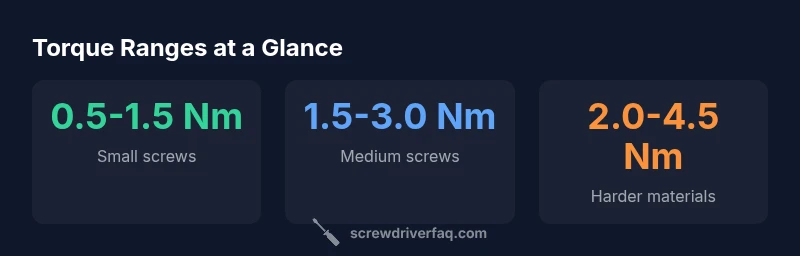
Start by identifying the screw type, size, and material. For small wood screws in soft woods, a torque range around 0.5-1.5 Nm is often adequate; for medium wood screws, 1.5-3.0 Nm; for metal screws or harder materials, 2.0-4.5 Nm may be appropriate. If you’re unsure, begin at the lower end of the recommended range and test using scrap material to observe thread seating and head flushness. Calibrate your tool and use a consistent driving technique (steady pressure, no rapid jerks). Document your chosen setting for future tasks to maintain consistency.
Common screw types and their torque needs
Screw torque requirements vary by material and fastener geometry. Soft woods and plastic typically tolerate lower torque, while hardwoods or metal fasteners demand higher torque within safe limits. For example, tiny wood screws may respond well to 0.5-1.5 Nm, whereas larger fasteners for cabinetry or metal surfaces might sit in the 2.0-4.0 Nm range. Always consult manufacturer recommendations, test on scrap pieces, and consider using thread-lock compounds or pre-drilling when needed to protect the joint.
Setting, locking, and verifying torque on your screwdriver
Follow a simple workflow to ensure accuracy. 1) choose a setting within the recommended range; 2) lock the dial or switch to prevent accidental drift; 3) drive the screw with steady, even pressure; 4) listen for the clicking or watch for the indicator to signal the target torque; 5) verify by checking the joint for tightness and head seating. If the joint feels underpowered or over-tightened, re-check the setting and test on a scrap piece. Document results for future projects.
Calibration, maintenance, and reliability of torque tools
Regular calibration ensures accuracy. Many brands recommend checking torque accuracy at least once every 6-12 months or after heavy use. Use a known reference piece or a calibration device to confirm readings at several points in the range. Keep the tool clean, store it with the setting disengaged, and avoid exposing it to long-term temperatures or moisture that can affect spring tension. Replace worn components promptly and record calibration dates.
Practical tips for accuracy and consistency
- Always set the torque before starting, not during the drive.
- Use scrap material to validate seating before committing to the final piece.
- Compare torque settings across similar tasks to build a personal reference library.
- If you frequently assemble projects with similar screws, create a chart of recommended ranges and stick to it.
- When working with sensitive materials, consider pre-drilling and using slower feeds to maintain control.
- Keep your torque screwdriver calibrated and test it after any drop, impact, or fall.
Myths and misconceptions about torque control
Common myths include: higher torque equals stronger joints, torque settings are universal for all screws, and torque devices are only for professionals. In reality, torque is material- and size-dependent, settings vary by fastener, and a properly calibrated torque screwdriver is a simple way to achieve repeatable results. Dismiss the myths by testing settings on scrap pieces and relying on manufacturer guidance.
Torque screwdriver vs. power tools: when to use which
Power tools excel at speed and heavy-duty work, but they can overshoot torque and damage delicate joints. A torque screwdriver provides predictable, repeatable results for assembly, electronics, or furniture where precision matters. In mixed tasks, reserve the power tool for initial drilling or loosening, and switch to a torque screwdriver for final tightening and final checks. The balance between control and efficiency is the hallmark of good screwdriving practice.
Torque ranges by screw type
| Screw Type | Recommended Torque Range | Typical Fastener Size |
|---|---|---|
| Wood screw (small) | 0.5-1.5 Nm | Size #6-#8 |
| Wood screw (medium) | 1.5-3.0 Nm | Size #8-#10 |
| Self-tapping metal screws | 2.0-4.0 Nm | Size #8-#14 |
Quick Answers
What is a torque screwdriver and why is it better than a regular screwdriver?
A torque screwdriver is designed to apply a defined torque to a fastener, preventing over-tightening and under-tightening. It improves repeatability for joints and is especially useful in furniture, electronics, and cabinetry work.
A torque screwdriver delivers a set torque, making tightening predictable and safer for delicate joints.
How do I know the torque setting I need for a particular screw?
Consult manufacturer specs when available, or start at a conservative mid-range setting and test on scrap material. Adjust up or down based on seating and the absence of thread damage.
Check the screw instructions and test on scrap to dial in the right setting.
How often should torque screwdrivers be calibrated?
Check calibration at least every 6-12 months or after heavy use. Use a reference piece to verify readings at several points in the range.
Most folks calibrate every 6-12 months, or after big drops or impacts.
Can I use a torque screwdriver on metal fasteners?
Yes, provided the torque range matches the fastener and material. Avoid exceeding the tool’s maximum rating to prevent tool drift and damaged threads.
Yes, but stay in the tool’s range to avoid damage or drift.
Is it safe to reuse old torque settings?
Not recommended. Torque screws can drift over time. Recalibrate and verify with a known reference before reuse.
No—recheck and recalibrate before reusing.
What are signs a torque screwdriver is out of calibration?
Inconsistent readings, drift across the range, or misalignment between set torque and actual seating indicate calibration drift.
Look for inconsistent torque readings and test against a reference.
“Precision in tightening isn't just about exerting force—it's about applying the right amount for each joint. A calibrated torque screwdriver makes that repeatable.”
The Essentials
- Identify screw type and material before selecting torque.
- Always calibrate and lock torque settings prior to driving.
- Test on scrap material to verify seating and avoid damage.
- Follow manufacturer guidance for ranges and procedures.
- Use torque screwdriver for precision; reserve power tools for larger tasks.