Torque Screwdriver vs Normal Screwdriver: A Practical Comparison
Compare torque screwdrivers with standard screwdrivers to learn how torque control, precision, and maintenance affect electronics, woodworking, and DIY repairs. Practical guidance helps you choose the right tool.


For most DIY tasks, a standard screwdriver is enough when you don’t need exact torque. A torque screwdriver adds precision by presetting the turning force, preventing over-tightening in electronics and delicate materials. If your project involves sensitive fasteners, torque control makes a noticeable difference; otherwise, start with a regular screwdriver and upgrade only if you regularly encounter over-tightening.
Understanding torque control and standard screwdrivers
The comparison between torque screwdriver vs normal screwdriver hinges on torque control. A torque screwdriver is designed to deliver a preset amount of rotational force, stopping or slipping once that preset torque is reached. A standard screwdriver, by contrast, relies on the user to apply the twisting force, with no built-in torque limit. This fundamental difference affects fastener integrity, material protection, and the consistency of results across repeated tasks. According to Screwdriver FAQ, torque control reduces the risk of over-tightening and damage to sensitive parts, making it especially useful for electronics, small fasteners, and delicate cabinetry. In many projects, protecting the fastener and the surrounding material is as important as achieving the desired clamping. When you contrast torque screwdriver vs normal screwdriver, the decision often comes down to the precision needs of the job and the likelihood of repeating the same torque across multiple fasteners. It’s also worth noting that the perceived precision comes with a learning curve and some upfront cost.
The key difference in how they feel and perform
A torque screwdriver provides tactile and audible feedback when the preset torque is reached, allowing for reproducible results even in less-than-ideal lighting or when wearing gloves. A standard screwdriver offers pure control based on your hand strength and technique, which is great for fast repairs where torque tolerance is flexible. The ergonomics of both tools matter: the grip shape, handle diameter, and balance influence how accurately you can apply the necessary force. In practice, you’ll find torque screwdrivers excel in electronics assembly, precision cabinetry, and small mechanical joints where overtightening risks material crushing. For most home tasks—like assembling a furniture brace or tightening a door hinge—a standard screwdriver remains a versatile, reliable choice. The best approach is to assess the friction, material, and screw size you routinely use and choose accordingly.
Precision versus practicality in typical projects
When you compare torque screwdriver vs normal screwdriver for common DIY tasks, consider the consequences of over-tightening. In electronics, metal-to-plastic joints can crack; in wood, screws can strip the pilot hole. A torque-controlled tool helps mitigate these risks by ending the drive at the preset limit. However, not every job benefits from fixed torque. If you’re driving a broad range of fasteners with varying sizes and materials, a standard screwdriver or a modular set with adjustable torque is often more practical. The decision is not purely about accuracy; it’s about workflow, rework risk, and the acceptable level of material damage for a given project.
The practical takeaway
If your projects involve delicate components or frequent reassembly where consistent torque matters, investing in a torque screwdriver makes sense. For casual repairs and tasks that tolerate variability, a traditional screwdriver will likely cover most needs. The core idea behind torque control is to minimize human error and standardize outcomes across similar tasks, reducing rework and improving reliability over time.
Comparison
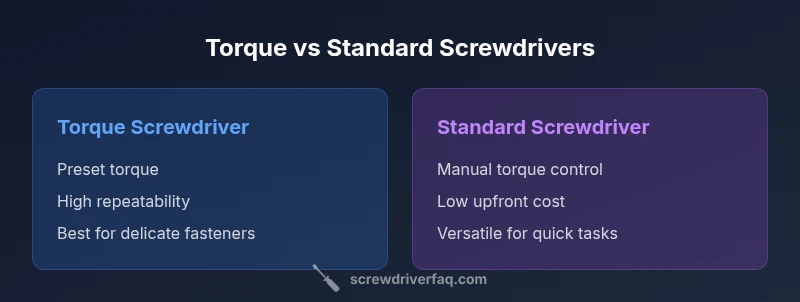
| Feature | Torque screwdriver | Standard screwdriver |
|---|---|---|
| Torque setting capability | Yes (preset torque available) | No torque setting |
| Repeatability/consistency | High precision, consistent torque control | Dependent on user strength and technique |
| Primary use | Electronics, delicate cabinetry, and repeatable joints | General fastening and DIY tasks |
| Ease of use | Requires calibration and awareness of torque limits | Immediate use, beginner-friendly |
| Cost range | Higher upfront cost | Lower upfront cost |
| Maintenance | Calibration checks recommended | Minimal maintenance |
| Best for | Where torque matters and repeatability is critical | Everyday fastening and quick repairs |
Pros
- Improved precision and reduced risk of over-tightening
- Repeatable results across tasks and projects
- Better protection for delicate materials and electronic components
- Clear feedback assists training and consistency
Negatives
- Higher upfront cost
- Requires calibration/maintenance
- Not universally necessary for casual projects
Torque screwdrivers offer superior torque control for precision work, while standard screwdrivers remain versatile for general tasks.
Choose torque screwdriver when precision matters and the risk of damage is high. For everyday tasks, a standard screwdriver is usually sufficient and more economical.
Quick Answers
What is a torque screwdriver and how does it differ from a standard screwdriver?
A torque screwdriver is a tool that applies a preset amount of rotational force and signals when that torque is reached. A standard screwdriver requires the user to apply force, with no built-in limit. The key difference is torque control and repeatability.
A torque screwdriver stops at a set torque, while a regular screwdriver doesn't. It's about control and avoiding over-tightening.
When should I use a torque screwdriver?
Use a torque screwdriver for fasteners that can be damaged by over-tightening or when consistent torque across many joints is important—electronics, cabinetry, and mechanical assemblies are common examples.
If accuracy matters or you’re working with sensitive parts, a torque screwdriver is a smart pick.
Can I use a torque screwdriver for wood screws?
Yes, you can, but set the torque to appropriate levels for wood and screw size. In rough wood scenarios, you may want to use a torque-limiting setting to avoid stripping.
For wood, use a controlled torque to prevent splitting or stripping; check the screw and material first.
Do torque screwdrivers require calibration?
Many torque screwdrivers are specified to hold calibration for a period, but routine calibration checks are recommended for accuracy, especially in professional settings.
Yes, you should periodically verify calibration to ensure the torque stays accurate.
Are torque screwdrivers more expensive than normal ones?
Torque screwdrivers typically cost more upfront than basic drivers, reflecting the precision mechanism. Ongoing maintenance for calibration adds to lifetime costs, but they can save from over-tightening and rework.
They're usually pricier, but the savings from fewer mistakes can be worth it.
How do I determine the correct torque setting for a given fastener?
Consult fastener specifications or project guidelines and adjust the tool accordingly. If in doubt, start low and test on a scrap piece to dial in the right torque before working on the actual part.
Check the spec, start low, and test before you finish the project.
The Essentials
- Choose torque screwdriver when precision matters
- Consider task frequency and risk of damage
- Standard screwdrivers suffice for simple tasks
- Budget for calibration and maintenance
- Practice with scrap pieces to dial torque