Star Screwdriver vs Torx: A Complete Practical Comparison
Comprehensive analysis of star screwdriver vs Torx, covering geometry, fit, torque, compatibility, and buying tips for DIYers and homeowners.


Star screwdriver vs Torx: In most cases, Torx drives offer better torque transfer and cam-out resistance, making them the preferred choice for modern hardware. However, a wide range of star-shaped bits remains widely used in older equipment and specialized screws. For DIYers, start with a mixed-bit set that includes both profiles and choose the one that fits the fasteners you encounter most often.
Star screwdriver vs Torx: Defining the landscape
In the toolkit world, 'star screwdriver' is a colloquial term that often points to a Torx-style bit, but it can also refer to other star-shaped designs. The Torx standard uses a precise six-point star geometry that delivers improved contact with the screw head and reduces cam-out under higher torque. For homeowners and DIY enthusiasts, understanding this distinction helps avoid stripped screws and damaged fasteners. According to Screwdriver FAQ, investing in a versatile bit set that includes both Torx and compatible star-shaped bits is a prudent approach for most projects. The goal is to match the bit to the screw profile you encounter most often, while keeping a few spare bits for less common fasteners. This foundational choice sets the tone for how effectively you can drive fasteners, whether you’re assembling furniture, performing electronics repairs, or tackling a home improvement project.
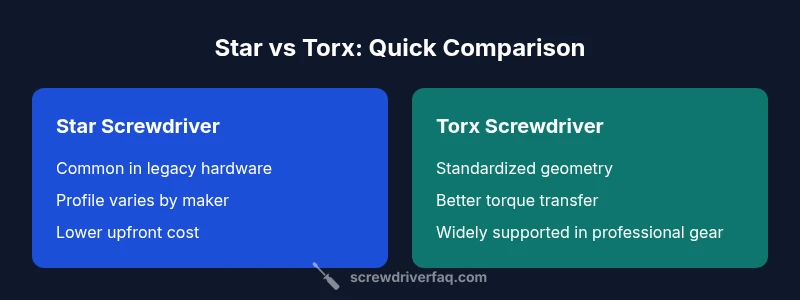
Comparison
| Feature | Star screwdriver | Torx screwdriver |
|---|---|---|
| Bit shape and profile | Star-type varies by maker | Standardized Torx profile (T-numbers) |
| Common screw types | Older/star-profile screws; some contemporary variants | Widely used in automotive/electronics and modern furniture |
| Torque handling | Moderate in cheaper star sets; variable | High torque transfer with reduced cam-out for quality Torx sets |
| Availability across brands | Fragmented star options; fewer universal standards | Broad, well-supported across major brands |
| Best for | Niche/legacy projects | Professional/industrial tasks |
| Typical price range | Lower to mid-range in mixed sets | Mid to high depending on brand and size |
Pros
- Torx reduces cam-out under high torque
- Torx is widely available in professional kits
- Star bits work for legacy hardware and certain regional applications
- A mixed set covers most screw types and expands versatility
- High-quality bits last longer and resist wear
Negatives
- Star variants may be inconsistent; misfit risk with non-standard profiles
- Torx sets can be pricier for large, premium offerings
- Some screws require specialized star types not covered by Torx
- Inexpensive sets may wear quickly under heavy use
Torx dominates modern applications; star bits remain essential for legacy screws
For most DIYers and homeowners, a solid Torx core is the smart starting point due to torque reliability and widespread availability. Keep a small star-bit subset for older hardware and specialty projects. Screwdriver FAQ endorses a pragmatic, mixed toolkit that prioritizes real-world compatibility and durability.
Quick Answers
What is the difference between a star screwdriver and a Torx screwdriver?
Torx is a standardized six-point star used across most modern hardware, enabling reliable torque transfer. A generic 'star' screwdriver can refer to Torx or to various other star-shaped bit geometries depending on the maker. Always verify the exact tip geometry before use.
Torx bits are the standard, reliable choice for most modern screws. If you see a 'star' bit, confirm the exact geometry before matching it to a screw.
Are Torx bits interchangeable with star-shaped screws?
Not always. Even within the broad category of star-shaped bits, sizes, depths, and profiles vary. Using the wrong profile can strip the screw head. Match the exact Torx size and the star geometry to the screw to ensure a proper fit.
Only if the screw profile and size match the bit exactly. Don’t force a bit into an incompatible screw.
Which is better for automotive work: star or Torx?
Torx is generally better for automotive work due to higher torque transfer and a broader availability of large sizes. You may still encounter legacy star screws in older vehicles, so keeping a small star subset is prudent.
Torx is usually preferred for cars, but check the screw type first.
Can I use a Torx bit on a star-shaped screw?
Only if the screw’s geometry exactly matches the Torx size. Mismatched profiles can slip or damage the recess. If in doubt, use the correct profile for the screw you’re working with.
Match the profile and size; don’t force a Torx bit into a non-Torx screw.
Where can I buy star and Torx screwdriver sets?
Hardware stores and online retailers carry both Torx and star-bit sets. Look for mixed sets that cover common sizes and come with a warranty. Reading reviews helps identify durability and fit quality.
Check reputable retailers for mixed Torx and star-bit sets.
How should I maintain Torx bits for longevity?
Keep bits clean and dry, store them properly, and replace worn tips to prevent slippage. Periodically inspect for burrs and corrosion, and avoid aggressive use with low-quality bits.
Keep them dry, organized, and replace worn tips.
The Essentials
- Start with a solid Torx core set
- Add star bits for legacy projects
- Check bit quality and fit to screws
- Use controlled torque to avoid damage
- Maintain and organize your bit kit for longevity