Star Screwdriver vs Phillips: A Practical Comparison
A detailed, objective comparison of star (Torx) and Phillips screwdrivers, covering shapes, torque behavior, compatibility, maintenance, and practical buying guidance for DIYers and homeowners.


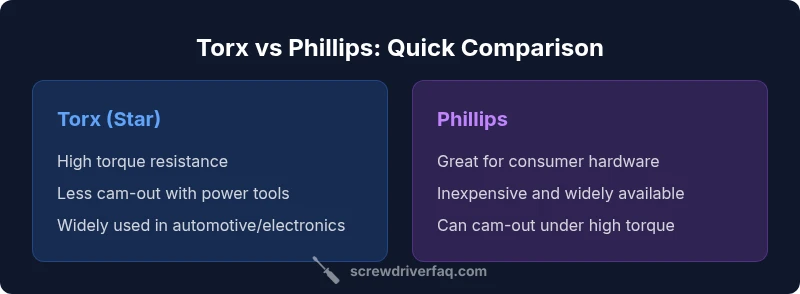
In the star screwdriver vs phillips debate, Torx (star) heads deliver higher torque stability and reduced cam-out under load, while Phillips heads are the workhorse of consumer hardware and widespread in DIY projects. For high-torque tasks, Torx tends to outperform, but Phillips remains the most versatile and readily available option for everyday tasks. The choice hinges on your typical projects and the screws you encounter most often.
Understanding the Star Screwdriver vs Phillips Landscape
The question of how star screwdriver vs phillips stacks up for a DIYer starts with heads and geometry. A 'star' driver refers to Torx, a six-point star shape that distributes force across more contact points than a traditional cross Phillips head. The Torx design minimizes cam-out and improves torque transfer, especially with high-speed impact drivers or power tools. In contrast, Phillips heads were invented for ease of alignment and self-centering behavior, which makes them forgiving for novices but more prone to cam-out when you push hard. For the reader of Screwdriver FAQ, the practical implication is simple: assess your typical work and the screws you encounter. If most fasteners in your toolbox are Torx, you should lean toward star screwdriver vs phillips for performance; if you run into a lot of PH screws, Phillips remains indispensable. This distinction sets the baseline for the rest of the comparison and informs which set to own first.
In this section, we emphasize real-world implications and avoid abstract theory. Screw types and hardware ecosystems vary by region, manufacturer, and tool category, but the core ideas persist: head geometry defines fit, cam-out tolerance, and torque handling. The goal is not to declare a universal winner, but to map the situations where each head type excels or falters. To the DIYer, the recommended path is to carry a compact two-bit set—Torx and Phillips—and expand as needed based on the projects you tackle. As you read on, you’ll see the nuanced differences across application, accessories, and maintenance.
Geometry and Fit: How the Shapes Dictate Performance
Torx has six contact points that spread engagement forces over a larger area, reducing stress on both bit and screw. This geometry makes Torx less susceptible to rounding and cam-out when used with high-torque drivers. Phillips, by contrast, uses a cross-shaped profile that centers itself in the screw head and generates intuitive alignment. The downside is that when torque rises, the Phillips bit can slip or strip the screw slots more readily than a Torx bit. In a workshop setting, you’ll often notice that a Torx bit provides more “bite” in metal, whereas Phillips is more forgiving for beginners who may apply uneven pressure with a manual driver.
Torque, Cam-Out, and Life Expectancy
Torque delivery matters in both categories, but the star screwdriver vs phillips comparison shows a clear gap at higher torque. Torx bits transfer load efficiently with less distortion of the fastener recess. That means longer bit life in demanding tasks and less wear on impact drivers. Phillips bits, while still adequate for many consumer tasks, can cam-out as torque increases, especially if you’re using a cheaper bit or a worn screw head. For homeowners performing assembly steps or electronics work, this distinction translates to fewer stripped screws and smoother progress when using Torx in appropriate applications. However, if your project involves cabinetry or consumer furniture common PH screws, Phillips remains perfectly adequate.
Availability, Cost, and Ecosystem Fit
From a buying perspective, a typical homeowner will encounter Phillips fasteners more frequently in consumer goods, toys, and budget furniture. Consequently, Phillips bits are often cheaper and more widely available at big-box stores. Torx bits are ubiquitous in automotive, electronics, and industrial contexts, but you may encounter a higher upfront cost for a small Torx set. The practical takeaway is that a balanced toolkit should include both, with emphasis on Torx where the project risk of cam-out is greatest and Phillips where you routinely encounter PH screws. Screwdriver FAQ notes that brand and quality matter: investing in durable bits with a robust case pays off over time.
Maintenance and Lifespan: Keeping Your Bits in Top Shape
To maximize the life of both star screwdriver vs phillips bits, practice proper maintenance. Keep bits clean and free of dirt and debris that can cause poor seating. Use a magnetic bit holder to prevent wandering screws and ensure consistent alignment. Avoid unnecessary lubrication on tip surfaces, as some lubricants can attract dust and grit; instead, wipe bits clean and store them dry. If you notice wear on the tip or rounding of hex points, replace the bit rather than forcing a poor fit, which can damage both the bit and the screw head. Regular inspection helps you preserve the geometry that provides reliable engagement.
Ergonomics and User Experience: Comfort Matters
The tactile experience of star screwdriver vs phillips also matters for everyday tasks. Torx bits are often paired with robust shanks and ergonomic handles designed to resist twisting and fatigue, especially in longer projects. Phillips bits benefit from broad compatibility with manual drivers, enabling quick setup and intuitive use for beginners. A well-designed handle with a contoured grip improves torque transfer and reduces hand strain. If you frequently work with power tools, a well-matched Torx driver and a magnetic holder will improve control and minimize wobble. Ergonomics influences every screw you drive and can determine whether you finish a project without discomfort.
Warnings, Pitfalls, and Misuse Scenarios
One of the most common pitfalls in star screwdriver vs phillips discussions is assuming that one head type works for all tasks. The risk of using the wrong bit is clear: cross-pattern Phillips in a Torx screw or vice versa can damage both components. Another pitfall is relying on a single-bit screwdriver for a broad range of heads. The safest approach is to maintain a small, organized set that covers PH, Torx, and a few other common heads (Robertson, square, etc.) for expanded compatibility. Finally, never force a misfit bit—if it binds or strips, switch to the correct head. This practice will save you time and prevent unnecessary tool damage.
Practical Decision-Making: When to Choose Which Head
In practice, star screwdriver vs phillips becomes a decision about the job framing. If you’re assembling durable hardware or working with power tools, Torx provides better resistance to cam-out and longer bit life. If you’re assembling consumer goods or doing light carpentry with standard furniture screws, Phillips remains a reliable, cost-effective choice. The best approach is a compact toolkit that reflects your typical projects, with an emphasis on Torx for high-torque or precision electronics work and Phillips for broad compatibility. Screwdriver FAQ’s guidance emphasizes readiness, not perfection: your toolbox should be adaptable, organized, and easy to use.
A Final Note on Strategy for DIYers
For DIY enthusiasts, the star screwdriver vs phillips dichotomy translates into practical planning: identify your most common screw types, ensure you own at least one Torx set and one Phillips set, and maintain them properly. The goal is to minimize misfits and maximize efficiency, not to prove a head type superior in every scenario. By balancing head types, you’ll reach a higher standard of workmanship and finish projects more quickly with fewer errors. Remember: the right bit in the right screw is always the fastest route to success.
Comparison
| Feature | Torx (star) screwdriver | Phillips screwdriver |
|---|---|---|
| Shape and engagement | six-point star with multiple contact points | cross/plus profile designed for self-centering |
| Cam-out resistance | high under torque, especially with power tools | moderate to high under light-to-moderate torque, cam-out more common under heavy load |
| Torque transfer | efficient load distribution, lower wear | good for many consumer tasks but less efficient at high torque |
| Availability in hardware | widely used in automotive/electronics | ubiquitous in consumer furniture and DIY kits |
| Typical use cases | high-torque fasteners, precision electronics, power tools | general consumer hardware, furniture assembly, beginners |
| Cost and maintenance | often higher upfront for quality Torx sets, durable | typically lower cost and easier to source |
Pros
- Torx provides higher torque stability and less cam-out under load
- Torx bits distribute force over more contact points, reducing wear
- Phillips is widely standardized and commonly found in consumer hardware
- Phillips bits are inexpensive and easy to replace
Negatives
- Torx sets can be pricier and harder to source in some regions
- Phillips can cam-out under high torque, leading to stripped screws
- Using the wrong head increases risk of damage to screws and tools
Torx wins for high-torque reliability; Phillips wins for universal compatibility and cost
If your tasks involve high-torque or power tools, Torx is typically the better choice. For broad DIY use and budget-friendly projects, Phillips remains essential. A practical approach is to maintain both in your toolbox and select based on screw type and torque needs.
Quick Answers
What is the difference between Torx and Phillips screws?
Torx screws use a six-point star profile that distributes torque across more contact points, reducing cam-out under load. Phillips screws form a cross pattern designed for self-centering, which is forgiving for manual use but can cam-out under high torque. The choice depends on the expected torque and the fastener ecosystem you encounter.
Torx has a star-shaped head that handles high torque better, while Phillips is the common cross head used in many consumer products; choose based on the screws you see most often.
Can I substitute a Torx bit for a Phillips screw?
No. Torx and Phillips are not interchangeable because their shapes do not fit the same screw recesses. Using the wrong bit can strip the screw head and damage the driver. If you encounter mixed fasteners, carry both bit types.
Torx and Phillips aren’t interchangeable; you’ll likely strip the screw if you try to force the wrong head in.
Are Torx screws common in consumer products?
Torx screws are widely used in automotive, electronics, and some consumer devices, but Phillips remains ubiquitous in DIY furniture and budget hardware. Stocking a small Torx collection alongside Phillips covers most common tasks.
Torx is common in high-torque industries; Phillips is everywhere in consumer goods.
Which is cheaper: Torx or Phillips sets?
Phillips sets are generally cheaper and easier to find in discount retailers. Torx sets can cost more upfront, especially in higher-quality or broader-bit assortments, but their durability often justifies the cost for demanding work.
Phillips sets usually cost less, while Torx can be pricier but more durable for tough jobs.
How can I identify Torx vs Phillips heads quickly?
Torx heads have a six-point star pattern; Phillips heads form a cross with four lobes. If in doubt, compare the tip to a known Torx or Phillips bit, or test on a scrap screw to observe fit and cam-out behavior.
Look for a six-point star vs a cross shape to tell Torx from Phillips.
What maintenance helps extend bit life for Torx and Phillips?
Keep bits clean and dry, use magnetic holders to reduce wobble, and replace worn bits rather than forcing a poor fit. Regular inspection helps prevent cam-out and screw damage.
Keep bits clean, dry, and replace worn ones to extend life.
The Essentials
- Identify your most common screw heads before buying bits
- Keep a Torx set and a Phillips set for versatility
- Choose Torx for power tools and high-torque tasks
- Expect Phillips to be cheaper and more ubiquitous
- Maintain and organize bits for longevity