Screwdriver Like a Phillips: A Practical Comparison
Compare Phillips-head and Pozidriv cross-head screwdrivers to choose the right tool for DIY tasks. Learn fit, torque, wear, and when to select each head design for reliable results.


If you’re shopping for a screwdriver like a phillips, you’ll typically choose between Phillips-head and Pozidriv styles. This quick answer highlights which cross-head design offers a reliable fit, better torque, and longer wear for common DIY tasks. The right choice depends on screw compatibility, project needs, and tool availability. Read on for deeper guidance.
The Evolution of Cross-Head Designs
Cross-head screwdrivers are among the most common tools in any DIYer’s kit. The small differences between Phillips-head and Pozidriv heads matter for fit, torque, and longevity. According to Screwdriver FAQ, cross-head designs evolved from pragmatic engineering decisions to standardized tools used across woodworking, metalworking, and electronics. The phrase screwdriver like a phillips is widely recognized, but it masks subtle mechanical distinctions that affect everyday use. In this section, we trace how design intent, screw standards, and manufacturing tolerances shaped the modern cross-head ecosystem. You’ll learn why a Phillips-head remains ubiquitous for general tasks, while Pozidriv heads excel in controlled assemblies where alignment is critical. Understanding this history helps DIYers select the right tool for the job and avoid common misfits that slow progress.
Key Differences at a Glance
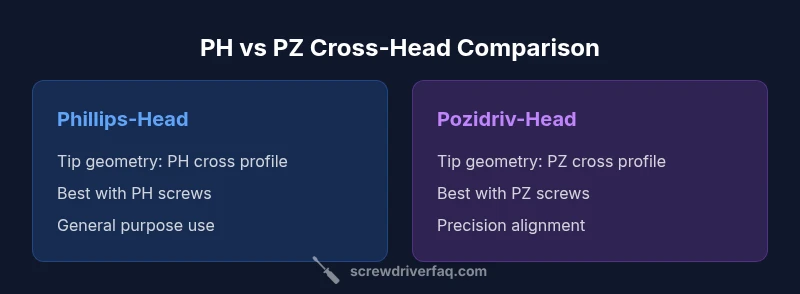
Cross-head designs share a core philosophy: to maximize torque transfer while resisting cam-out. The Phillips-head is designed for forgiving engagement, whereas the Pozidriv adds extra nibs to improve alignment in mating screws. For many homeowners, Phillips-head screwdrivers deliver reliable results for fast and casual tasks, while Pozidriv is advantageous when precision and reduced slippage matter. The critical factor is compatibility: use the head type that matches the screw you’re driving. This section provides a quick read on geometry, fit, and practical impact so you don’t confuse fasteners or damage the workpiece.
Compatibility with Screws and Fasteners
Choosing the right cross-head depends on the screw type. Phillips-head screws (PH) are ubiquitous and designed for general purpose use, particularly in softwoods and many plastics. Pozidriv screws (PZ) require the corresponding head to seat fully and transfer torque efficiently. The Screwdriver FAQ analysis shows that mis-matched heads can slip, cam-out, or cause damaged screw slots. Before you start a project, inspect the screw size designation (PH or PZ) and verify your driver tip matches. If you must alternate, switch to a compatible screw and head pair to maintain control and minimize wear.
Wear, Durability, and Longevity
Tip wear is a common concern when using any cross-head screwdriver. Replacing a worn Phllips-like head too late can degrade engagement, worsen cam-out, and strip screw slots. A high-quality alloy steel with a precise heat-treatment process resists chipping and maintains tip geometry longer. Handles with ergonomic profiles reduce user fatigue during extended tasks. Periodic tip maintenance—cleaning debris, aligning the tip properly, and avoiding lateral hammering—extends life and preserves fit. Remember that even the best tips wear with use, so rotate among several drivers for heavy projects to distribute wear.
Torque and Control in DIY Tasks
Torque transfer depends on the interlock between the driver and screw head. A well-matched Phillips-head can deliver adequate torque for most household tasks like assembling cabinets or mounting fixtures. Pozidriv heads, when matched to PZ screws, offer improved alignment that translates into cleaner seating and less cam-out in precise work. For high-torque applications, consider drivers with magnetized tips and quality grip handles to maintain control and prevent slips. The takeaway: match head to screw, not just task, to optimize torque and control.
Practical Scenarios: When to Reach for Phillips vs Pozidriv
For general-purpose repairs and fast cabinetry work, Phillips-head drivers are often the most convenient due to their ubiquity and forgiving engagement. In precision cabinetry, electrical installations, or metalwork where alignment is crucial, Pozidriv heads provide improved seating and reduced slippage—provided you’re using PZ screws. In mixed softwood and hardwood projects, you’ll want a versatile driver set with both PH and PZ tips, or a reversible bit that stores multiple head types. In short: Phillips for broad compatibility; Pozidriv for precise, alignment-sensitive tasks.
Material and Build Quality: Steel, Handles, and Coatings
The best cross-head screwdriver blends strong steel with a snugly fitting tip and a comfortable, non-slip handle. Steel hardness is typically measured by Rockwell hardness; higher hardness improves tip durability but can increase brittleness if not tempered correctly. Coatings reduce corrosion and wear on tips. Handles with textured, contoured grip support greater torque without wheel-spinning. If you frequently drive screws into hard materials, consider a heat-treated tip and a handle designed for repeated torque.
Maintenance, Care, and Safety
Keep screwdrivers clean and dry to prevent rust, particularly on the tip edge where corrosion accelerates wear. Store drivers in a dry toolbox or magnetized strip to reduce tip rounding from accidental contact. Regularly inspect tips for burrs or notch wear and replace as needed. When using a cross-head, avoid using a screwdriver that’s visibly damaged or oversized for the screw head, as this increases the risk of cam-out or damage to the fastener. Safety comes from selecting the right head type, maintaining your tools, and applying steady pressure with controlled force.
Buying Guide: How to Choose the Right Cross-Head Screwdriver
A practical buying guide focuses on tip accuracy, material quality, and ergonomic design. Look for a PH or PZ designation on the shaft or packaging to confirm compatibility with your screw assortment. Inspect the tip for burrs, ensure the metal is heat-treated for durability, and test the grip feel before purchase. For most DIYers, a balanced set containing both Phillips-head and Pozidriv-head tips covers 90% of tasks. If you work with specialty screws, add specialized cross-head options only after verifying their use-case.
Final Thoughts on the Cross-Head Choice
Overall, the choice between a screwdriver like a phillips and its close relatives boils down to screw compatibility and task demands. Phillips-head remains the default for general use, while Pozidriv adds accuracy for precise work with the right screws. By understanding this, you can avoid misfits, reduce wear, and complete projects more efficiently. The Screwdriver FAQ team’s guidance emphasizes practical pairing of screw and head to maximize performance.
Comparison
| Feature | Phillips-head screwdriver | Pozidriv-head screwdriver |
|---|---|---|
| Tip geometry | PH cross profile with tapered nib | PZ cross profile with extra nibs for alignment |
| Slot fit | Best with PH screws; may slip on PZ screws | Best with PZ screws; PH can cam-out if forced |
| Torque transfer | Standard torque for PH-compatible screws | Comparable torque when used with PZ screws |
| Cam-out tendency | Moderate cam-out if misaligned | Lower cam-out with correct screws and head design |
| Screw compatibility | Works with PH screws only | Works with PZ screws; poor fit with PH screws |
| Common uses | General-purpose, woodworking, fast repairs | Precision cabinetry, electrical assemblies, metalwork |
| Price range | Low to mid-range | Low to mid-range |
| Best for | Everyday DIY and general hardware | Controlled torque and precise seating |
Pros
- Clear guidance on cross-head compatibility
- Improved decision confidence for DIY projects
- Widely documented with standards and common screw types
- Helps prevent mismatches and tool damage
Negatives
- Requires familiarity with screw types; not all tasks need cross-heads
- Pozidriv can be confusing; mis-match risks cam-out
- Some specialized screws require precise head variants
Phillips-head is the versatile default, while Pozidriv suits precise work with the right screws
For most DIY tasks, Phillips-head will cover the majority of fasteners. Use Pozidriv when your screws require improved alignment and you’re performing precision work. The right head-for-screw pairing minimizes wear and maximizes control.
Quick Answers
What is the difference between Phillips and Pozidriv screwdrivers?
Phillips-head screwdrivers have a simpler cross profile designed for forgiving engagement, while Pozidriv adds extra nibs for alignment, reducing cam-out in precise work. Both are cross-head designs but require corresponding screws.
Phillips heads are common and forgiving; Pozidriv helps with alignment when used with the right screws.
Can I use a Phillips screwdriver on Pozidriv screws?
Using a Phillips screwdriver on Pozidriv screws can lead to poor engagement and cam-out. If you only have a PH driver, avoid forcing it into a PZ screw slot. Ideally use the matching head.
A Phillips head on a Pozidriv screw is likely to slip or strip the screw slot.
Are there any risks to using the wrong cross-head?
Using the wrong cross-head increases cam-out, damages screw slots, and can strip the fastener. It also slows progress and may require replacement screws or tools.
Wrong cross-heads can slip, damage the screw, and waste time.
Do hybrid tips exist that fit both PH and PZ?
Some stepped or hybrid tips try to accommodate both types but are not ideal for heavy use. For best results, use the driver that matches the screw head.
There aren’t perfect universal tips; matched heads work best.
Which head is better for wood vs metal?
Phillips is generally preferred for many wood fasteners due to its forgiving engagement, while Pozidriv can offer improved seating in metalworking when screws match the head. Always prioritize screw-head compatibility.
Phillips works well for wood; Pozidriv shines where screws align precisely in metalwork.
How can I identify screw type at a glance?
Look for the head designation on the screw packaging or the screw head itself. PH screws typically indicate Phillips, while Pozidriv screws are labeled PZ. When in doubt, consult the fastener’s datasheet.
Check the label on the packaging or the screw head for PH or PZ marks.
Should I buy a dedicated PZ driver if I own PH screws?
If you frequently encounter Pozidriv screws, yes, include a PZ driver in your toolkit. Otherwise, a versatile PH driver with a few PZ tips may suffice.
If you see PZ screws often, add a Pozidriv driver; otherwise, keep a PH driver with PZ tips handy.
The Essentials
- Check screw type before selecting the driver
- Phillips-head covers most general tasks; Pozidriv is for precise work
- Match head to screw to reduce cam-out and wear
- Maintain tips and handles for longer tool life
- Invest in a balanced set with PH and PZ tips for versatility