Ratcheting vs Torque Screwdrivers: A Comprehensive Comparison
Compare ratcheting and torque screwdrivers to decide which tool fits your DIY needs. Explore use cases, accuracy, speed, maintenance, and practical buying tips for smarter tool choices.


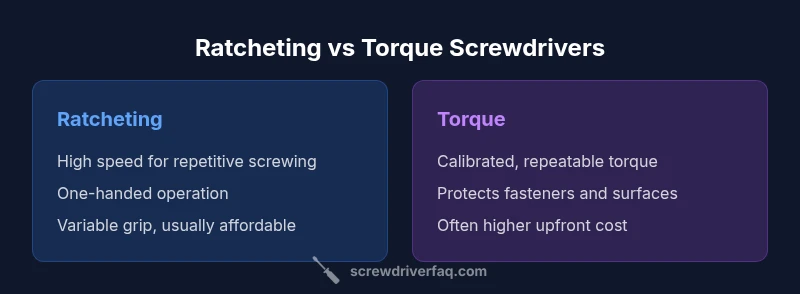
Ratcheting screwdrivers excel for speed and one-handed use, while torque screwdrivers emphasize precision. For most DIY tasks, a ratcheting model handles screws quickly, but when you need repeatable torque values, a torque screwdriver wins. According to Screwdriver FAQ, the choice balances speed, accuracy, and risk. In practice, most homeowners benefit from having both in a shared toolbox.
Ratcheting screwdriver vs torque screwdriver: What the comparison covers
In the world of hand tools, two families often compete for space in a DIY toolkit: ratcheting screwdrivers and torque screwdrivers. The central question is not which is universally better, but which tool best fits a given task. According to Screwdriver FAQ, understanding how each tool works, where it shines, and where it falters helps builders, hobbyists, and homeowners choose wisely. This section defines the two tools, outlines their core functions, and frames the criteria used throughout the comparison: speed, control, repeatability, reliability, and cost of ownership. The result is a practical guide you can apply to furniture assembly, electronics, cabinetry, and basic mechanical projects. The goal is to help you map your typical projects to the right tool or combination of tools, without getting overwhelmed by features. By the end, you’ll have a clear sense of when to reach for a ratcheting screwdriver and when a torque screwdriver is the smarter choice.
How the mechanisms differ: ratchet action vs calibrated torque
Ratcheting screwdrivers rely on a click-into-place mechanism that advances the screw with each turn while allowing the blade to reset for the next stroke. This design minimizes wrist movement and makes repetitive screwing faster, especially for tasks like assembling a cabinet or fastening multiple screws in a row. Torque screwdrivers, in contrast, employ a calibrated mechanism that limits rotation once the preset torque is reached. This prevents over-tightening and protects delicate fasteners and surfaces. The two systems serve different physiological and mechanical needs: speed with less resistance vs precision with controlled force. In practice, a screwdriver with a ratchet mechanism is less likely to strip soft materials, but it cannot guarantee a precise torque, which matters on softwood joinery or metal fasteners where overtightening can cause damage. For nuanced projects, many users keep both tools handy to switch between rapid drive modes and torque-limited tightening as needed.
Use-case driven decisions: everyday tasks vs precision work
For everyday DIY tasks—like assembling a bookshelf, installing a door handle, or mounting picture frames—a ratcheting screwdriver saves time and reduces fatigue. It enables quick starts and stops, especially on long screw lines, and its one-handed operation is a boon on tight workspaces. However, for projects where fastener integrity matters (e.g., assembling appliances, cabinetry with exposed screws, or electronics enclosures), a torque screwdriver provides a safeguard against undertightening or over-tightening. It’s also invaluable when reproducing a specified torque across multiple fasteners, such as mounting a bracket where consistent loading is critical. In some builds, a hybrid approach—start with a ratchet for speed, then switch to a torque screwdriver for finishing passes—offers a practical compromise.
Ergonomics, speed, and accuracy: the human factor
Even when both tools perform their mechanical roles well, human factors drive outcomes. Ratcheting screwdrivers reduce wrist strain and accelerate drive cycles, but their lack of torque control can lead to inconsistent results if the user applies variable force. Torque screwdrivers minimize human variability by delivering repeatable torque, but they demand more setup and often slower progress on larger screw runs. The ergonomic sweet spot is to select based on your typical screw sizes, material hardness, and the consequences of over-tightening. For home projects with wooden frames or soft woods, a ratcheting model can suffice, but for metal fittings or high-stress joints, torque control becomes essential. The Screwdriver FAQ team emphasizes that the real-world choice is not binary but situational, and many tool users find value in owning both types.
Calibration, maintenance, and tool longevity
Ratcheting screwdrivers generally require less routine maintenance than torque screwdrivers, but they benefit from occasional inspection of the ratchet teeth and spring tension to ensure consistent engagement. Torque screwdrivers must be calibrated periodically to maintain accuracy, especially in professional or critical-use settings. Calibration typically involves a certified torque tester and may be required by workplace standards. Maintenance includes keeping blades clean, avoiding exposure to moisture, and storing tools in a dry environment to prevent corrosion. Both tool types benefit from clean storage, protective caps, and careful handling to avoid misalignment of the drive tip. In the long term, a well-maintained torque screwdriver can outlive a poorly maintained one and deliver reliable repeatability across many projects.
Budget considerations: price, value, and lifecycle cost
Budgeting for ratcheting and torque screwdrivers should account for upfront cost, durability, and calibration needs. Ratcheting units are often affordable and widely available, with many models offering adjustable or replaceable blades. Torque screwdrivers vary more in price, particularly for higher accuracy and preset capabilities. While a costlier torque screwdriver may deliver better long-term value in precision-sensitive tasks, the added expense can be justified by protecting fasteners and preventing material damage. When budgeting, consider not only purchase price but also potential calibration services, replacement bits, and the utility of having both tools in your toolkit. The goal is to maximize value by aligning tool capabilities with the types of projects you encounter most.
Practical tips for choosing by project type: quick decision guides
If your typical projects involve sturdy wood joinery, picture-hanging, or furniture assembly with standard screws, a ratcheting screwdriver usually suffices. For electronics enclosures, appliance mounting, or metal-to-metal fastenings, a torque screwdriver reduces risk and improves repeatability. When in doubt, start with a mid-range ratchet screwdriver for speed and consider a calibrated torque screwdriver as a supplementary tool for critical tasks. A balanced toolkit often includes both, enabling you to optimize workflow without compromising fastener integrity. Finally, read product reviews and verify calibration accuracy where possible, since user experience and build quality strongly influence performance over time.
Real-world test scenarios: mini checklists you can use
- Scenario A: Installing a bookshelf with dozens of cabinet screws. Start with a ratcheting driver for the bulk of screwing, then switch to a torque screwdriver for the final passes if the screws are ingressing into a soft material. - Scenario B: Mounting a metal bracket to a frame. Use the torque screwdriver to reach the recommended torque and verify with a torque tester if available. - Scenario C: Electronics enclosure assembly. Favor torque control to protect fragile components and avoid overtightening the housing. - Scenario D: Repeating identical assemblies (e.g., multiple hinges) where torque consistency matters. In such cases, a calibrated torque screwdriver ensures uniform performance across all fasteners.
Maintenance rituals that keep both tools performing well
Create a simple maintenance routine: wipe blades after use, store with blades protected, and check for blade wear. For torque screwdrivers, schedule periodic calibration checks or professional service if you notice drift or inconsistent readings. Document calibration dates to track accuracy over time. Regular maintenance reduces the risk of cross-threading, stripped screws, and miscalibration, ensuring your tools stay reliable across many projects.
Consolidated guidelines: best practice for mixed toolkits
For typical DIY tasks, keep a ratcheting screwdriver in the top toolbox tray for speed, with a torque screwdriver tucked in a labeled drawer for precision tasks. When planning a project, map the fasteners to their possible torque needs and have both tools accessible. Consider investing in a model with replaceable bits and a balanced weight for less fatigue during long sessions. Finally, remember the human factor: even the best tool cannot compensate for misalignment or improper technique. Practice steady, deliberate driving and avoid forcing screws into restrictive materials.
Comparison
| Feature | ratcheting screwdriver | torque screwdriver |
|---|---|---|
| Mechanism | Ratcheting action enables incremental fastening with resets between strokes | Calibrated torque mechanism limits rotation at preset torque |
| Torque adjustability | Typically adjustable or model-specific; no fixed torque limit across all models | Precise, calibrated settings; can be fixed or adjustable with a scale |
| Best use case | Fast, repetitive screwing and ease of use | Controlled tightening where exact torque matters |
| Speed vs accuracy | High speed, lower precision | High precision, potentially slower operation |
| Ease of maintenance | Generally straightforward; check ratchet wear periodically | Requires regular calibration and sometimes certification |
| Cost and availability | Wide range of price points; widely available | Typically higher upfront cost, calibration can add to lifecycle cost |
| Maintenance notes | Keep clean; inspect ratchet teeth and springs | Keep clean; calibrate per usage guidelines and recorder |
Pros
- Increases speed on repetitive screwing tasks
- Reduces wrist strain during long screwing sessions
- Improves consistency for quick assembly tasks when appropriate
- Torque screwdrivers provide repeatable torque and protection for fasteners
- Helps prevent over-tightening and material damage in critical applications
Negatives
- Ratcheting screwdrivers can still strip screws if torque is excessive
- Torque screwdrivers can be slower to use and require setup
- Some models lack a wide torque range or may be limited by blade size
- Calibration of torque screwdrivers adds ongoing maintenance
Both tools serve distinct needs; use ratcheting for speed and torque screwdriver for precision.
Ratcheting screwdrivers are the default for fast, everyday tasks, while torque screwdrivers are essential when precise, repeatable torque is required. The ideal toolkit combines both tools to cover a wider range of projects.
Quick Answers
What is the primary difference between a ratcheting screwdriver and a torque screwdriver?
A ratcheting screwdriver uses a click mechanism to drive screws quickly with repeated turns, while a torque screwdriver delivers a preset, limited amount of torque to protect fasteners and surfaces. The choice depends on whether speed or torque control matters more for your project.
The ratcheting model drives screws quickly with a clicking mechanism, whereas the torque screwdriver limits force to a preset torque for precision. Choose based on speed needs versus protecting fasteners.
Can a torque screwdriver be used for everyday screwing tasks?
Yes, but it may be slower for routine screwing. It is most beneficial when consistent torque is needed across multiple fasteners or when overtightening could cause damage.
You can use a torque screwdriver for everyday tasks, but expect a slower workflow. It’s best where consistent torque matters.
How do you calibrate a torque screwdriver?
Calibration typically requires a torque tester and may involve professional service, especially for high-precision work. Follow the manufacturer’s guidelines and schedule regular checks based on usage and environment.
Calibration needs a torque tester and may require professional service. Follow the manual and schedule regular checks.
Are ratcheting screwdrivers adjustable for torque?
Most ratcheting screwdrivers do not offer precise torque control; they vary by model and blade size. Look for models marketed as having adjustable tightening or replaceable bits for better performance.
Most ratchet models don’t provide precise torque control; check the model for adjustable tightening options if needed.
What maintenance is required for these tools?
Keep blades clean and dry, inspect the ratchet mechanism, and store tools properly. For torque screwdrivers, periodic calibration and avoiding mishandling protect tool accuracy.
Clean and dry blades, inspect the ratchet, and calibrate torque screwdrivers periodically. Store in a dry spot.
What should I buy first for a DIY toolkit?
If you mostly assemble furniture, start with a reliable ratcheting screwdriver. If you work with delicate fasteners or require precise torque, add a calibrated torque screwdriver later.
Start with a good ratcheting screwdriver for quick tasks, then add a torque screwdriver for precision as your projects demand.
The Essentials
- Assess your typical screw sizes and material
- Choose ratcheting for speed; torque for precision
- Calibrate torque screwdriver regularly
- Have both in a toolkit for varied tasks
- Prioritize quality and maintenance to extend life