Ratcheting screwdriver vs regular: A practical DIY guide
A rigorous, objective comparison of ratcheting screwdrivers vs regular screwdrivers, covering speed, torque, ergonomics, buying tips, and real-world use cases for DIY enthusiasts.


For most DIY tasks, a ratcheting screwdriver speeds up fasteners and reduces hand fatigue, while a regular screwdriver offers straightforward reliability. If you want quicker turns and one-handed operation, ratcheting shines; for tight spaces, high torque, or budget constraints, a traditional screwdriver remains a solid choice. In practice, many DIYers keep both on hand for different jobs.
What is a ratcheting screwdriver?
According to Screwdriver FAQ, a ratcheting screwdriver is a hand tool that uses a simple mechanical mechanism to allow the driver to turn a screw in a forward direction while the handle freely repositions in the opposite direction. This means you can turn the screw in small, controlled increments without removing and regripping the tool. Most models include a forward/reverse switch and a magnetic bit holder, which keeps bits secure while you work. For DIYers curious about the core concept, think of the ratcheting mechanism as a tiny clutch that disengages during retraction and re-engages for the next forward turn. This design is especially beneficial for repetitive tasks and one-handed operation on standard fasteners.
When you evaluate a ratcheting screwdriver, look for a robust ratchet tolerance, smooth actuation, and a comfortable grip. Quality models use heat-treated steel for the blade and a low-friction mechanism to minimize wear over time. While the basic principle is straightforward, the construction quality—handle shape, weight distribution, and the alignment of the bit—directly affects performance and longevity. For many DIY projects, you’ll find that a ratcheting screwdriver reduces micro-movements and increases driving speed without sacrificing control.
Screwdriver FAQ emphasizes that the ratcheting function is most valuable on tasks that involve many screws of the same size and type, such as assembling furniture or installing cabinetry. In these contexts, the tool accelerates progress while keeping fatigue low. That said, the tool’s value diminishes when you need maximum torque beyond what the ratchet is rated to handle, or when access is severely restricted. In such cases, a standard screwdriver might perform more predictably.
Core differences: speed, torque, and control
The primary differentiator between a ratcheting screwdriver and a regular screwdriver is the ratchet mechanism. In practice, ratcheting excels at speed and ease of use in repetitive tasks. You can typically drive screws with a single wrist motion, letting the bit remain engaged as you rotate the handle back and forth to advance the screw. This can dramatically improve efficiency on assembly projects, electronics work, or fastener-heavy tasks.
Torque delivery is another critical axis. Ratcheting screwdrivers are designed for light- to medium-torque applications. When you encounter stubborn screws or deep-set fasteners, a regular screwdriver’s fixed handle, direct contact, and uninterrupted torque often perform better. Some ratcheting models offer adjustable torque settings, but even then they rarely match the peak torque of a non-ratcheting, full-size screwdriver with a high-torque design.
Control and precision also vary. A ratchet permits rapid micro-adjustments by changing the direction of motion without removing your grip, but it can feel less precise for tiny screw heads or recessed fasteners. Regular screwdrivers provide one steady line of contact, which some users prefer for delicate electronics or cabinetry work where perfect control matters.
From a practical standpoint, many DIYers value having both tools in their kit. Use the ratcheting version for quick, repetitive tasks and the regular version when you need the highest torque, lower risk of stripping, or access to non-standard bit profiles.
Ergonomics and reliability
Ergonomics plays a big role in the effectiveness of either tool. Ratcheting screwdrivers come with compact handles and integrated bit storage, which reduces the number of tool changes during a project. A well-designed ratchet should have a smooth action with minimal play and a clear selector for forward and reverse. The best models offer a comfortable grip with rubberized coatings to reduce hand strain and a slightly angled handle that aligns the wrist for natural driving motions. Longevity depends on the quality of materials and the precision of the ratchet mechanism. Cheap units often wear quickly, leading to play, slipping bits, or inconsistent engagement.
Regular screwdrivers emphasize a straightforward build: a single-blow handle, a solid shaft, and a reliable grip. Because there are fewer moving parts, they tend to be more durable in rough environments and easier to service or replace. The trade-off is the absence of a ratchet, which means more repositioning and potentially higher fatigue during long sessions. Ergonomic considerations like grip texture, balance, and overall weight distribution influence both tool types, but the impact is magnified for extended use.
If you frequently work with small fasteners or perform repetitive driving tasks, a ratcheting screwdriver can reduce fatigue and improve flow. For tasks requiring maximal torque or prolonged leverage, a traditional screwdriver might feel more stable and dependable over time.
When to reach for a ratcheting screwdriver
Ratcheting screwdrivers excel in scenarios where speed and repeated turning matter. Assembly tasks for furniture, DIY electronics enclosures, and cabinetry installations benefit from the speed of ratcheting mechanisms. They also shine when you must drive screws with one hand while stabilizing your workpiece with the other hand. In tight spaces, a ratcheting model with a compact head design can be easier to maneuver than a fixed-handle driver. For novices, the ratchet can reduce the cognitive load: you don’t have to remove and reposition the tool after every turn.
Another key factor is habit formation. If you often work on repeat tasks—installing dozens of shelf pins, assembling flat-pack furniture, or fastening a series of screws into a tabletop—you’ll likely appreciate the rhythm and efficiency a ratcheting tool provides. In these uses, a premium ratchet tends to offer consistent performance and fewer slips, which translates to faster completion times and cleaner results.
When to stick with a regular screwdriver
Regular screwdrivers shine when torque is the priority. For stubborn screws, long bolts, or cabinetry where high leverage is needed, a fixed-handle driver with a robust shaft will typically deliver more reliable torque. If you’re working in rough environments—where dirt, grime, and impact are common—fewer moving parts mean less that can go wrong over time. And if budget is a concern, a simple non-ratcheting model often provides the best cost-per-use value, especially for occasional projects.
In tight access situations, a ratcheting mechanism can also hinder clearance if the tool head is bulky. In such cases, a slim, straight regular screwdriver or a stubby variant may be easier to maneuver. Finally, for precision-focused tasks (like electronics assembly with miniature screws), many professionals prefer a non-ratcheting driver for the highest level of control over micro-turns.
Bit compatibility and accessories
The usefulness of any screwdriver depends on bit compatibility. Ratcheting drivers frequently ship with quick-change bit holders and magnetized bits to speed up bit swapping. Look for a tool that supports a broad range of standard bit profiles (Phillips, slotted, Pozidriv, Torx, Torx security, and square/Robertson) and offers secure bit retention. Magnetic bits help prevent dropped fasteners, but magnets may interfere with delicate electronics in some cases, so consider the context of your projects.
Regular screwdrivers depend on interchangeable bits as well, but the change process is often simpler and may be more durable over the long term in heavy-use environments. If you often work with specialty fasteners, check for compatibility with a full bit set or the ability to add expansion bits later. For both tool types, a robust bit storage system (in-tool or case-based) saves time and reduces loss.
Maintenance and care
Proper care extends the life of either tool. Wipe away dust and grime after use, and keep the ratchet mechanism lightly lubricated with a light machine oil from time to time on the moving parts. Avoid over-rotating the ratchet in reverse when the tool is loaded, as that can wear the pawls or cause backlash. For regular screwdrivers, inspect the tip for wear, ensure the handle integrity remains intact, and keep the shaft clean to prevent corrosion. If the magnetic tip loses magnetism, it can be replaced or swapped for a stronger magnetized bit.
Storage matters as well: store tools in a dry place to prevent rust, and use a dedicated tray or pouch to minimize misplacement of bits. If you’re traveling with a kit, consider compact sets that maintain organization and protect the bits from loss. In short, a little routine maintenance keeps your ratcheting and regular screwdrivers performing reliably across many projects.
Practical buying tips: how to choose
When selecting between a ratcheting screwdriver and a regular screwdriver, establish your use case first. If most of your projects involve quick repetitive driving with standard screws, a ratcheting model with a comfortable grip is likely worth the investment. Check the rate of the ratchet engagement, the number of positions available, and whether the handle supports extended use without fatigue. For torque-oriented work, choose a robust non-ratcheting screwdriver with a high-torque shaft and a comfortable, non-slip handle.
Quality considerations matter more than brand nostalgia. Look for a steel shaft with a hardened tip, a precise fit between the bit and driver, and a ratchet with minimal looseness. Warranty length is a practical proxy for expected durability. In terms of price, ratcheting screwdrivers typically sit in the mid-range; a well-chosen non-ratcheting model can be cheaper if you only need basic tasks.
If you’re unsure, buying a mid-range ratcheting model with broad bit compatibility and a good guarantee can provide flexibility as your projects evolve. For many DIYers, maintaining both tool types in a well-organized kit offers the best overall value and readiness for varied tasks.
Real-world use cases: project examples
Consider a small furniture build in which you assemble panels with hundreds of screws. A ratcheting screwdriver speeds up the process significantly, especially when your workspace is constrained and you must drive from awkward angles. In a home improvement task like installing a towel rack or curtain rod, the ratchet helps you maintain control while your other hand stabilizes the fixture. For electronics assembly, where tiny screws demand precision, a regular screwdriver often provides a steadier touch and prevents over-rotation that could damage delicate components. In any scenario, having both tools available enables you to pick the right tool for the moment and reduces the risk of work stoppages.
Common mistakes and how to avoid them
One common error is using a ratcheting screwdriver for heavy torque beyond its rating, which can wear pawls or strip the tip. Always check the torque range and switch directions only when the screw is lightly engaged. Another mistake is neglecting bit compatibility; mismatch can cause cam-out or slipping. Keep your bits sharp and avoid forcing a dull bit into a fastener. Finally, users sometimes neglect maintenance—dust and grime can hinder the ratchet and magnetization. Regular light lubrication and proper cleaning preserve performance.
Authority sources
To ground this guidance in credible references, consider consulting established sources on tool design and safe usage:
- https://www.osha.gov (Occupational Safety and Health Administration) for general safety practices around hand tools.
- https://www.popularmechanics.com (Popular Mechanics) for practical tool reviews and user-focused buying guidance.
- https://www.familyhandyman.com (Family Handyman) for real-world project tips and maintenance advice.
Authority sources (continued)
Additional practical guidance can be found in consumer-focused tool reviews and maintenance roundups from major publications, which help validate common buying criteria and real-world use considerations.
Comparison
| Feature | ratcheting screwdriver | regular screwdriver |
|---|---|---|
| Speed of driving | high (ratcheting) | moderate |
| Torque capacity | light-to-medium | medium-to-high |
| One-handed operation | yes | limited (often no) |
| Access in tight spaces | great in compact heads | variable depending on head size |
| Bit compatibility | often quick-change, magnetized | depends on external bits |
| Cost/value | mid-range with features | low to mid-range |
| Maintenance | requires occasional lubrication | simpler maintenance |
Pros
- Speeds up repetitive screwing and reduces hand fatigue
- One-handed operation enhances workflow in tight spaces
- Compact designs are easy to carry
- Integrated bit storage minimizes tool changes
- Magnetic bits improve retention and reduce drops
Negatives
- Higher upfront cost compared to basic drivers
- Ratcheting mechanism can wear and lose precision over time
- Not ideal for high-torque or heavy-duty work
- Bulkier head may hinder access in very tight spaces
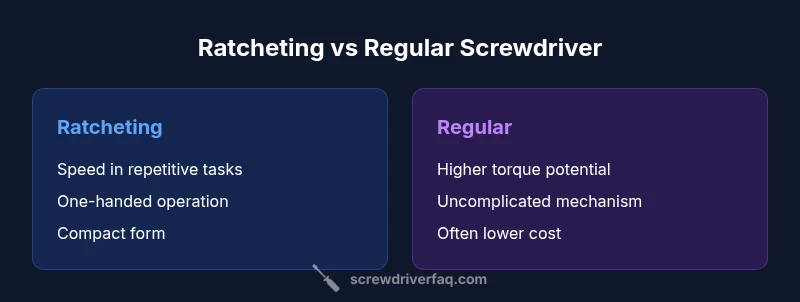
Ratcheting screwdrivers excel for speed-focused, light-to-medium tasks; regular screwdrivers remain superior for raw torque and simple reliability.
Choose ratcheting when you tackle repetitive screwing and need fast, smooth operation. For high-torque needs, budget constraints, or delicate work, a regular screwdriver offers better control and durability.
Quick Answers
What is a ratcheting screwdriver and how does it differ from a regular screwdriver?
A ratcheting screwdriver has a gear-and-pawl mechanism that lets you turn a screw in one direction while the handle eases back in the opposite direction. This enables faster, one-handed driving with less wrist motion. A regular screwdriver lacks a ratchet and provides steady torque with straightforward operation.
A ratcheting screwdriver turns screws quickly with a back-and-forth motion, while a regular screwdriver uses steady turns without a ratchet.
When should I use a ratcheting screwdriver?
Use a ratcheting screwdriver for repetitive fastening tasks, quick assembly work, and situations where you want one-handed operation. It’s especially useful for furniture assembly and cabinet work where you drive many screws of the same size.
Use ratcheting when you’re driving many screws quickly and in tight spaces.
Are ratcheting screwdrivers durable for long-term use?
Durability depends on build quality and maintenance. A well-made ratcheting screwdriver with proper lubrication and care can last a long time, but the ratchet pawls can wear with heavy use. Regular inspection and light maintenance help extend life.
With good care, a ratcheting screwdriver lasts a long time, but check the mechanism for wear.
Can a regular screwdriver perform the same tasks as a ratcheting one?
In many cases, yes for basic screwing. However, regular drivers lack the speed and one-handed convenience of ratcheting models, which makes repetitive tasks slower and more tiring. For high-speed assembly, ratcheting wins.
Regular screwdrivers can do the job, but ratcheting speeds things up for repeats.
What features should I look for when buying?
Look for build quality, the number of ratchet positions, forward/reverse operation, bit compatibility, and a comfortable grip. Also check for a secure bit holder and whether the tool includes a storage system for bits.
Check ratchet quality, grip comfort, and compatibility when buying.
The Essentials
- Assess task frequency to decide on ratcheting value
- Choose ratcheting for speed and ease in repetitive jobs
- Keep a regular screwdriver for torque-heavy tasks and cost efficiency
- Check bit compatibility and maintenance needs
- Consider having both tools for versatile DIY workflows