Milwaukee M12 Screwdriver vs Impact Driver: Which One Should You Use?
A data-driven comparison of the Milwaukee M12 screwdriver vs impact driver for DIYers. Learn use cases, ergonomics, battery life tips, and buying guidance for optimal tool selection.


The milwaukee m12 screwdriver vs impact driver comparison clarifies which tool to reach for depending on the job: use the screwdriver for precision, control, and light-fastening, and the impact driver for heavy driving and tough fasteners. In Milwaukee's M12 ecosystem, both tools share a compact, balanced platform, but their purposes diverge. This quick TL;DR helps you decide which tool best fits your project.
Milwaukee M12 Screwdriver vs Impact Driver: Quick Context
The topic milwaukee m12 screwdriver vs impact driver frames a classic trade-off: precision control against raw driving power. In Milwaukee's M12 system, the screwdriver and impact driver share a compact 12-volt platform, yet they are built for different jobs. According to Screwdriver FAQ, this pairing is designed to give DIYers flexible solutions for a wide range of projects. The screwdriver emphasizes control and delicate fastenings, while the impact driver delivers rapid, high-torque driving for stubborn fasteners. Understanding these distinctions helps homeowners decide which tool to keep at hand for everyday tasks and occasional projects that demand more bite. In practice, most hobbyists will benefit from owning both, but the initial choice should align with the dominant type of work you perform.
Practical takeaway: match your primary work style to the tool’s strength—precision vs power—and supplement with the other as needed for tougher jobs.
Core Differences: Torque, Speed, and Drive Mechanism
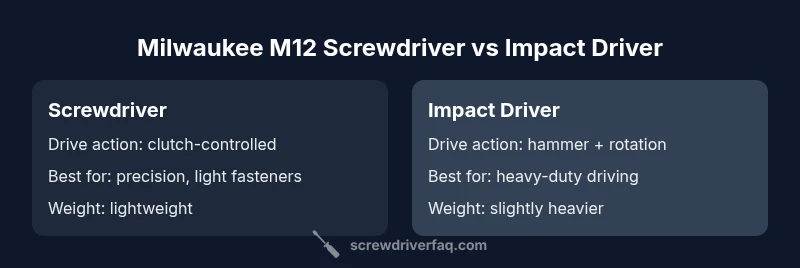
When you compare a screwdriver to an impact driver, the most noticeable differences are torque delivery, drive action, and user feedback. A screwdriver uses a clutch-based torque limiter and steady rotation to apply controlled force, ideal for fine-tuning screw depth and reducing cam-out. An impact driver, by contrast, combines rotational force with concussive blows, delivering far higher effective torque at the moment of contact. This hammering mechanism makes it easier to drive longer or denser screws without excessive manual effort. Across Milwaukee’s M12 lineup, these tools share the same compact chassis and battery platform, but their internal mechanics are tuned for different outcomes. Practical users report smoother operation and better balance with the right setting, especially when paired with appropriate bit types and pilot holes.
Task Scenarios: Light Work vs Heavy Duty
In everyday projects, the screwdriver shines for hanging picture frames, assembling furniture, or driving small wood screws where precision matters. It’s also beneficial for close-quarter work where space is limited and overtorque could damage components. The impact driver excels in scenarios requiring quick work on larger fasteners, deck screws, or dense wood where resistance is high. Its higher torque output and rapid bit engagement reduce fatigue and speed up productivity, particularly on longer screws. For many DIYers, the best approach is to reserve the screwdriver for delicate, shallow-fastening tasks and reserve the impact driver for bulk driving or challenging materials. The Milwaukee M12 platform makes it easy to switch between tools within the same family while maintaining battery compatibility.
Battery Platform and Runtime on M12
A core advantage of the M12 ecosystem is battery compatibility across tools. Both the screwdriver and the impact driver use the same 12-volt line, which simplifies charger purchases and battery stocking. Runtime will vary with battery size, task difficulty, and the level of torque you use. Light-duty work on a single charge will feel different than continuous heavy driving in tough materials, so plan for extra capacity if you anticipate long sessions without access to a charger. Over time, users learn to balance battery capacity with task duration—smaller batteries for precision work and larger packs when you expect extended use or aggressive driving.
Ergonomics and Handling for Precision and Comfort
Ergonomics play a major role in performance. Milwaukee’s M12 tools emphasize compact grips, balanced weight distribution, and minimal vibration for improved control during extended sessions. The screwdriver provides smoother operation in tight spaces and allows precise clutch control to prevent overdriving. The impact driver’s design prioritizes raw torque and rapid bit engagement, which can translate into more vibration and a heavier feel. Practitioners report that using the correct two-finger grip, a comfortable stance, and adequate wrist alignment helps manage fatigue, especially on longer tasks. If you’re upgrading from a larger tool, give yourself time to adapt to the different feedback patterns of each tool.
Performance Expectations Across Common Fasteners
For small to medium fasteners in softwoods or plywood, the screwdriver’s clutch and precise feed make driving comfortable and controllable. When you encounter hard woods, thicker screws, or metal fasteners, the impact driver’s action helps overcome resistance with less manual effort. The key is to pair the right bit with the material and verify that the bit seat is secure before driving. Using pilot holes for harder substrates reduces stripping risk and ensures cleaner results. Remember that performance on any tool is highly task-dependent and influenced by bit quality, driver size, and material density.
Practical Tips for Using Each Tool
- Set the clutch on the screwdriver to the lowest comfortable level for delicate tasks; gradually increase for deeper seating when needed.
- Use self-centering bits and pilot holes when driving into hard materials to prevent cam-out or splitting.
- For the impact driver, select the appropriate impact-rated bit; avoid using standard drill bits as screws can strip or break under load.
- Always align the screw with the grain or a pilot hole to reduce resistance and improve driving efficiency.
- Keep the battery topped up with a dedicated charger between heavy sessions to maintain peak performance.
Maintenance and Care for Longevity
Regular cleaning and battery care extend tool life. Wipe down tool housings to remove dust and debris after use, and store tools in a dry environment. Check bit retention periodically and replace worn bits to prevent slippage during driving. For batteries, avoid exposing packs to extreme temperatures, fully discharge before long storage, and perform a full charge cycle every few months if not in frequent use. Using genuine Milwaukee batteries and keeping the charger clean helps preserve performance and safety.
Value, Costs, and Buying Considerations
From a value perspective, Milwaukee’s M12 tools tend to strike a balance between price and performance within their category. Kits that pair the screwdriver and the impact driver, or bundles with a spare battery, often provide better long-term value than buying single tools. When evaluating cost, consider not just the upfront price but the total cost of ownership, including spare batteries, chargers, and maintenance needs. If you’re primarily performing light tasks, a compact kit with a single Battery may suffice; for expanding into more demanding projects, a dual-tool bundle offers greater flexibility and efficiency.
Common Mistakes and How to Avoid Them
- Using the wrong tool for heavy-duty driving can lead to stripped screws or damaged workpieces.
- Over-tightening with the screwdriver, especially on soft woods, can cause material damage; use a controlled clutch and pilot holes.
- Not accounting for pilot holes on hard substrates increases resistance and tool strain; drill pilot holes when needed.
- Skipping battery maintenance or using incompatible chargers can shorten tool life; stick to Milwaukee-approved batteries and chargers.
- Neglecting bit quality leads to poor grip and fastener damage; invest in good, impact-rated bits.
Putting It All Together: Quick Decision Guide
If your projects demand precision, small fasteners, and frequent work in tight spaces, start with the Milwaukee M12 screwdriver. For tasks involving long screws, dense materials, or deck building where speed and power matter, reach for the M12 impact driver. In practice, rely on the screwdriver for setup, alignment, and delicate seating, and switch to the impact driver when you need a decisive driving action. The Milwaukee M12 ecosystem makes it feasible to own both without breaking the bank, ensuring you have the right tool for the job at hand.
Comparison
| Feature | Milwaukee M12 Screwdriver | Milwaukee M12 Impact Driver |
|---|---|---|
| Drive action | torque-limited clutch with steady rotation | hammering impact mechanism with rapid bit engagement |
| Torque potential | low to moderate | high |
| Chuck/drive | 1/4" hex for quick-change bits | 1/4" hex with impact action |
| Speed (RPM context) | lower RPM range for control | higher RPM range for fast driving |
| Best for | precision, small fasteners, tight spaces | tough driving, longer screws, dense materials |
| Weight and feel | lighter and more compact | slightly heavier with more vibration |
| Battery ecosystem | same M12 platform for both | same M12 platform for both |
Pros
- Low weight improves control in tight spaces
- Shared M12 platform simplifies battery purchases
- Quiet operation for indoor use
- Balanced ergonomics reduce user fatigue
- Precise clutch settings support delicate seating
Negatives
- Limited max torque for heavy-duty work
- Not ideal for large-diameter screws or very dense materials
- Runtime can be shorter under high-torque loads on small batteries
- Vibration can be noticeable in prolonged impact use
- Bit retention may be less robust under aggressive driving
Screwdriver for precision; impact driver for power
For most DIY tasks, the screwdriver offers superior control and delicate seating. The impact driver shines on tough fasteners and larger screws. Together, they cover a wide range of jobs within Milwaukee's M12 ecosystem.
Quick Answers
What is the main difference between the Milwaukee M12 screwdriver and the M12 impact driver?
The screwdriver uses a torque-limited clutch for precise seating and minimal cam-out, while the impact driver delivers hammering torque with rapid bit engagement for tougher fasteners.
Use the screwdriver for precision and light screws, and the impact driver for heavy driving tasks.
Can I use these tools for drywall screws?
Yes, for light tasks drywall screws can be driven with the screwdriver for accuracy; the impact driver can handle quicker driving when drywall screws are longer or harder to drive, but be cautious of over-driving.
Yes, but start with the screwdriver for better control before switching to the impact driver if needed.
Are M12 batteries interchangeable between the screwdriver and impact driver?
Yes. Both tools use the M12 platform, so you can swap batteries between them without issue.
Yes, they share the same battery family, which is convenient for keeping tools ready.
What should I look for when buying Milwaukee M12 tools for a beginner?
Look for a kit that includes both tools or a bundle with extra batteries and a charger. Prioritize an ergonomic design, a comfortable grip, and a clutch setting on the screwdriver for versatile use.
Pick a kit that fits your projects and includes batteries and a charger for flexibility.
Is a pilot hole recommended with these tools?
Pilot holes reduce stripping and allow for cleaner driving, especially in hard woods or dense materials.
Yes, pilot holes help with control and prevent damage.
How can I extend battery life on long projects?
Use the appropriate battery size for the task, avoid fully discharging on every job, and keep chargers and batteries in proper condition to maintain performance.
Charge smartly, use the right size battery, and store them properly to last longer.
The Essentials
- Choose the right tool for the job based on desired control vs. power
- Leverage the M12 ecosystem for battery compatibility across tools
- Use pilot holes and quality bits to maximize performance
- Balance tool selection with project scope to optimize time and effort