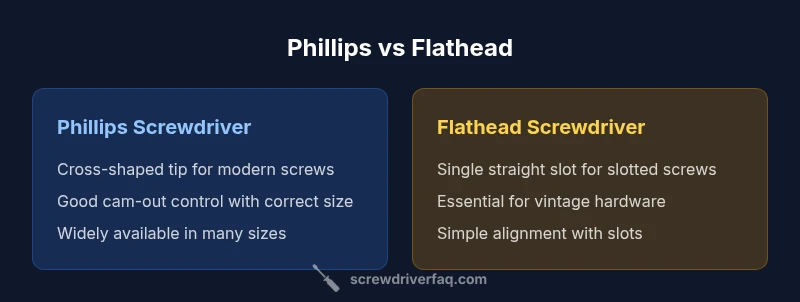
Phillips Screwdriver vs Flathead: An Analytical Comparison
Explore the differences between Phillips and flathead screwdrivers, including tip design, use cases, wear, and how to choose the right driver for DIY projects and professional work.


In most modern DIY projects, a Phillips screwdriver is the go-to for fasteners common in furniture and electronics, thanks to its cam-out resistance and self-centering design. A flathead screwdriver, however, remains essential for older, slotted screws and narrow slots. For practicality, keep a balanced kit with both tip types to handle a wide range of screws and avoid damage. This phillips screwdriver vs flathead comparison shows why each tool excels in specific scenarios.
phillips screwdriver vs flathead: what they are and why it matters
Screwed connections rely on a compatible driver tip to seat the screw head firmly and prevent damage. The phrase phillips screwdriver vs flathead is common because these two tip families dominate most households and workshops. A Phillips screwdriver features a cross-shaped tip with four contact points, designed to apply torque while guiding the bit into the screw head. In contrast, a flathead screwdriver uses a single straight slot that fits a slotted screw head. The right match improves drive quality and reduces slipping, especially when working with wooden, metal, or plastic fasteners. The choice also affects handling in tight spaces, tool wear, and the ease of finding replacement bits. For DIYers and homeowners, recognizing when to reach for each type is a practical skill that saves time and prevents stripped screws. The Screwdriver FAQ team emphasizes building a compact, balanced set of both tip types as a foundation for reliable hand tool work.
History and geometry: tip profiles and cam-out
Tip geometry shapes how a driver engages fasteners. Phillips tips incorporate a cruciform cross shape with a precise angle, engineered to bite into the screw head and resist deliberate stripping. The design’s intention is to self-center and guide torque, but it can cam out if the screw head is under high torque or if the bit diameter is not a close fit. Flathead tips are linear and simple—flat blades that slide into a single-slot screw head. They excel where a straight alignment is easy and where screws are designed for sliding contact. Throughout history, equipment and furniture built before modern fasteners frequently relied on flathead screws, while postwar machinery and consumer electronics adopted Phillips heads for quicker assembly. In practice, cam-out behavior and tip wear matter; learning how each geometry handles torque helps you choose the right driver for the job.
Common screw types and which tip fits best
Not all screws are created equal, and the tip must match the head slot or recess for optimal engagement. A cross-shaped PH or similar Phillips configuration is designed to deliver good torque with a tendency to cam-out when misaligned, which can be beneficial in preventing overtightening on sensitive materials. Slotted screws come in a single straight slot that often requires precise alignment; any tilt reduces bite, increases wear, and can damage the slot. Some screws use combination heads (Pozidriv, JIS) that resemble Phillips heads but require different tips for best fit. For beginners, the rule of thumb is straightforward: use a Phillips driver for most modern furniture, electronics, and consumer hardware; use a flathead driver for older appliances, vintage fixtures, and hardware with a wide slot. Always verify the screw type before selecting the driver to avoid stripping.
Practical performance: torque transfer, cam-out, and durability
Torque transfer depends on how well the tip matches the screw head. Phillips tips spread pressure across four lugs, which improves grip and reduces slippage in many modern screws, especially when using the appropriate size. However, cam-out remains a consideration if you apply too much torque or hit resistance in the workpiece. Flathead tips concentrate force along a single plane; when aligned, they can provide adequate torque, but misalignment increases the chance of cam-out and wear on the slot. Over time, tip wear alters engagement and can lead to rounded edges or complete failure to seat. Quality materials and coatings—such as chrome vanadium steel and corrosion resistance—improve durability for both tip types. In real-world use, the Phillips household set is usually more versatile for daily tasks, while flathead remains a reliable choice in older assemblies.
Use-case scenarios across trades and DIY projects
In carpentry and general home repairs, Phillips screws dominate modern furniture, cabinetry, and most consumer electronics, making a PH-screwdriver the everyday workhorse. Flathead screwdrivers remain essential for vintage hardware, some electrical switches, and certain builders’ fixtures that use straight-slot screws. Electronics enthusiasts often encounter tiny Phillips screws in devices, requiring precision tip sets. Plumbers and electricians may still encounter slotted screws in older installations or specialized equipment, making a flathead important in a selective toolkit. The key is not to pretend the two tips are interchangeable; rather, curate a small set for the typical job you face and keep a few spare bits on hand for stubborn fasteners or mismatches. A balanced approach reduces tool swaps and speeds up tasks.
Interchangeability and accessory ecosystem
A robust screwdriver kit pairs tip types with compatible handles, bits, and bit holders. Most power drills and impact drivers accept both Phillips and flathead bits through standard hex shanks, adapters, and magnetic bit holders. The broader ecosystem includes Pozidriv and JIS variants that resemble Phillips heads but require different tips to avoid damaging fasteners. When building your set, consider having at least two Phillips sizes and two flathead widths to cover common sizes. Magnetic tips can help secure screws, while sturdy storage cases keep bits organized and protected from rust. Proper storage and labeling reduce misplacements and ensure you always have the right tip at hand.
Cost, availability, and value considerations
Costs for individual tips can vary based on material quality, coatings, and brand, but both Phillips and flathead tips remain affordable in most markets. In budget tool kits, you might find one or two sets of flathead bits alongside a basic Phillips assortment; more comprehensive sets offer broader size ranges and higher durability. When evaluating value, consider the long-term performance: a slightly more expensive high-quality tip resists wear longer and minimizes risk of screw damage, which saves time and money on bigger projects. Availability is broad for both tip types across hardware stores, online retailers, and professional suppliers, making it easy to expand a kit as your needs evolve.
Safety considerations and best practices
Always don the right size for the screw head and ensure proper alignment before applying torque. Using an undersized or oversized tip increases the risk of stripping or slipping. Keep blades dry and free from rust; moisture can degrade steel and cause corrosion, reducing performance over time. Use the correct handle grip to maintain control, apply steady pressure, and avoid forcing a stubborn fastener. When using power tools, start at a low torque setting, maintain alignment, and use gradually increasing torque to prevent cam-out and potential damage to the workpiece. Wearing eye protection is prudent in dense material work or when working overhead.
Starter toolkit recommendations: building a versatile foundation
For most DIYers, a compact starter kit should include a Phillips screwdriver with several common sizes and a flathead screwdriver with a couple widths, plus a small set of spare bits. Prioritize quality over quantity: a durable chrome vanadium or high-grade steel tip lasts longer, resists wear, and reduces the risk of cam-out. Add magnetic bit holders and a reversible screwdriver handle to improve usability. If you anticipate electronics or electronics enclosures tasks, include precision PH and flathead bits in smaller sizes. For beginners, the goal is to cover the majority of tasks with minimal tool swaps, while allowing room to add specialized tips as projects demand.
Maintenance and tip-care: longevity tips
Tip care begins with cleanliness and dryness; wipe off grime after use and store tips in a dry environment. Regularly inspect for wear, rounding of edges, or bending; replace worn tips to avoid damaging screws. Keep tips aligned by gently honing slightly rounded edges with professional tools only, and avoid aggressive grinding that weakens the metal. Lubrication is typically unnecessary for dry-use tools, but you should wipe away rust and consider coatings that resist corrosion. Magnetic tip holders should be cleaned to remove metal shavings that can attract moisture. Proper storage reduces exposure to moisture and prolongs life.
Decision framework: when to choose Phillips vs flathead in practice
When confronted with a screw, start by identifying the head type and space constraints. If the screw is modern or has a cross-shaped head, reach for Phillips. If you are dealing with an older, straight-slotted screw or a tight space where direct alignment matters, a flathead may be the better option. When possible, keep both handy and match size precisely to the screw. The decision framework should emphasize the screw head geometry, the torque tolerance of the material, and the availability of replacement bits. In most household tasks, a balanced approach using a Phillips driver will handle the majority of fasteners efficiently, with the flathead standing by for the exceptions.
Comparison
| Feature | phillips screwdriver | flathead screwdriver |
|---|---|---|
| Tip shape | Cross-shaped cruciform (PH) | Single straight slot |
| Common sizes | Widely available across household sizes | Widely available across household sizes |
| Cam-out tendency | Higher with misalignment/high torque | Lower when perfectly aligned |
| Torque transmission | Good torque transfer with proper size | Adequate torque transfer but more sensitive to misalignment |
| Best for | Most modern screws and furniture | Older hardware and straight-slot screws |
| Tooling ecosystem | Large selection of bits and power-tool compatibility | Typically fewer modern variants, simpler ecosystem |
Pros
- Phillips tips reduce cam-out when correctly sized, boosting drive success
- Flathead tips are simple, inexpensive, and ideal for older hardware
- Both tip types are widely available and supported by many tool sets
- Quality tips last longer and resist wear more effectively
Negatives
- Mismatched tip size can strip screws or damage the workpiece
- Phillips cam-out can occur under high torque or poor alignment
- Flathead tips offer less torque stability on many modern fasteners
- Combining tip families in a kit increases cost and storage needs
Keep both tip families in your toolkit to handle modern and older hardware effectively
Phillips is the default for most modern screws due to cam-out resistance and widespread use, while flathead remains essential for vintage or straight-slot fasteners. A balanced set minimizes damage and maximizes versatility across DIY and professional tasks.
Quick Answers
What is the essential difference between Phillips and flathead screwdrivers?
Phillips screwdrivers have a cross-shaped tip designed to resist cam-out and work well with modern fasteners; flathead have a single straight slot for slotted screws. Each is optimized for different screw geometries.
Phillips is cross-shaped and resists cam-out; flathead fits straight slots.
Can I use a Phillips screwdriver on a flat-head screw?
Not reliably. If forced, the tip can slip and strip the screw head or damage the slot. Use the matching tip size.
No, use the right tip for the screw.
What sizes do Phillips and flathead screwdrivers come in?
Both families come in various sizes to fit different screws; choose size by comparing the screw head width and slot depth.
Sizes vary; pick the one that fits the screw head.
Are there situations where one tip is clearly better than the other?
Yes: Phillips excels with modern, multi-slot screws and furniture; flathead is preferred for vintage or straight-slot screws in tight spaces.
Phillips for modern screws; flathead for older ones.
Can you use these tips with power tools?
Yes, many drills accept both Phillips and flathead bits with the proper bit holders; avoid forcing screws and maintain control.
Yes, with the right bit and holder.
How should I maintain screwdriver tips to extend life?
Keep tips clean and dry, inspect for wear, and replace worn tips promptly. Store in a dry case and rotate bits to prevent wear.
Keep tips clean and dry; replace worn tips.
The Essentials
- Keep both tip types in your toolkit.
- Match tip size precisely to avoid stripping.
- Phillips dominates modern hardware; flathead suits older screws.
- Invest in quality tips for durability and performance.
- Practice proper alignment to minimize cam-out.
- Maintain tips to prolong life and reliability.