How Long Is a Screwdriver in Centimeters? A Practical Guide
Learn how long is a screwdriver in centimeters, with practical length ranges for flathead and Phillips models, measurement tips, and space-saving choices.


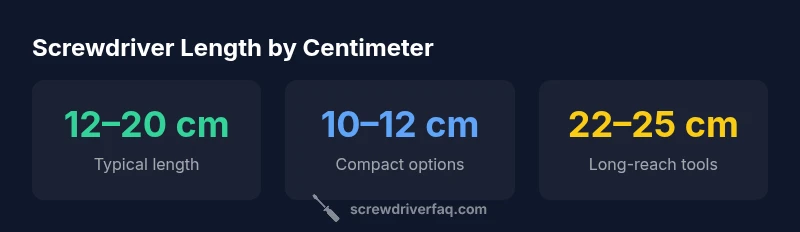
How long is a screwdriver in centimeters? A standard screwdriver is typically 12–20 cm long overall, with most common sizes around 15–18 cm. The exact length depends on handle style, blade type (flathead vs Phillips), and whether you include the handle in measurement. For tight spaces, consider compact 10–12 cm models, while longer variants can exceed 20 cm for reach. This quick guide gives you a practical starting point for selecting tools based on centimeter length.
Why centimeter length matters
In DIY work, length measured in centimeters shapes how you reach inside cabinets, align screws, and apply torque without straining your wrist. When you ask how long is a screwdriver in centimeters, the answer isn't a single number—it depends on the job, the space, and the user’s grip. For many projects around the house, centimeter length helps balance reach and control. According to Screwdriver FAQ, this measurement is a practical guide for selecting the right tool. By understanding centimeter measurements, you can pre-select tools that minimize frustration and maximize safety, especially when you’re working in tight corners or behind fixtures.
Bold insight: centimeter length is a practical heuristic, not a rigid rule. The exact figure matters less than how it fits your task and grip.
How length affects leverage and control
Length directly affects how much torque you can apply and how easily you can access recessed fasteners. In centimeter terms, adding a few extra centimeters can extend your reach into narrow spaces, but too long a shaft makes delicate control harder. The mathematics of leverage means a longer handle can multiply the force you apply, yet the same length also increases the arc of movement, potentially causing over-rotation in tight spots. Users who regularly assemble furniture or work on plumbing fixtures often favor mid-length screwdrivers (around 15–18 cm) to balance torque and reach. Conversely, abnormally short tools (roughly 10–12 cm) excel for single-screw tasks in cramped corners. The takeaway: small centimeter increments can change how you feel the tool in your hand and how accurately you drive screws.
Tip: test a couple of lengths in your typical work area to feel what length offers best control.
Length variations by screwdriver type
Flathead and Phillips models share a broad length range, but the shape of the blade interacts with length in practical ways. A standard flathead around 12–20 cm helps you line up blades with flat slots, while a Phillips tip benefits from similar overall length but may feel different in the hand due to blade engagement. Pozidriv or Torx variants also sit in the same general range, with small tip geometries influencing engagement quality and tip wear. For professional trades, electricians and carpenters often carry a couple of lengths to cover both reach and precision. The centimeter length you choose also interacts with handle design and weight, which influence fatigue over long tasks.
Practical note: if you work with intricate electronics, opt for shorter variants to enhance precision and reduce wrist strain.
Practical length ranges by task
General household repairs: 15–18 cm tools are comfortable for most tasks such as cabinet screws or picture-hanger anchors. Electronics work: shorter models around 12–15 cm reduce risk to sensitive components. Furniture assembly: mid-length screwdrivers around 16–18 cm balance leverage and control. Automotive and heavy-duty jobs: longer variants between 20–25 cm may be used for access behind panels, yet you should pair them with steady wrists and proper technique. Always check the fit against the screw head and the space behind the fastener. If you’re working in very tight spaces, a compact 10–12 cm model can be decisive. Remember that centimeter lengths are a guide: your ergonomic comfort matters more than any single number.
How to choose: align length with the typical screw head size and the space you work in; don’t sacrifice grip quality for a marginally better reach.
How to measure length accurately in centimeters
Measurement should start at the tip of the blade and extend to the end of the handle, unless a tool spec states otherwise. Place the tool on a flat surface and align the blade with the ruler edge, then read the measurement in centimeters. If you own multiple screwdrivers, measure each one using consistent endpoints to compare lengths meaningfully. When shopping, look for a length range as a descriptor rather than a single figure—this reduces the chance of choosing a tool that will be too long or too short for your tasks. Finally, consider the thickness of the handle, too; the overall length includes the handle, but you may prioritize reach over grip depending on the job.
Choosing the right length for space constraints
Space constraints are often the deciding factor in selecting tool length. In a tight kitchen cabinet, a 10–12 cm compact screwdriver may let you reach behind hinges; in a repair on a large piece of furniture, a longer 20 cm model might be faster. For home-improvement novices, a small set that covers 10–18 cm can be more flexible than a single long tool. When buying, think about the typical space you work in and aim for a few options across centimeter-length ranges. The right choice improves control, reduces wrist strain, and speeds up tasks, especially when you combine length with appropriate blade type and handle comfort.
Common mistakes when selecting length
One common mistake is assuming one length fits all tasks. This leads to awkward angles and dropped screws. Another error is ignoring handle comfort; a tool may be the right length but feel heavy, causing fatigue. Finally, some buyers overlook the difference between measurement endpoints—whether they include the handle or just the blade—leading to mismatched expectations. Remember that centimeter-length preferences evolve with the task and user hand size, so it’s wise to sample several options before committing to a single tool.
Data-driven overview: length ranges at a glance
This section provides a quick reference to the most common centimeter-length ranges you’ll encounter in home projects and professional tasks. The data draws from typical products across household tools and trade-grade options. Use this as a baseline, then adjust for personal comfort and the screw head size. The takeaway is not to chase a single perfect number, but to choose a length that aligns with your tasks, space, and grip.
Quick reference: centimeter-length cheat sheet
- 10–12 cm: compact tools for tight spaces and precision work.
- 12–15 cm: electronics and small fasteners.
- 15–18 cm: general purpose, furniture, and cabinets.
- 18–20 cm: balanced reach and torque for mid-sized tasks.
- 20–25 cm: longer reach for behind-panel access or stubborn screws.
Length ranges by screwdriving category
| Measurement | Typical length (cm) | Notes |
|---|---|---|
| Standard screwdriver (flathead) | 12-20 | General-use length for common tasks |
| Standard screwdriver (Phillips) | 12-20 | Similar range; tip compatibility varies |
| Pocket/mini screwdriver | 6-12 | For tight spaces and precision work |
Quick Answers
What is the 'standard' length range for screwdrivers?
Most standard screwdrivers fall in the 12–20 cm range, with electronics and precision tools leaning toward the shorter end.
Most standard screwdrivers are about 12 to 20 cm long.
Does length affect torque?
Yes. Longer screwdrivers can increase leverage, but too long can reduce control in tight spaces.
Yes, longer length increases leverage but may reduce control.
Should I buy a set with multiple lengths?
A small set covering 10–20 cm covers most tasks. It’s practical for homeowners.
Yes, a set with a range is best.
How do I measure the length of a screwdriver I already own?
Measure from tip to end of the handle, including the handle if your tool spec states so.
Measure tip to handle end.
Are there safety concerns with long screwdrivers?
Long screwdrivers require more precise control to avoid slipping. Use proper technique and personal protective equipment.
Longer tools demand careful grip.
“Length is a practical guide for tool selection, but comfort and task context matter most.”
The Essentials
- Measure from tip to handle to ensure centimeter accuracy
- Most common lengths are 12–20 cm; 15–18 cm covers many tasks
- Balance torque and reach: longer = more reach, shorter = more control
- For tight spaces, prefer 10–12 cm models
- Always match length with handle comfort and space constraints