How Long Is a Screwdriver: A Practical Guide
Learn how long a screwdriver should be for different tasks, from electronics to furniture assembly, with practical guidance from Screwdriver FAQ. Practical length tips, measurements, and maintenance.


How long is a screwdriver? The answer depends on the task: common household screwdrivers range from about 4 inches (100 mm) for general use to 8–12 inches (200–300 mm) for reach in tight spaces; specialized models can be even shorter or longer. When choosing length, weigh reach against control, and consider the screw location, material, and torque requirements for your project.
Why Length Matters for Screwdrivers
Knowing how long is a screwdriver matters because length directly affects leverage, reach, and control. According to Screwdriver FAQ, length choices hinge on the task at hand: longer shafts provide reach but can reduce maneuverability in tight spaces, while shorter blades offer quicker control and feedback for detailed work. In practice, the question 'how long is a screwdriver' has load-bearing answers that range from compact pocket tools to long, specialty drivers. For most DIY tasks at home, you’ll encounter a handful of standard lengths: a 4-inch to 6-inch general-purpose screwdriver covers most consumer projects; extended-length versions in the 8-inch to 12-inch range tackle deep-set fasteners or recessed screws. The key is to balance the need for reach with the ability to apply torque without bending or slipping. The Screwdriver FAQ team found that users often overestimate length when buying online, leading to tools that are awkward for the project and uncomfortable to use over extended periods.
Standard Lengths You Will See
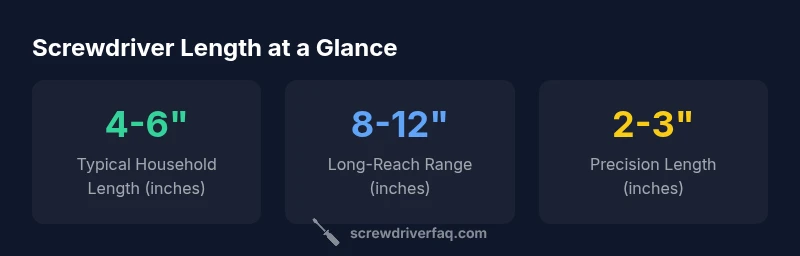
Screwdrivers come in several common length classes. The shortest pocket screwdrivers run about 2 to 3 inches (50 to 75 mm) and are designed for tiny fasteners or electronics work. The most common household sizes are roughly 4 to 6 inches (100 to 150 mm), providing a good balance between control and reach for furniture, cabinets, and general repair tasks. Longer models in the 7 to 9 inches (180 to 230 mm) range are popular for reaching screws that sit in deeper cavities or behind obstacles. The long-reach class, typically 8 to 12 inches (200 to 300 mm), is built for professional use and heavy-duty tasks where you need to stand off from the surface while applying torque. When you read tool listings, measure both the blade length (the driving portion) and the overall length, because some products advertise blade length rather than total length.
How to Choose the Right Length for Your Task
To pick the correct length, start by locating the screw you need to engage. If you can see the screw head clearly and have room to maneuver, a shorter driver often offers better control and feedback. If space is tight or the screw sits behind a panel, you’ll benefit from a longer handle and shaft. Consider the environment: tight corners, limited working distance, or the need to stand above furniture — these conditions favor longer drivers. Evaluate the torque you must exert; longer tools require more wrist action to avoid bending. A practical approach is to hold the tool as you would during actual work; if you cannot keep the screw aligned without awkward angles, choose a different length. The goal is to maximize leverage without sacrificing precision.
Lengths by Use Case: General, Electronics, and Mechanics
For general-purpose household tasks, a mid-length screwdriver (about 4 to 6 inches) is a reliable default. For electronics or small fasteners, a compact 2 to 3 inch driver, often with a magnetic tip, reduces the risk of over-tightening or slipping. In mechanics or automotive work, longer drivers (8 to 12 inches) can dramatically improve reach, but you must maintain steady wrists to keep the blade engaged. Some gardeners and carpenters also use specialty lengths and handles that increase torque for stubborn screws. Use the right tip type (Phillips, flat, Torx) in combination with appropriate length to optimize control and reduce tool slippage.
How Length Impacts Torque and Control
Torque delivery depends on lever length; longer tools increase the arc length, which can boost torque, but reduce your precision in confined spaces. Shorter screwdrivers offer immediate feedback because your hand is closer to the screw, making micro-adjustments easier. In practice, you may trade some torque for control when working in tight spaces or on small fasteners. For most DIY projects, choosing a length in the 4-6 inch range gives a comfortable compromise between torque and control, while specialty tasks may justify longer drivers. Always start with the shortest length that lets you see and align the screw head from your working position, then switch if you need more reach.
How to Measure and Compare Screwdrivers
Measure both the blade length (the portion that engages the screw) and the overall length from the tip to the end of the handle. A lot of confusion comes from measuring blade versus overall length, which is why you should read product specs carefully. Compare tools by grip comfort, handle diameter, and weight; a heavier handle can reduce fatigue, but only if the balance feels natural in your hand. When testing multiple lengths, perform several light passes to ensure the blade stays aligned with the screw head. If the fit feels loose or you notice tip wobble, consider a different length or a magnetized tip for added retention.
Maintenance Tips to Preserve Performance Across Lengths
Keep your screwdrivers clean and dry to prevent rust on the blade and handle. Wipe the blade after use, and store tools in a dry, organized rack to minimize accidental damage. For longer drivers, check the handle for cracks and ensure the grip remains comfortable; replace if the grip shows wear. Periodically apply a light coat of light machine oil to the blade to ease entry into screws, but avoid over-lubrication. A magnetic screwdriver can help retain screws, reducing the chance of dropping parts when working at height. With proper care, a full-length toolkit remains reliable across a wide range of tasks.
Common Mistakes and Quick Fixes
Common mistakes when choosing length include assuming longer is always better; quick fix is to evaluate task requirements, measure screw depth, and test with replacement length in a scrap piece before committing to a project. Avoid using too short a driver for long screws, which can cause cam-out and bent heads. Do not ignore grip size or weight, which can cause fatigue on extended tasks. Always match tip type to screw head (Phillips, flat, Torx) to maximize torque and minimize cam-out. For electronics work, prefer a molded or insulated handle with a non-slip grip and, when possible, a magnetized tip to keep screws from dropping. Finally, test on a spare piece of material to confirm fit and control before using the actual project piece.
Length guidance by screwdriver type and use case
| Screwdriver Type | Typical Length Range | Best Use |
|---|---|---|
| Standard (Flathead/ Phillips) | 4-6 inches (100-150 mm) | General-purpose tasks close to the work surface |
| Precision (2-3 inches) | 2-3 inches (50-75 mm) | Small fasteners, electronics |
| Long-reach | 8-12 inches (200-300 mm) | Recessed screws, deep cavities |
| Mini/precision Torx | 3-4 inches (75-100 mm) | Electronics/repair |
Quick Answers
What is the standard length of a screwdriver?
There is no universal standard. Common household screwdrivers are typically 4-6 inches, with shorter pocket variants around 2-3 inches and longer models reaching 8-12 inches for difficult-to-reach screws. Always pick a length that matches your task and comfort level.
Common screwdrivers are usually 4 to 6 inches, but choose shorter for electronics and longer for deep screws.
How do I choose the right length for a project?
Assess screw location and available workspace. If you have room to maneuver, a mid-length tool (4-6 inches) offers a good balance of control and torque. In tight spaces, opt for a shorter tool; for deep cavities, a longer one is helpful. Always test fit before committing.
Start with a mid-length tool and switch if you need more reach or control.
Are longer screwdrivers harder to control?
Longer drivers can reduce precision in tight spaces because of greater tip deflection and slower feedback. They are excellent for reach, but you must keep wrists steady and align the blade carefully to avoid cam-out.
Yes, longer tools can feel less controllable in tight spots; use them when you need the extra reach.
What length is best for electronics work?
For electronics, a short, precise driver (2-3 inches) with a finely tuned tip is ideal. Look for magnets to help hold tiny screws and an insulated handle to protect components.
For electronics, go short and precise with a magnetic tip if possible.
Can I use a screwdriver as a pry tool?
Screwdrivers are not designed as prying tools and can bend or break, risking damage or injury. Use proper prying tools for leverage when needed and reserve screwdrivers for driving screws.
No—don’t pry with a screwdriver. Use intended tools for leverage.
“"Length is a balance between reach and control. The right screwdriver length lets you see the screw head clearly while applying steady torque."”
The Essentials
- Choose length based on reach and control needs
- Match blade length to screw depth for best results
- General tasks fit 4-6 inch drivers; deeper work may require 8-12 inches
- Test multiple lengths on scrap material when possible
- Maintain grip and blade condition for consistent performance