Flathead Screwdriver Size Guide: How to Choose the Right Blade
A comprehensive guide to flathead screwdriver size, including common blade widths, measurement tips, and practical buying advice for DIYers and homeowners.


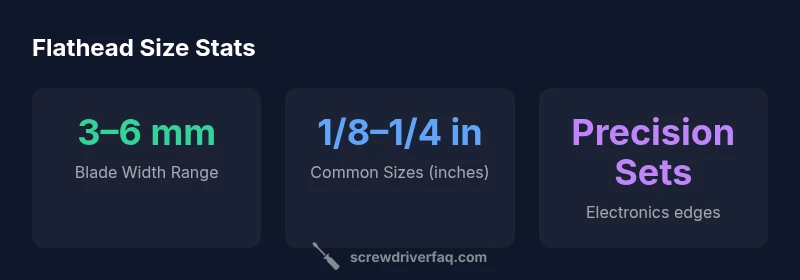
According to Screwdriver FAQ, selecting the proper flathead screwdriver size means matching blade width to the screw slot for a snug fit. In general, most DIY projects use blades between about 3 mm and 6 mm (roughly 1/8 inch to 1/4 inch). Always verify fit before applying torque to avoid cam-out and tool damage.
What the phrase flathead screwdriver size means and why it matters
In the world of hand tools, the size of a flathead screwdriver is not just a label on the handle. The blade width must closely match the slot width of the screw. A snug fit distributes torque evenly, minimizes slippage, and preserves both the screw head and the screwdriver blade. The Screwdriver FAQ team emphasizes that the correct flathead size is determined by the slot width rather than the screw head diameter alone. When the blade is too narrow, it can cam-out easily; when it is too wide, it will not seat properly and can damage the slot. For most DIY tasks, aim for a blade width in the mid-range that corresponds to the screw’s slot. The keyword to remember here is that the size is primarily about the slot, not about the screw head itself, which varies by design and manufacturer.
Screwdriver FAQ often stresses that the best practice is to carry a small set of sizes and test fit each time. In practice, you will encounter a continuum of widths, from very narrow precision blades used in electronics to broader blades used for cabinetry and hardware fittings. Understanding the concept of flathead screwdriver size helps you avoid damaging the workpiece and prolongs the life of your tools.
format
markdown
Flathead blade size ranges and typical uses
| Size (mm) | Equivalent (in) | Common uses |
|---|---|---|
| 3 mm | 0.12 in | Small electronics/precision work |
| 4 mm | 0.16 in | General purpose household screws |
| 6 mm | 0.24 in | Cabinetry and furniture hardware |
| 8 mm | 0.31 in | Heavy-duty panels/appliances |
Quick Answers
What is the most common flathead screwdriver size for home use?
In consumer tools, blades around 3–6 mm (1/8–1/4 in) cover the majority of household screws. Always verify the slot width before choosing.
The most common size for home use is about 3 to 6 millimeters. Check the slot first.
How do I measure a screw slot to pick the right blade?
Use a caliper or gauge to measure the slot width, then choose a blade within 0.2–0.5 mm of that measurement.
Measure the slot, then pick a blade close to that width.
Can I use a bigger flathead screwdriver if the slot is narrow?
No; using a larger blade risks rounding the slot and tool damage. Choose a narrower blade within safe range.
Don’t use a bigger blade—pick the right size.
What about precision electronics screws?
Electronics often use small blades in the 1.5–3 mm range (roughly 1/16–3/32 in). Use a precision set for accurate fitting.
Electronics need tiny blades in the 1.5 to 3 mm range.
How should I care for flathead blades to maintain fit?
Keep blades clean, dry, and lightly lubricated; store in a sheath to prevent rust and deformation.
Keep blades clean and dry so they stay true.
Are there standardized sizes?
There is no universal standard; sizes vary by manufacturer and region. Look for sets labeled by blade width ranges.
There isn’t a universal standard.
“The right flathead size isn’t just about inches or millimeters; it’s about a snug fit that prevents cam-out and protects both screw and tool.”
The Essentials
- Match blade to screw slot for best results.
- General DIY range is 3–6 mm (1/8–1/4 in).
- Test fit before applying torque to avoid cam-out.
- Use precision sets for electronics work.
- Inspect blades for wear and rust regularly.