Which screwdriver for which screw: A practical guide for DIYers
Learn how to match screwdriver types to screw heads, understand drive systems, and pick the right bits for DIY projects. This guide covers common drives, sizes, safety, and setup from Screwdriver FAQ.


Mastering which screwdriver for which screw begins with matching each drive type to the screw head (slotted, Phillips, Torx, or square) and confirming the screw size. Use the correct bit length and a steady grip to prevent cam-out. With a proper bit set and technique, most DIY fasteners go in cleanly and securely, without damaging the surrounding material.
Understanding screw drives and heads
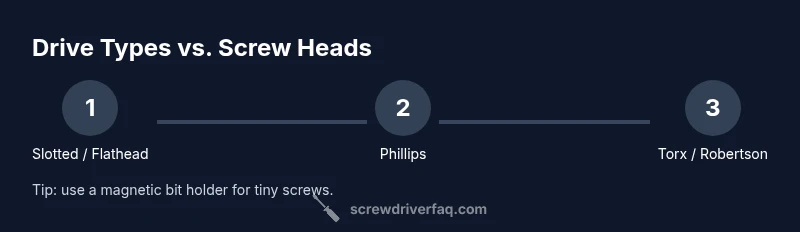
In most household and electronics projects, screws come with one of several drive styles: slotted (flathead), Phillips, Torx, and square (Robertson). A few specialty screws use hex or other patterns, but for basic DIY, these four cover the majority of fasteners. According to Screwdriver FAQ, the first step to choosing the right screwdriver for which screw is recognizing the drive shape, as this determines the bit profile you need. The Screwdriver FAQ Team found that many beginners struggle not because they lack strength, but because they pick a mismatched bit that cam-outs or strips the screw head. Start by inspecting the screw head: does it have a single flat groove, intersecting crosses, a star-like pattern, or a square socket? Each shape maps to a family of screwdriver tips. In practice, consistency matters: always pair the drive type to the head; mismatches lead to quick wear and damaged fasteners, especially with smaller screws and hard materials. As a rule, plan to use the simplest, snug-fitting bit you own: a poor fit invites cam-out and rounded corners.
How to read screw head markings and sizes
Screw heads themselves carry clues about the correct driver. Slotted heads require flat-blade bits whose width matches the groove. Phillips heads demand a corresponding PH bit that fills the cross without bottoming out. Torx and square drives use their own families of bits; for Torx, the number indicates the star size, while for Robertson, the square shape requires a appropriately shaped blade. When in doubt, test-fit: a snug fit will sit squarely in the head and resist cam-out. The screw’s size is not always printed on the head; you gauge it by the screw’s diameter and length, and by the slot or drive width. For electronics and cabinets, tiny screws often require finer bits; for larger wood and metal, you’ll use bigger profiles. Understanding these signals helps you answer the question: which screwdriver for which screw is the right pairing in practice.
Matching screw size to driver tip and bit length
The core rule for which screwdriver for which screw is to ensure the bit matches the screw head exactly. A bit that is too small will slip (cam-out); one that is too large can strip the head or damage the groove. Start by confirming the drive profile (slotted, Phillips, Torx, Robertson) and choose a bit length that reaches the screw without binding. For tight spaces, shorter bits offer better control; when you need reach, use a longer bit with a grip that remains steady. If you’re unsure, try a few bits from your multi-bit set until one sits flush and seats squarely.
Special cases: security Torx, hex, square drives
Some screws use security Torx with a center pin, others use hex or square (Robertson) drives. For security Torx, you’ll need a matching pin-included bit from a security-bit set; without it, the head won’t engage. Hex (Allen) drives and square drives require corresponding fasteners and bits that fit snugly. The principle remains the same: the drive profile must fill the head, and the bit must seat flat without wobble. When compatibility is uncertain, start with the most common drive type in your toolkit and test, then expand your set as needed.
Tips for selecting a screwdriver set
A well-chosen screwdriver set saves time and reduces damage. Look for a range of precision tips (PH and flathead in small sizes, Torx, and Robertson) plus a magnetic tip holder to manage tiny screws. Magnetic tips dramatically improve one-handed work, especially in tight corners. Consider an insulated screwdriver for electrical work, and a compact multi-bit handle for on-the-go projects. Avoid sets with worn or chipped blades, which can cam-out and chew screw heads. A good set should cover your most frequent screw types while staying compact and comfortable to grip.
Safety and technique basics
Always wear protective eyewear when drilling, driving fasteners, or working with power tools. Secure the workpiece with clamps or a vise to prevent slipping. Apply steady, downward pressure and avoid twisting with force if the bit doesn’t seat; back out and try a different bit. Use a dry, clean surface to keep bits free of dust and debris, which can affect fit. Storing bits in a labeled organizer helps reduce time wasted searching for the right size. When handling small screws, keep a magnet handy to prevent drops and lost hardware.
Authority sources
For further reading and safety guidelines, see credible sources on hand-tool use and mechanics. OSHA provides general hand-tool safety guidelines, while university-extension domains offer practical, hobbyist-friendly guidance on fasteners and driving techniques. These references help reinforce best practices for choosing the correct screwdriver for which screw and for maintaining your toolkit.
Quick decision guide: tools to carry in a basic toolkit
A practical starter kit includes a few essential drivers: slotted (flathead), Phillips (PH2), Torx (T15), and Robertson (1/4 inch). Add a magnetic bit holder, a screwdriver with interchangeable bits, an insulated variant for electrical work, and a compact multitool that can handle small adjustments. In crowded work areas, a small, ergonomic handle reduces hand fatigue and increases control. With these tools, you’ll quickly determine which screwdriver for which screw and proceed with confidence.
Tools & Materials
- Phillips screwdriver (PH2)(Common size for medium wood and metal screws)
- Flathead screwdriver (slotted) 3.0 mm blade(For classic slotted screws)
- Torx screwdriver (T15)(Standard for many electronics and furniture fasteners)
- Robertson/square screwdriver (1/4 inch blade)(Strong grip for square-drive screws)
- Magnetic bit holder(Keeps small screws from dropping)
- Screwdriver set (multi-bit)(Useful to cover rare drives or hex patterns)
- Insulated screwdriver(For electrical work up to rated voltage)
- Safety glasses(Protect eyes from screws and debris)
- Caliper or screw gauge(Helpful for precise sizing)
Steps
Estimated time: 20-30 minutes
- 1
Identify the drive type
Examine the screw head and determine whether it is slotted, Phillips, Torx, or square. Recognize any security features such as pins or unusual patterns. This step is the foundation for choosing the correct screwdriver for which screw.
Tip: Look for the smallest mismatch: if you feel binding, swap the bit. - 2
Select a matching driver
From your toolkit, pick the drive that matches the head exactly. If you are between sizes, choose the larger one that still fits without forcing the head.
Tip: Avoid forcing a close fit; use the bit that seats flush. - 3
Choose bit length and grip
In tight spaces, use a shorter bit for better control; for deeper holes or recessed screws, use a longer bit but maintain a firm grip.
Tip: Ensure the bit sits squarely in the screw head before applying torque. - 4
Drive with controlled torque
Apply steady downward pressure and turn with a smooth, consistent motion. If the bit slips, back out and reposition rather than forcing it.
Tip: Maintain alignment to prevent head rounding. - 5
Check alignment and finish
After driving, inspect the screw for flush seating and uniform head alignment. Re-check adjacent material for cracking or stripping.
Tip: If the screw head is recessed, consider a longer bit or a slightly larger drive. - 6
Store and maintain tools
Clean blades after use and store them in a labeled case. Periodically inspect for wear and replace dull bits to preserve performance.
Tip: Regular maintenance reduces future cam-out.
Quick Answers
How can I quickly tell which screwdriver fits a screw head?
Start by inspecting the head pattern: flat for slotted, cross for Phillips, star for Torx, and square for Robertson. Then try a matching bit from your set and confirm it seats flush without wobble.
Look at the screw head pattern and try the matching bit from your set to ensure a flush fit with no wobble.
Is it okay to use a smaller or larger screwdriver than the screw requires?
No. A bit that is too small will slip and damage the head; a bit that is too large may strip the slot or cross. Always match the drive type and size.
No—use a bit that fits the screw head snugly. If it doesn’t fit, try a different size rather than forcing it.
When should I use an insulated screwdriver?
Use insulated screwdrivers for electrical work or when working around live circuits to reduce shock risk. They provide a protective layer between the metal shaft and your hand.
Use insulated screwdrivers when you’re near live electrical parts to stay safe.
Can I rely on a magnetic screwdriver for tiny screws?
Yes. A magnetic tip helps hold small screws in place, especially in overhead or confined spaces. Remove magnets when not needed to avoid attracting metal debris.
A magnetic tip is great for small screws, especially in tight spots.
What’s the difference between Torx and Phillips in durability?
Torx drives generally provide better torque transfer and resistance to cam-out, which is useful for higher-torque tasks. Phillips is common and versatile but can cam-out with high torque.
Torx handles more torque without cam-out, while Phillips is versatile but can slip under heavy load.
Should I pre-drill before driving screws with a screwdriver?
For hard woods or dense plastics, pre-drilling helps prevent splitting and makes driving easier. For soft woods, pre-drilling is optional but still beneficial for alignment.
Pre-drill in hard materials to reduce splitting and get nicer results.
Watch Video
The Essentials
- Select the correct drive type to avoid cam-out
- Always ensure bit fits snugly in the screw head
- Use proper bit length for clearance and leverage
- Maintain a clean, organized toolkit for quick decisions