Phillips Screwdriver vs Regular: A Practical DIY Guide
Understand the differences between Phillips and flathead screwdrivers, when to use each, and how to choose, maintain, and budget for a versatile tool set for common DIY tasks.


Phillips screwdriver vs regular (flathead) is a fundamental choice for DIYers. This comparison highlights tip geometry, screw compatibility, and real-world use cases to help you pick the right driver for most home tasks. By understanding the strengths and limits of each, you can reduce cam-out, protect fasteners, and build a versatile toolkit.
Historical Context and Core Design Differences
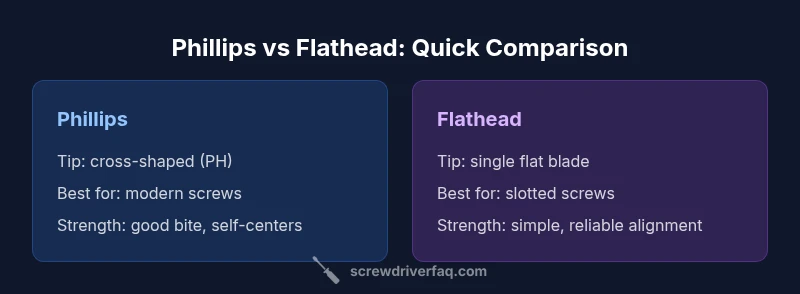
The phillips screwdriver vs regular debate mirrors a long arc of tool design evolution. In most households, the modern cross-shaped Phillips tip was engineered to create a self-centering drive, helping users align the bit with the screw head quickly and reduce wobble on mid-torque tasks. This design favored speed in assembly lines and consumer furniture, electronics, and automotive interiors. By contrast, the flathead, or slotted screwdriver, relies on a single straight blade to engage with straight-slotted screws. While simple and robust, it offers less self-centering guidance and is more sensitive to angle and blade wear. According to Screwdriver FAQ, recognizing these differences is practical, not academic: it translates directly to fewer stripped screws, cleaner slots, and longer-lasting workpieces. For DIYers, the takeaway is simple—match the screw head design to the driver, and choose a setup that minimizes risk and maximizes control.
Comparison
| Feature | Phillips screwdriver | Flathead screwdriver |
|---|---|---|
| Tip geometry | Cross-shaped PH design with four wings that self-center | Single flat blade that seats in a straight slot |
| Common screw types | Phillips (PH) screws common in modern hardware | Slotted screws common in older fixtures and simple projects |
| Cam-out tendency | Moderate to high under heavy torque or worn bits | Low when properly matched and used with correct pressure |
| Best for | Cross-slot fasteners in furniture, electronics, and cabinetry | Slotted screws in older decks, hardware, and rustic projects |
| Size range | PH0 to PH3 common; many sets include multiple sizes | Wide range of blade widths for various slot sizes |
Pros
- Widely available in affordable, quality sets
- Excellent bite on cross-shaped screws when properly matched
- Strong general purpose coverage for most DIY tasks
- Self-centering design reduces wobble and speeds up driving
- Easy to find replacements and extensions in tool stores
Negatives
- Cam-out can occur under high torque, risking damage to the workpiece
- Worn or cheap Phillips tips lose bite and slip more easily
- Not ideal for slotted screws; misfit can scar slots
- Flathead can be unreliable for modern fasteners unless perfectly centered
Phillips screwdriver vs regular: Phillips is typically the default for modern fasteners, while flathead remains essential for older or specific applications.
In most homes, a Phillips driver covers the majority of tasks due to its prevalence in contemporary hardware. Keep a flathead on hand for older fixtures and simple slots. The right mix minimizes tool clutter and maximizes task success.
Quick Answers
What is the primary difference between Phillips and flathead screwdrivers?
The Phillips driver is designed for cross-shaped screws with a self-centering tip, which helps during rapid driving but can cam-out under high torque. The flathead driver engages with straight-slotted screws and offers straightforward engagement but lacks self-centering, increasing the risk of cam-out if the blade is misaligned.
Phillips bits center themselves for faster driving, while flatheads sit in straight slots; each suits different screw types.
When should I use Phillips vs flathead in a DIY project?
Use Phillips for most modern fasteners found in furniture and electronics. Use flathead when dealing with older hardware, rustic projects, or slots that require a precise alignment. In mixed projects, keep both on hand to avoid damage from forced fits.
Phillips for modern screws, flathead for older or slot-specific tasks.
Can I use a Phillips screwdriver on slotted screws?
You can, but it’s not recommended. The cross-shaped tip will not align well with a single-slot screw and increases the risk of cam-out and tool wear. If you encounter a slotted screw, switch to a flathead bit that matches the slot width.
Don’t force Phillips into a straight slot—use a proper flathead.
Do Phillips screws cam-out more than flathead screws?
Yes, Phillips screws can cam-out more readily under high torque or with worn bits because the design relies on the screw’s center to work optimally. Slotted screws tend to cam-out less when driven in line with the slot, but misalignment can still cause slips.
Phillips can cam-out under pressure; flatheads are steadier with proper alignment.
What sizes do Phillips and flathead drivers come in?
Phillips drivers range from PH0 through PH3 in most consumer sets. Flathead drivers vary by blade width to fit different slot sizes. For general use, a small-to-medium Phillips set plus a versatile flathead set covers most tasks.
PH0 to PH3 covers common needs; add a flathead set for compatibility.
How should I maintain my screwdrivers to extend life?
Keep tips clean and dry, avoid exposing steel to moisture, and store them properly in a dry toolbox. Regularly inspect for worn edges and replace worn bits. Magnetic holders can help keep bits organized and reduce misplacement.
Keep tips sharp and dry, check for wear, and store properly.
The Essentials
- Identify screw head type before selecting a driver
- Keep both Phillips and flathead sets in your toolkit
- Match tip size to screw size to reduce cam-out
- Maintain sharp tips and avoid using worn bits
- Consider buying quality sets for better value over time