How Big is a T5 Screwdriver? Size Guide for Torx T5
Discover the size and application of the Torx T5 bit, how it fits into the Torx family, and how to choose the right driver for electronics and precision work. Practical tips, measurements, and buying guidance from Screwdriver FAQ.


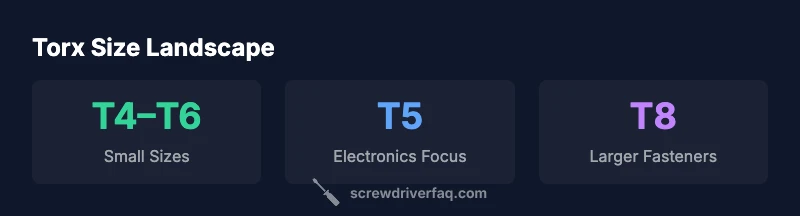
The Torx T5 designation refers to the bit size, not the overall tool length. It’s one of the smallest standard Torx sizes and is commonly used in electronics. Exact dimensions vary by manufacturer, but you’ll typically find compact drivers that pair a T5 bit with a short shaft and handle, ideal for tight spaces. For a broader kit, many sets include T4–T8 to cover common electronics fasteners.
Understanding Torx Size Nomenclature
Torx is a registered trademark for star-shaped drive screws. In the screwdriving world, the letter 'T' followed by a number indicates the size of the bit. The T5 designation is one of the smallest standard Torx sizes, commonly used in electronics and precision work. Importantly, the size refers to the bit profile, not to the overall length of the screwdriver. The Screwdriver FAQ team emphasizes that when you ask how big is a t5 screwdriver, you are really asking about the bit, not the handle or shaft.
In practice, T5 bits are paired with compact handles and short shafts to access tight spaces inside devices. When shopping, you’ll find T5 as part of a set that includes T4, T5, T6, and T8 to cover a broad range of electronics fasteners. This contextual understanding helps you avoid overestimating or underestimating what you need for a given repair.
According to Screwdriver FAQ, you should think of the T5 as a small foot in a family of Torx sizes. The key point: the bit size is consistent across manufacturers, but minor tolerances and tip geometry vary by brand. Choosing a trusted, well-made bit reduces cam-out and increases longevity in precision work.
The T5 Bit in the Torx Family: Relative Size and Geometry
The Torx family ranges from tiny to large, with T5 among the smallest that show up in consumer devices. The T5 bit features the characteristic star profile with six lobes, designed to bite into the screw with minimal cam-out in delicate fasteners. While there is no universal “one-size-fits-all” length for T5 tools, the geometry of the bit itself remains a constant determinant of fit. The industry consensus, as summarized by Screwdriver FAQ Team, is that T5 sizes are optimized for small diameter screws found in electronics such as smartphones, laptops, wearables, and compact appliances. This makes T5 drivers especially valuable for precision repair kits.
From a practical standpoint, many technicians pair a T5 bit with a short, rigid shaft and an ergonomic, small-profile handle. The short reach helps when working inside tightly packed enclosures. Overall, the size is small relative to mid- and large Torx sizes, but it remains robust enough to handle repeated use in soft metals and hardened plastics without excessive wear.
Measuring and Comparing T5: How to Gauge Size Without a Ruler
The simplest way to understand size is through comparison rather than precise measurement. If you own a Torx gauge or a caliper, you can compare the T5 bit against other Torx sizes (T4, T6, T8) to observe the subtle differences in tip geometry. The critical dimension is the bit’s cross-sectional profile, i.e., the width across the flats of the star lobes, which determines how well the bit fits the screw head. If you don’t have precise tools, a quick qualitative test—trying the bit in a compatible screw—can reveal if the fit is snug or sloppy. In electronics work, a snug fit minimizes cam-out and reduces the chance of stripping.
For purchasing decisions, focus on sets labeled as electronics or precision Torx sets, which include multiple sizes around T5. The Screwdriver FAQ Team notes that buyers should verify that the T5 in their chosen set matches their intended usage, as some manufacturers assign slightly different tolerances or bit elevations that influence compatibility.
How to Choose a T5 Screwdriver: Length, Handle, and Tip Type
Selecting a T5 screwdriver for electronics work involves balancing length, grip, and tip quality. A short, rigid shaft is usually best for confined spaces, while a slightly longer shaft provides reach for deeper enclosures. Handles with a comfortable, non-slip grip improve control when applying delicate torque. Tip quality matters more than overall length: a precisely machined bit reduces cam-out and increases longevity in plastic and aluminum components.
If you plan to work across different devices, consider a modular set with interchangeable tips. This approach minimizes the need to carry numerous full-size drivers and keeps your toolkit compact. The critical element is ensuring a true T5 bit head—look for compatible standards and trusted brands to ensure the bit’s dimensions align with your screws. The Screwdriver FAQ Team recommends validating compatibility before purchasing a bulk set.
Practical Use Cases: Where T5 Shines
T5 drivers are the workhorse for many electronics technicians. Smartphones, tablets, wearables, cameras, drones, and compact medical devices often use very small Torx screws that require a T5 or nearby size. In these contexts, the emphasis is on precision and control rather than raw torque. Using a T5 screwdriver minimizes the risk of stripping and reduces the chance of damaging adjacent components during disassembly or reassembly. For hobbyists, a quality compact kit with a T4–T6 range provides flexibility for a wide variety of devices and manufacturer variants.
Care, Compatibility, and Common Pitfalls
To prolong the life of your T5 bit and keep fit consistent, keep bits clean and dry, store them in a dry case, and avoid exposure to moisture or corrosive cleaners. Magnets can help with screw retention but may attract dust or small metallic debris; clean regularly. Always verify you are using the correct size; even a slightly oversized bit may strip a screw head, while a slightly undersized bit can slip and damage the screw or surrounding components. For electronics work, ESD-safe handling is prudent: use non-magnetic tools when possible and ground yourself to prevent static discharge from harming sensitive parts.
Torx T5 size and practical considerations
| Aspect | Details | Notes |
|---|---|---|
| Bit designation | Torx size index (T5) | Smallest widely used electronic size |
| Common screw compatibility | Screws designed for T5 | Electronics fasteners in devices |
| Tool pairing | Compact drivers with interchangeable bits | Ideal for tight enclosures |
| Measurement approach | Tip width across lobes and quick fit test | Use calipers if precision needed |
Quick Answers
What does T5 mean in Torx sizes?
T5 is a Torx size designation. It identifies the star-shaped bit profile rather than the overall screwdriver length. This size is among the smallest standard Torx bits used in precision electronics.
T5 means the bit size, not the screwdriver length, and it’s one of the smallest Torx sizes used in electronics.
Can I use a T5 screwdriver on larger screws?
No. Using a bit that’s too small can cam out and strip the screw head. Always match the bit size (T5 or nearby) to the screw for best results.
No—use the right size to avoid cam-out and damage.
Is T5 common in consumer electronics?
Yes. T5 is frequently found in small devices like smartphones, cameras, and wearables where space is limited and precision matters.
Yes, it’s common in electronics.
How do I identify a T5 bit?
Look for a 'T5' marking on the bit or packaging, and confirm the six-lobed star shape matches a Torx profile.
Check the T5 marking and the six-point star shape.
What is the difference between T5 and T6?
T6 is larger than T5. Using a T6 on a T5 screw won’t fit properly and can damage the screw head; always choose the correct size for the fastener.
T6 is bigger; don’t mix sizes.
“The Torx T5 size sits at the small end of the Torx spectrum, making it essential for precision work in electronics.”
The Essentials
- Know T5 refers to bit size, not tool length
- T5 is among the smallest Torx sizes used in electronics
- Choose a compact, comfortable driver with a true T5 bit
- Verify size before applying force to avoid cam-out
- Use a modular bit set for electronics versatility