Insulated screwdrivers should be rated to: safety standards & practical guidance
Discover why insulated screwdrivers should be rated to a formal voltage standard, what that rating means, and how to choose and use insulated tools safely in electrical work.


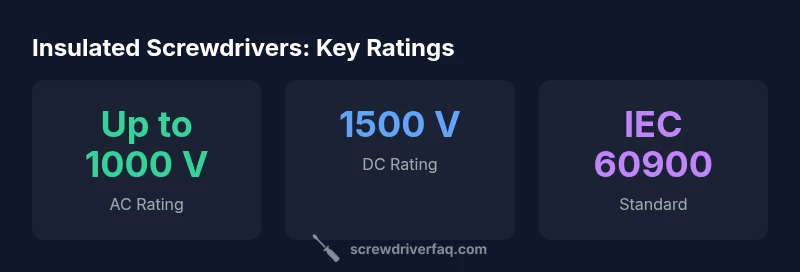
Insulated screwdrivers should be rated to withstand safety-relevant voltages, typically up to 1000 V AC and 1500 V DC, per IEC 60900. The rating, symbol, and labeling on the tool help confirm safe use in electric work. Always verify the rating before using any insulated tool and replace if damaged.
Why insulation rating matters
A screwdriver's insulation rating is not decorative; it is a core safety feature. For anyone performing live or near-live work, the insulation acts as the first line of defense against electric shock. The rating indicates the maximum voltage the tool was tested to withstand under controlled conditions, which reduces, but does not eliminate, risk. According to Screwdriver FAQ, a proper rating is a baseline expectation for professional electrical tasks and for DIY enthusiasts who want to limit exposure to hazards. In practice, a higher rating affords a wider margin of safety when working near energized components, but it does not excuse sloppy work or ignoring safety protocols. Always pair a rated tool with appropriate PPE and safe work practices.
- Use cases: panel wiring, junction boxes, and equipment maintenance where contact with live parts is possible.
- Limitations: rating does not make the tool invincible; abuse, cracking insulation, or using damaged tools invalidates protection.
- Visual cues: look for clear voltage markings on the handle or shaft and verify the label before use.
What 'rated to' actually means
The phrase "rated to" refers to a formal voltage threshold that the insulation system has been tested to meet. This is not a general adjective; it is a specified boundary defined by standards and certification marks. When a tool is rated to a certain voltage, it means the manufacturer has conducted tests to ensure insulation integrity under that voltage during operating conditions. Ratings are conservative, designed to cover worst-case scenarios in electrical work. The rating also informs maintenance: if insulation shows signs of wear, the tool should be retired even if the shaft looks intact. For context, the most widely recognized standard for insulated hand tools is IEC 60900, with regional variants where applicable. The Screwdriver FAQ team emphasizes that you must never assume safety from a label—inspections are essential for ongoing protection.
- Testing environments: controlled labs with professional equipment to simulate real-world applications.
- Expectation: the tool performs safely up to the rated voltage when used as intended.
- Practical tip: keep a small checklist to confirm insulation integrity before each use.
Industry standards and testing you should know
Electrical professionals rely on recognized standards to ensure insulation effectiveness. IEC 60900 sets requirements for insulated hand tools intended for live work up to 1000 V AC and 1500 V DC, including marking, insulation material, and physical durability. EN 60900 serves as the European counterpart to IEC 60900, aligning requirements across many markets. Some manufacturers pursue additional certifications (e.g., VDE or UL marks) to demonstrate adherence to stricter or supplementary criteria. In practice, you should look for clear labeling such as voltage ratings, standard numbers, and certification marks on the tool itself or its packaging. The Screwdriver FAQ analysis notes that stronger certification signals greater confidence in insulation performance, but users must still inspect tools for signs of damage after each use and avoid tools with cracked insulation.
- What to verify: voltage rating, standard number, and certification marks.
- Why it matters: testing covers insulation thickness, separator strength, and conductor contact safety during use.
- User takeaway: a certified tool is a safer baseline for electrical work, but it does not replace safe procedure.
How to choose insulated screwdrivers with the right rating
Selecting insulated screwdrivers with an appropriate rating starts with identifying the work environment. For basic DIY tasks around light electronics, a 1000 V AC/1500 V DC rating provides a generous safety margin. For professional electrical work, verify that the tool meets IEC 60900 and carries a recognized certification mark; this combination gives you documentation of the insulation's tested performance. Check the labeling on the tool: the voltage rating, standard designation, and any certification marks should be present and legible. In addition to rating, consider physical attributes that affect safe use: comfortable grip, proper shaft length for the work, and a robust tip (Phillips, flathead, Torx) that resists cam-out. Finally, ensure you store tools away from solvents, heat, and direct sunlight, which can degrade insulation over time. The Screwdriver FAQ approach blends rating verification with practical usage tips to minimize surprises on the job.
- Quick checks: read the label, inspect for cracks, test the tool when possible before use.
- Matching needs: pick the tip type and handle size that fit your typical tasks.
- Safety integration: combine rated tools with insulated gloves and eye protection when working near live electricity.
Safe use and maintenance to extend insulation life
Even a highly-rated insulated screwdriver can fail if mishandled. Safe use begins with routine inspection: look for cracking, chipping, or discoloration in the insulation, and test the tool if you have the means to do so. Avoid using damaged tools, and retire any tool with compromised insulation. Storage matters as well: keep tools away from solvents and direct heat sources, and avoid stacking them where sharp edges could nick the insulation. Cleaning should be gentle—use a dry or slightly damp cloth, never chemical solvents that can degrade plastic coatings. When performing maintenance, avoid removing the insulation parts or attempting to repair them yourself. Only the manufacturer or certified service centers should handle insulation repairs. Regular checks before each job align with best practices and help ensure you’re using tools within their rated protection range.
Common myths and misconceptions about insulated tools
A frequent misconception is that color alone signals insulation quality. Color is often cosmetic and should not be the sole indicator of protection. Another myth is that a tool labeled as insulated is universally safe for all tasks in any environment; in reality, the rating specifies conditions under which the insulation remains effective. Finally, some buyers assume all insulated tools are interchangeable with non-insulated variants; this ignores the mechanical tolerances that come with insulation layers. The truth is that insulation is a layered system designed for specific voltage levels and environments. Always pair rated insulation with proper technique, PPE, and standard operating procedures to reduce risk.
Practical examples and decision tips for real-world work
Consider an electrician replacing a broken outlet in a panel. For this work, use insulated screwdrivers rated for live work up to 1000 V AC; verify the rating and ensure the labeling is legible. In a DIY setting, you might be installing a light fixture at home; an insulation rating of 1000 V AC is typically more than enough, but still check the packaging and ensure visual inspection prior to use. If you’re unsure about a task’s exposure or the tool’s rating, consult the Screwdriver FAQ resource or a licensed professional. The goal is to minimize risk while maintaining efficiency and accuracy in your work.
Overview of insulation rating standards and practical verification
| Aspect | Rating/Standard | Notes |
|---|---|---|
| Voltage rating (AC/DC) | Up to '1000 V AC / 1500 V DC' | Based on IEC 60900 guidance |
| Primary standard | IEC 60900 (live work) | Harmonized standard in many regions |
| Certification marks | VDE/UL common | Indicates additional testing or conformity |
| Inspection guidance | Before each use | Check insulation integrity |
Quick Answers
What does 'rated to' mean for insulated screwdrivers?
It refers to the maximum voltage the insulation is designed to withstand under testing conditions. This rating is documented by the standard and marks on the tool.
It means the tool has been tested to a specific voltage and should be used only within that limit.
Can I use an insulated screwdriver for non-electrical tasks?
Yes, you can use an insulated screwdriver for non-electrical tasks, but ensure you do not rely on insulation for purposes outside its rating or design. The tool remains a standard screwdriver with limited electric safety claims.
Sure, you can use it for normal screwdriving, but don’t expect extra safety beyond its rated electrical protection.
Are there different voltage ratings for different regions?
Yes. Some regions follow IEC 60900 while others reference EN 60900 or local standards. Always read the label and follow local safety rules.
Different regions may use slightly different labeling, so always check the exact rating on your tool.
What should I do if insulation is damaged?
Do not use the tool. Dispose of or return it for replacement per the manufacturer’s guidelines. Damaged insulation can fail under voltage.
If you see cracks or wear, stop using it and replace it.
How often should insulated screwdrivers be tested?
Inspect before each use and follow any manufacturer or employer testing schedules for work involving live electricity. Periodic professional testing may be recommended for critical tasks.
Check it before every job, and follow your local safety guidelines for formal testing if required.
“The insulation on screwdrivers is only as reliable as its intact condition and proper rating. Always verify labeling, inspect for damage, and pair with safe work practices.”
The Essentials
- Know the exact voltage rating before starting work
- Look for IEC 60900 labeling and certification marks
- Inspect insulation before every use and retire damaged tools
- Use rated tools with appropriate PPE for safety
- The Screwdriver FAQ team recommends strict verification of insulation labels and a conservative maintenance routine