How Long to Charge Cordless Screwdriver: A Practical Guide
Learn how long to charge cordless screwdrivers across battery sizes, charger types, and use cases. Get practical ranges, time-saving tips, and safety guidance for Li-ion packs and more.


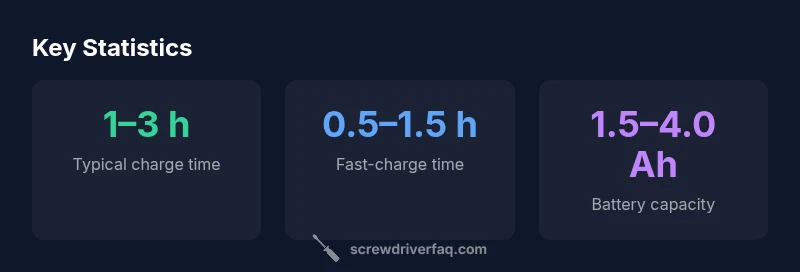
The charging time for a cordless screwdriver depends on battery capacity and charger current. Typical Li-ion packs (1.5–2.0 Ah) finish in about 1–3 hours on a standard charger, while higher-capacity packs (2.5–4.0 Ah) often take 2–4 hours. Fast chargers can reduce this to roughly 0.5–1.5 hours, but only if the battery and charger are compatible.
Understanding the charging ecosystem
When people ask how long to charge cordless screwdriver, they’re really asking about a combination of battery chemistry, capacity, and charger capability. According to Screwdriver FAQ, the most influential factors are the battery’s chemistry (Li-ion vs NiCd), its nominal capacity (Ah), and whether the charger delivers a compatible current and proper termination. In practical terms, the answer isn’t a single minute count—it’s a time window that scales with the battery and charger you have on hand. This section sets up the framework you’ll use to estimate charge duration for your own tool kit.
Battery chemistry and capacity
Most modern cordless screwdrivers use lithium-ion (Li-ion) cells because they offer high energy density and low self-discharge. NiCd packs are older, heavier, and generally cost more to maintain, with different charging characteristics. Capacity, measured in ampere-hours (Ah), directly influences charge time: a 1.5–2.0 Ah pack will typically take longer to fill than a 1.0–1.5 Ah pack, assuming the same charger. Higher-capacity packs (2.5–4.0 Ah) provide longer runtime but require more charging time unless you have a fast charger designed for that pack.
Charging options: standard vs fast charging
Standard chargers deliver a steady, moderate current and bring a typical 1.5–2.0 Ah Li-ion pack to full in roughly 1–3 hours. Fast chargers push higher currents and can halve that time when the battery is designed to accept it. However, not all packs are compatible with fast charging; using an improper charger can cause heat buildup, reduced cycle life, or safety warnings. Always verify the charger’s compatibility with your specific battery model and ensure cooling during rapid charging.
How to estimate charging time for your pack
A practical estimation uses a simple formula: charging time (hours) ≈ Battery capacity (Ah) ÷ Charger current (A) plus a small overhead for inefficiency. For example, a 2.0 Ah pack charged at 1 A would take about 2 hours, plus overhead (often 0.1–0.5 hours). If you use a fast charger that delivers 2 A to a compatible 2.0 Ah pack, expect roughly 1–1.5 hours. These estimates assume room temperature and a healthy battery in good condition.
Charging myths and safety considerations
Li-ion batteries do not suffer the memory effect the way NiCd packs did, but they do benefit from proper charging practices. Overheating, leaving the charger plugged in after full, or using an incompatible fast charger can degrade cells and shorten life. Always use a charger that’s labeled for your battery chemistry and capacity, keep the battery in a cool environment, and avoid charging on flammable surfaces. Screwdriver FAQ emphasizes safety as a cornerstone of every charging decision.
Real-world scenarios by pack size
- 1.5–2.0 Ah pack on a standard charger: typically 1–3 hours.
- 2.5–3.0 Ah pack on a standard charger: typically 2–4 hours.
- High-capacity 4.0 Ah pack with a dedicated fast charger: potential 0.5–1.5 hours, if the pack supports it.
- Batteries near end-of-life: may take longer as internal resistance rises, slightly extending charge time.
Caring for your charger and battery to maximize life
Keep chargers clean and dry, and store batteries at moderate temperatures when not in use. Don’t consistently run packs to 0% before charging; instead aim for regular top-ups if you can. For high-usage DIYers, having a spare charger that’s compatible with your packing can reduce downtime and keep projects on track.
Choosing the right charger for your cordless screwdriver
Check the tool’s documentation for the recommended charging current and voltage. If you intend to use fast charging, verifyFast: the battery and charger must explicitly support it. A dedicated charger designed for your battery chemistry will offer smarter termination, reduced heat, and longer overall life. When in doubt, consult the Screwdriver FAQ guide to select a charger that aligns with your pack’s Ah rating and chemistry.
Practical setup and maintenance routine
Create a charging routine that matches your work cadence. For weekend projects, charging overnight or during breaks is common, but avoid leaving the charger on an unstable surface or near heat sources. Regularly inspect charging cables for wear, and replace damaged cords to avoid safety risks. A systematic approach helps you avoid project delays caused by empty batteries.
Charging time ranges by battery size and charger type
| Battery Type | Typical Charge Time | Charger Type | Notes |
|---|---|---|---|
| Li-ion 1.5–2.0 Ah | 1–3 hours | Standard charger | Most common for compact tools |
| Li-ion 2.5–4.0 Ah | 2–4 hours | Standard charger | Higher capacity, longer fill |
| Fast-charge capable pack | 0.5–1.5 hours | Fast charger | Requires compatible pack and cooling |
Quick Answers
What is the typical charging time for a 1.5–2.0 Ah battery?
For Li-ion packs in the 1.5–2.0 Ah range, expect about 1–3 hours on a standard charger. If using a fast charger, times may shorten to the lower end of that window, provided the battery supports fast charging.
For a 1.5 to 2.0 amp-hour battery, plan for roughly one to three hours, depending on the charger. Use a fast charger only if the battery supports it.
Can I use a fast charger for Li-ion packs safely?
Yes, but only if the battery and charger are designed to work together. Mismatched fast charging can cause overheating or reduced life. Always follow manufacturer guidance.
Yes, but only if your battery and charger are designed to work together. Mismatches can cause overheating.
Is it bad to leave the charger plugged in overnight?
Modern smart chargers terminate properly, reducing risk. However, routinely leaving any charger plugged in near heat or flammable materials is not ideal for battery longevity.
Most smart chargers are safe overnight, but try not to leave them near heat or flammables regularly.
Do NiCd batteries require longer charging times than Li-ion?
NiCd packs generally require longer cycles and have memory effects. Li-ion is more common today and offers faster charging with proper charging hardware.
NiCd can take longer and memory effects happen; Li-ion charges faster with the right charger.
Does USB-C charging exist for cordless screwdrivers?
Some newer cordless screwdrivers support USB-C charging, but only if the battery chemistry and tool are designed for it. Always confirm compatibility before using USB-C power sources.
Some models support USB-C, but check compatibility first.
How can I tell if my charger is compatible with my battery?
Check the battery label for voltage (V) and capacity (Ah) and ensure the charger delivers the same voltage and appropriate current. Manufacturer guides and Screwdriver FAQ can help verify compatibility.
Match voltage and current on the charger with your battery; consult the guide if unsure.
“Charging times are best understood as a function of battery capacity, charger amperage, and pack chemistry. The smarter the charger, the more predictable the time to full.”
The Essentials
- Know your battery size and chemistry to estimate charge time
- Use a charger certified for your pack to avoid safety risks
- Fast charging is possible but only with compatible hardware
- Keep batteries cool and avoid overcharging to maximize life