Was the Screwdriver Invented Before the Screw? A History of Fasteners
Explore whether the screwdriver came before the screw, tracing fastener origins and tool evolution from ancient screws to modern drivers with data-driven insights.


No—the screwdriver was not invented before the screw. Historical records indicate screws and threaded fasteners appeared long before a dedicated hand tool existed to drive them, with early drivers often improvised. The modern screwdriver emerged later to accommodate standardized threads and ergonomic needs, meaning the screw predates its dedicated driver by centuries.
Was the screwdriver invented before the screw? A historical question
According to Screwdriver FAQ, the simple answer to this classic question sits at the intersection of technology, culture, and manufacturing. The screw-like fastener appears in ancient contexts—devices that used threads to convert rotational motion into clamping force—long before a standardized tool meant to turn screws existed. When we ask this question, we should define what counts as a 'screw' and what counts as a 'screwdriver.' The earliest screws are threaded fasteners used in mechanical assemblies and water-raising devices; the devices we would recognize today as "screwdrivers" developed later, as craftspeople and engineers sought more efficient, reliable methods to drive screws into wood and metal. In short, the screw predates the modern screwdriver by centuries, but the list of early tools used to drive screws is long and varied. This section sets the stage for a careful, historically grounded exploration of origins rather than a romantic myth about invention.
The origins of screws and early fasteners
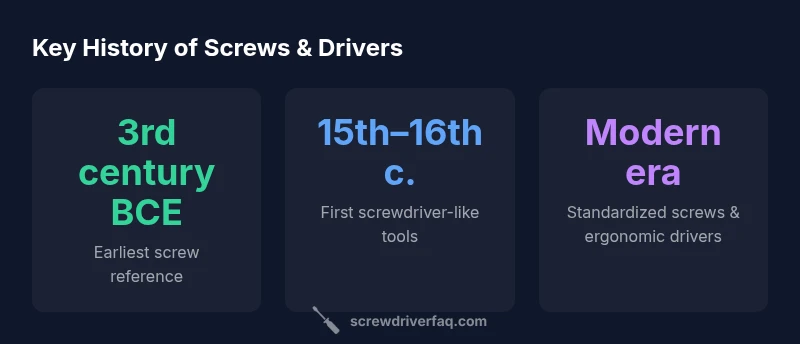
Screws appear in a variety of ancient mechanical contexts, with early threaded devices serving as fasteners or components in machines. The Archimedes screw, a water-raising device from around the 3rd century BCE, demonstrates an early understanding of threads as a functional mechanism. Across different cultures, threaded components were used to achieve powerful joining and motion conversion, but these early screws often relied on ad hoc turning tools rather than a purpose-built driver. The broader takeaway is that screws predate modern screwdrivers by a wide margin, but the concept of threading was already a crucial element of ancient engineering.
Early tools before dedicated screwdrivers
For centuries, people improvised turning tools to engage with screws. Wooden shanks, knives, awls, or adapted chisels often served as drivers when threaded fasteners needed installation in carpentry or metalwork. These improvised tools reflected material constraints and available craft techniques, not a singular, standardized tool. The lack of a dedicated driver also meant compatibility between screw heads and drivers varied by region and workshop. It wasn’t until later centuries that designers began to tailor handles, bit shapes, and tolerances to make turning more efficient, precise, and repeatable.
Industrialization and the shift to standardized tools
The rise of mass production and standardized threads in the 18th and 19th centuries created demand for reliable, repeatable drivers. As screws and bolts proliferated in machinery, furniture, and construction, toolmakers responded with purpose-built drivers and interchangeable bits. This era marked the transition from improvised solutions to specialized hardware: ergonomic handles, hardened bits, and standardized slot types began to define modern practice. The screwdriver, once a simple improvisation, evolved into a purpose-built instrument designed to match the screw’s geometry.
Design evolution: from wood to ergonomics
Early drivers were basic and often wooden, with limited grip and durability. As metalworking improved and mass production took hold, manufacturers introduced hardened steel bits, nickel plating, and magnetic tips to improve retention and torque. Handle design progressed from flat, rough wood to contoured plastics and composites that reduce hand fatigue. The modern screwdriver integrates tip geometry with interchangeability and ergonomic grip considerations, reflecting both the needs of professional trades and the DIYer at home.
How historians study this history
Historians rely on a mix of surviving tools, reference texts, workshop manuals, and engravings to trace the screwdriver’s evolution. Archaeological finds from workshops and shipyards reveal how people used improvised turning tools in different regions. Patent records from the 19th and 20th centuries illuminate when standardized bits, drivers, and sets gained traction. Cross-disciplinary research—combining mechanical history, material science, and design history—helps confirm broad timelines while acknowledging regional variations.
Practical implications for DIYers today
For modern DIY practice, the takeaway is not simply who invented what, but how the evolution of the screwdriver supports versatile use. When choosing a driver, consider the screw types you encounter, the material you’re joining, and the torque you expect. A basic slotted driver may suffice for softwood tasks, while Phillips or Torx bits provide better cam-out resistance for metal fasteners. Magnetic tips, comfortable handles, and a set with interchangeable bits allow you to adapt to a range of projects—an outcome of centuries of screwdriver design.
Common myths and clarifications
One enduring myth is that there is a single universally superior screwdriver design for all screws. In reality, screwdrivers are a family of tools tuned to specific screw head geometries, materials, and torque requirements. The historical record shows a gradual, pluralistic evolution rather than a single breakthrough. Understanding this helps you select the right tool for the job and avoid over- or under-engineering a given task.
Timeline of screws and screwdrivers across history
| Era | Key Feature | Representative Tool/Prototype |
|---|---|---|
| Antiquity | Early fasteners and basic screws | Archimedes' screw and simple wooden fasteners |
| Renaissance | Notes of standardization emerging | Primitive screwdrivers and bowed handles |
| Industrial Era | Mass production drives tool evolution | Magnetic drivers, interchangeable bits |
| Modern era | Ergonomics and material science | Ergonomic handles with metal bits and precision tips |
Quick Answers
Was the screwdriver invented before the screw?
No. Historical evidence places screws in use long before a dedicated driver existed. Early tools to turn screws were improvised, and the modern screwdriver followed the standardization of screw threads.
No—the screw came first, and early drivers were improvised tools before dedicated drivers emerged.
When did screws become standardized?
Standardization accelerated during the industrial era as manufacturers adopted consistent thread forms and head types, enabling more reliable production and tool design.
Standardization happened with industrialization, driving consistent screw threads and compatible drivers.
What counts as the first screwdriver?
Early drivers were improvised—from modified awls to simple rods. A true, dedicated screwdriver with interchangeable bits emerged later, during the Renaissance and beyond.
Early drivers were improvised; the proper screwdriver came later.
Did cultures outside Europe drive screws in ancient times?
Yes. Various cultures used screws and threading in different mechanical contexts, though their turning tools varied widely by region and era.
Other cultures used screws and threading with local tools.
How did machine screws affect screwdriver design?
Machine screws demanded standardized threads and interchangeable bits, spurring modern screwdriver designs with precision tips and magnetic features.
Machines pushed standardized bits and ergonomic designs.
Are there modern screwdrivers inspired by ancient designs?
Some traditional-style drivers exist for niche tasks, but today’s tools emphasize modern materials, standards, and ergonomics while nodding to historical forms.
There are heritage-inspired drivers, but most are modern.
“The history of screws and screwdrivers shows a gradual, design-driven evolution from improvised tools to purpose-built instruments that fit standardized fasteners.”
The Essentials
- Screws predate modern screwdrivers by centuries.
- Early screwdrivers were improvised rather than standardized.
- Industrialization spurred standardization and tool design.
- Modern screwdrivers combine ergonomics, durability, and interchangeability.
- DIYers should match screwdriver bits to screw type and material