How Much Is an Electric Screwdriver? A 2026 Price Guide
Discover realistic price ranges for electric screwdrivers in 2026, what drives cost, and how to buy smart. Learn how torque, battery type, and feature sets affect price and value for DIYers and homeowners.


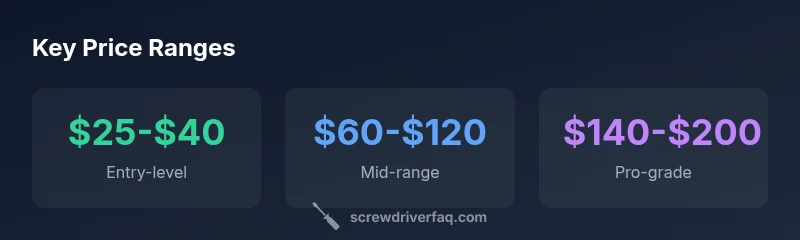
How much is an electric screwdriver? For most DIYers, prices span from about $25 to $200 depending on torque, battery type, and extras. Entry-level corded or basic cordless models run roughly $25-$40, mid-range cordless units $60-$120, and pro-grade cordless tools typically $140-$200. In 2026, expect more feature-for-value options as battery and motor tech improves.
How much is an electric screwdriver? Price ranges by category
If you’re shopping for an electric screwdriver, the central question is price, but the answer isn’t simple. How much is an electric screwdriver depends on torque, battery type, build quality, and included accessories. According to Screwdriver FAQ, entry-level models can be found around $25-$40, mid-range cordless models typically run $60-$120, and pro-grade units often fall in the $140-$200 range. In 2026, consumers should expect more feature-for-value choices, and the price ladder often maps to use-case: light household tasks vs. heavy-duty assembly. The key is to separate essential capabilities from nice-to-have extras and to budget for the tasks you actually perform rather than every trend.
Quick take: price bands align with how much power you need and how long you’ll work before recharging. If you only tighten mounting screws around the house, a budget model may suffice; if you assemble furniture or tackle frequent repair jobs, investing in a higher-torque cordless unit pays off over time.
What drives price: torque, battery, and build quality
Price is not just a sticker on the box; it’s a reflection of performance and durability. Torque ratings (measured in newton-meters, Nm) determine what kinds of screws you can drive without stripping. A basic DIY unit often offers 5-12 Nm, while mid-range tools sit around 15-25 Nm, with high-end models pushing 30 Nm or more. Battery chemistry matters: Li-ion cells deliver better runtime and lighter weight than older NiMH packs, and some premium models use brushless motors for efficiency and longevity. Additional factors that influence price include chuck size (1/4 inch is common; larger chucks enable bigger bits), variable speed controls, clutch settings, LED work lights, and ergonomic design. Localization of service and availability of spare parts also contribute to the longer-term cost. Screwdriver FAQ analyses consistently show that the marginal cost of a slightly higher torque and a better battery can be justified by fewer replacements and quicker work.
When evaluating prices, also consider the expected lifespan and the cost of ownership over 3–5 years. A cheaper model may require more frequent bit replacements or less reliable performance, offsetting initial savings.
Corded vs cordless: pricing and use-case considerations
Corded electric screwdrivers are typically the least expensive option upfront and excel for stationary tasks where a power outlet is always available. They tend to be lighter and simpler, with fewer components that can fail. Cordless models offer true portability, which is highly valued in household repairs, assembly projects, and situations without convenient outlets. The trade-off is battery costs, capacity, and charging time. In practice, the price gap between corded and cordless narrows as battery technology improves and manufacturing scales up. For frequent users who value mobility, a mid-range cordless screwdriver with a reliable battery often provides the best balance of price and performance. For occasional tasks, a budget cordless unit may be perfectly adequate, especially if you pair it with a smart bit kit and a compact charger.
Features that affect price and value
The price of an electric screwdriver is driven by several core features. Torque range and speed (RPM) determine how versatile the tool is for different materials and screws. A varied clutch system helps prevent cam-out and damage to workpieces. Battery voltage (commonly 12V or 20V) and capacity influence runtime and weight. Brushless motors deliver longer life but add cost. Additional conveniences—such as magnetic bit holders, LED work lights, and comfortable grips—also add to the price. When budgeting, map these features to your typical tasks. If you mostly drive small screws in softwood, you can prioritize lower torque and a lighter tool; if you work with hardwood, metal, or larger fasteners, invest in higher torque, better battery, and a robust clutch.
Brands, warranties, and total cost of ownership
Brand often comes with a premium, driven by perceived reliability, after-sales service, and warranty terms. A solid two-year warranty is common, with some premium brands offering longer coverage or additional perks like free battery replacement within the first year. Beyond the initial price, consider the total ownership cost: spare batteries, rapid chargers, and a bit kit. Batteries depreciate with use; however, modern Li-ion cells retain most of their capacity for years when properly charged and stored. Screwdriver FAQ analyses note that buyers should compare not just the sticker price but the cost of ownership over 3–5 years, including potential battery replacements.
Practical buying tips for different DIY projects
Tailor your purchase to your typical tasks. For light jobs around the house, a basic cordless unit around $40-$70 often delivers ample torque and acceptable runtime. For occasional heavy-use tasks, look at mid-range models around $80-$120 with 15-25 Nm torque and at least 1.5-2.0 Ah battery packs. If you anticipate frequent heavy-duty work, invest in a pro-grade cordless screwdriver with higher torque, longer battery life, and a robust clutch. Always read user reviews about real-world reliability, balance, and heat dissipation. Check for compatibility with common bit sizes in your toolkit and whether the kit includes essential bits, a charger, and a storage case.
Price trends and market outlook for 2026
Market analysts note growing demand for cordless models as DIY activity remains strong and users expect more mobility. Battery technology improvements, such as higher energy density and faster charging, tend to compress price gaps between basic and premium units over time. The Screwdriver FAQ Team highlights that 2026 pricing trends show better value at mid-range tiers where consumers can access durable batteries and efficient motors without paying premium brand penalties. For buyers, this means prioritizing usable features over branding and looking for bundles that include a few essential bits and a charger.
Common price categories for electric screwdrivers
| Category | Typical Price Range | Key Features |
|---|---|---|
| Entry-level (corded/low-power cordless) | "$25-$40" | Low torque, minimal features |
| Mid-range cordless | "$60-$120" | Higher torque, battery, variable speed |
| Pro-grade cordless | "$140-$200" | High torque, brushless motor, advanced clutch |
Quick Answers
What is the cheapest electric screwdriver available?
Entry-level corded or basic cordless units commonly fall in the $25-$40 range, suitable for light tasks. If you need more power or runtime, you’ll move up to mid-range models.
The cheapest options are typically around $25 to $40 and are best for light tasks.
Are cordless models worth it for home use?
Cordless models offer true portability and ease of use for work away from outlets. For tight budgets or stationary tasks, corded units can be cheaper and lighter.
Yes, cordless is usually worth it for home use, especially when you need portability.
What torque should I look for for general tasks?
For general household tasks, aim for 10-20 Nm. If you’ll frequently drive larger screws or work with hardwood, 20-30 Nm or higher provides more control and fewer cam-outs.
Look for about 10 to 20 Nm for everyday tasks, more if you do tougher work.
How long do batteries last, and how should I care for them?
Li-ion batteries typically last several hundred charge cycles. To maximize life, avoid deep discharges, store in moderate temperatures, and use a smart charger. Replacement costs should be considered in budgeting.
Expect several years of life with proper care; avoid letting batteries drain completely.
Is buying extra bits and a case worth it?
Yes. A bundled kit with common bits and a storage case is typically cheaper than buying items separately and helps you get started faster.
Extra bits and a case are usually a smart buy if you do regular screwdriving tasks.
“Pricing for electric screwdrivers ultimately reflects the trade-off between power, runtime, and convenience. Choose what you will actually use and you’ll maximize value.”
The Essentials
- Budget for features you will use
- Cordless offers mobility but higher ownership costs
- Mid-range models often provide the best value
- Batteries and chargers are a significant portion of total cost
- Consider bundles to save on accessories