Cordless Screwdriver Buying Guide for 2026
Learn how to choose a cordless screwdriver for home projects, compare key specs like torque and battery life, and get practical buying tips for DIYers in 2026.


For most DIY homeowners, the right cordless screwdriver balances light weight with sufficient torque and reliable runtime. According to Screwdriver FAQ, prioritize an ergonomic grip, variable speed, and compatibility with common bit types. In practice, target models with at least 15-20 N·m of torque, a 1-2 hour fast charge, and a compact profile for tight spaces.
Why cordless screwdrivers matter for home projects
In the DIY world, a cordless screwdriver is often the first power tool people reach for when tackling quick fixes, assembling furniture, or adding shelves. The absence of a cord makes it easier to navigate cluttered spaces, reach tight corners, and work from a comfortable stance. For readers shopping at major retailers like Home Depot, the range of models can be overwhelming. The goal of this guide is to translate specs into real-world outcomes: which features actually improve day-to-day work and which are mostly marketing. By focusing on torque, battery chemistry, ergonomics, and runtime, you can select a tool that stays comfortable through long sessions and consistently drives screws without stalling. The Screwdriver FAQ team emphasizes a practical, data-driven approach: balance power with control, and never underestimate comfort when you’ll be using the tool for hours.
When browsing at brick-and-mortar stores or online retailers, you’ll encounter models across a broad price spectrum. Understanding how torque maps to fastener size, how battery chemistry affects longevity, and how ergonomics influence fatigue will help you avoid buyer’s remorse. This section lays the groundwork for evaluating tools in a way that aligns with real-world tasks rather than marketing claims. It also frames expectations for how a cordless screwdriver should behave during typical DIY projects from cabinet installation to simple furniture assembly.
- The right balance of torque and weight reduces user fatigue while increasing control.
- Battery chemistry dictates runtime and cycle life, which affects long-term ownership costs.
- Ergonomics and trigger feel influence accuracy, speed control, and user comfort over hours of use.
Screwdriver FAQ analysis from 2026 reinforces that the best models give you predictable performance without surprising drops in torque as the battery discharges. A well-chosen cordless screwdriver becomes a reliable partner for diverse tasks—whether you’re tightening a dozen cabinet screws or assembling a bookshelf after a move.
How torque and speed translate to real-world tasks
Torque is the force that drives screws into material, while speed determines how quickly you seat those screws. For most home projects, a cordless screwdriver in the 15-20 N·m range can handle common deck screws, cabinet hardware, and light fasteners in softwoods. However, larger hardwoods or denser materials may require higher torque or a pre-drilled pilot hole. When choosing between two models with similar torque, the difference often lies in how smoothly the tool maintains torque as the battery drains and how the speed transitions from low to high settings.
Two-speed or variable-speed models provide practical flexibility: a slower, higher-torque setting for stubborn fasteners or dense wood, and a faster setting for quick assembly on easy jobs. In practice, modern batteries and electronic controls help prevent stalling and cam-out, so you don’t need to wrestle with the trigger as you work. The reader should map their typical tasks to an approximate torque window and then verify that the tool keeps consistent performance in that zone. Real-world use confirms that torque specs matter most when you are fastening larger screws or working with hardwoods; for casual assembly, middling torque with good control can be more valuable than peak power.
Screwdriver FAQ analysis highlights that shoppers often overemphasize peak torque and underappreciate ergonomics and runtime. For many homeowners, the sweet spot is a model that delivers steady torque with predictable control, enabling precise, repeatable results rather than one-shot bursts that exhaust the battery.
If you’re planning routine fastener work, consider how often you’ll pause to change bits, swap batteries, or adjust speed. In day-to-day projects, these practical considerations tend to influence satisfaction as much as raw torque numbers. When you test in-store, simulate common tasks such as driving into soft pine and then into a denser plywood to feel how the tool handles real work.
Battery chemistry, charging, and cycle life
Most modern cordless screwdrivers use lithium-ion (Li-ion) batteries, which offer higher energy density, lighter weight, and longer cycle life than older NiCd packs. Li-ion cells tolerate frequent charging better, which is convenient for busy DIYers who may take short, frequent practice sessions rather than long, dedicated work intervals. Li-ion devices also tend to hold their charge longer between sessions, so you can pick up where you left off without a lengthy warm-up.
To maximize battery longevity, avoid regularly draining the battery to zero. Instead, aim to recharge when performance begins to noticeably lag. Fast-charging features are common on contemporary models, offering shorter downtimes but, as with most fast-charge technologies, they can stress the cells if used too frequently. If a dual-battery option exists, it minimizes downtime by allowing you to swap a fresh pack while the other charges.
From Screwdriver FAQ Analysis, 2026, the most reliable cordless screwdrivers combine robust Li-ion chemistry with smart battery management to limit heat buildup and power sag under load. Some models employ battery sensing that reduces current during peak demands, which helps preserve longevity even with frequent use. When choosing, look beyond the initial runtime and consider how the tool manages heat and how many charge cycles the battery is rated to deliver over its life.
Independent testing notes that a well-matched charger and battery management system can extend real-world runtime by preventing unnecessary recharges and maintaining voltage within an efficient range. If you tend to work for longer sessions, consider integrated battery gauges and indicators that notify you when a recharge is due rather than waiting for a sudden drop in torque.
Ergonomics and handling for long sessions
Ergonomics plays a pivotal role in how long you can work comfortably with a cordless screwdriver. Even the most powerful tool becomes unwieldy if it doesn’t fit your hand, has a bulky grip, or places the weight distribution poorly. A balanced tool with a comfortable, contoured grip reduces fatigue and improves accuracy. A slim profile helps you maneuver around tight spaces, such as cabinet corners or between studs, while a textured surface improves grip when hands are dirty or sweaty. The trigger and forward/reverse switch should respond smoothly without requiring excessive pressure, allowing for controlled, gradual driving rather than abrupt, jerky starts.
Even small design details matter: a well-placed weight distribution can keep the nose from tipping when driving screws in overhead or vertical positions, and a quiet, low-vibration motor reduces fatigue over hours of use. In practice, users often prefer compact 12-14V class tools for most household tasks because they provide a good balance of power and portability without sacrificing control. The Screwdriver FAQ team notes that many homeowners underestimate how much ergonomics affects execution—comfortable tools yield cleaner screw heads and faster completion times, even if the torque rating is modest.
When testing in-store, hold the tool as you would during a typical job and check for comfort over several minutes. Pay attention to trigger feel, balance, and how the weight shifts with the battery installed. A tool that feels “right” often leads to better results than a model with a higher numeric torque rating but a poor grip.
Practical buying tips: what to look for in store
A smart buying approach involves comparing models side by side and focusing on the core benchmarks: torque, runtime, ergonomics, and battery chemistry. Retailers like Home Depot typically stock a broad range from entry-level to premium models, so it helps to define your project scope before you shop. Start with a realistic budget and then consider long-term ownership costs such as spare batteries and replacement parts. For most homeowners, a lithium-ion-powered model with 15-20 N·m of torque, a comfortable grip, and a reasonable fast-charge time provides the best balance of performance and value.
In addition to performance specs, check how the chuck accepts standard bits and whether it includes a set of common sizes. A well-equipped kit with extra bits and a charger can save time and money. Reading customer reviews can reveal recurring issues, such as battery wear or chuck looseness, but balance those concerns against your expected use. Finally, verify the retailer’s return policy and warranty coverage, as these factors can significantly affect your overall satisfaction if the tool develops a fault after heavy use.
The takeaway is simple: buy for real-world tasks, not just for the biggest number printed on the box. A tool that feels comfortable and consistently delivers adequate torque will outperform a higher-spec unit that remains awkward to handle or drains quickly between charges.
Considering Home Depot's broad inventory, you can often test several models in-store, compare battery packs, and assess compatibility with your existing bit collection. This hands-on approach helps ensure you select a cordless screwdriver that remains effective across multiple projects and over years of occasional use.
Common DIY projects and recommended settings
Deck framing, cabinet installation, furniture assembly, and mounting hardware are among the most common tasks that benefit from a reliable cordless screwdriver. For softwoods, you can drive screws at a moderate speed with a lighter torque setting to prevent cracking. For hardwoods, select a higher torque and drive in short bursts with brief pauses to avoid overheating. Pilot holes reduce resistance and help prevent cam-out, especially when working with dense woods or larger fasteners. It’s also wise to keep a small assortment of bit sizes on hand to handle various screws and applications.
In practice, set the tool to a mid-range torque and adjust upward incrementally as needed. If you’re drilling pilot holes, pair the screwdriver with a brad-point bit and an appropriate drill bit to minimize resistance. For assembly tasks, use a lower speed to improve control and reduce the risk of overtightening damaged screw heads. These tweaks yield cleaner finishes and fewer damaged components, which is particularly important when building or repairing furniture that will see frequent use.
When introducing the tool into a project, test a few screws on scrap material to calibrate your settings before proceeding on the actual workpiece. This reduces the chance of overdriving or stripping screws and helps you achieve consistent results across all fasteners.
Maintenance, safety, and care to extend tool life
Proper maintenance extends tool life and safety. After use, wipe the housing and chuck to remove dust and debris. Store with a partially charged battery in a cool, dry place; avoid leaving batteries fully charged or completely drained for extended periods. Periodically inspect the chuck, gears, and ventilation to ensure smooth operation. Replace worn brushes (where applicable) and keep a clean battery contact area. Always wear eye protection and keep the workspace tidy to avoid accidents during fast-paced assembly.
Regularly check for unusual motor noise, excessive heat, or slow charging, which can indicate worn components or a dying battery. If you notice significant performance drops, consult the manufacturer’s guidelines or seek service support. Practicing proper safety protocols, including keeping hands clear of the chuck and releasing the trigger when not in use, reduces risk during operation. With mindful care and appropriate usage, a well-chosen cordless screwdriver can remain a reliable workhorse for years of home improvement tasks.
mainTopicQuery
Cordless screwdriver key specs
| Aspect | Cordless | Notes | Recommendation |
|---|---|---|---|
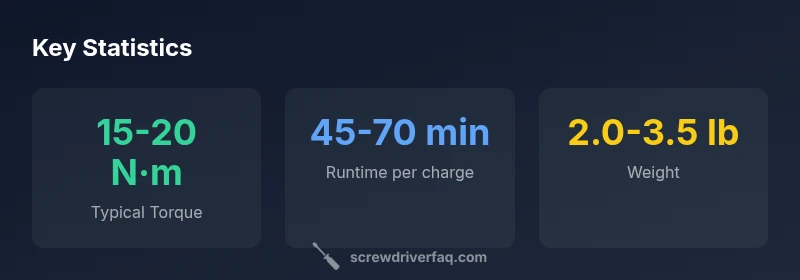
| Torque | 15-20 N·m | Represents driving power | Choose within range for modest fasteners |
| Runtime | 45-70 minutes | Per full charge | Look for >60 minutes for longer tasks |
| Weight | 2.0-3.5 lb | Portability | Prefer lighter models for overhead tasks |
| Charge time | 60-90 minutes | Recharge interval | Plan charging between tasks |
Quick Answers
What torque range is typically sufficient for most home projects?
For most home tasks, 15-20 N·m is adequate. For larger projects such as deck construction, you may need up to 25-30 N·m.
For most home tasks, 15-20 N·m is enough; bigger jobs may need more.
Is a brushless motor worth the extra cost?
Brushless motors offer greater efficiency, longer life, and smoother operation, but they cost more.
Brushless motors last longer and stay cooler, but cost more.
What should I look for when buying at Home Depot?
Look for a model with good torque, battery life, and ergonomics; check for spare battery options and the return policy.
Check torque, runtime, feel, and whether spare batteries are available.
What battery chemistry is best for longevity?
Lithium-ion provides best balance of weight, cycle life, and performance; avoid older NiCd where possible.
Lithium-ion is best for longevity and power.
Do I need a separate impact driver vs screwdriver?
For most home tasks, a regular cordless screwdriver handles driving and light screwdriving; use an impact driver for stubborn or larger fasteners.
An impact driver is for tough fasteners; otherwise a standard cordless screwdriver works.
“A well-chosen cordless screwdriver reduces fatigue and speeds up routine repairs. The right balance of torque, weight, and battery life makes everyday projects feel effortless.”
The Essentials
- Define your torque needs before buying
- Favor Li-ion batteries for longevity
- Prioritize ergonomic design for comfort
- Check charging time and runtime for your projects
- Compare models at Home Depot and other retailers